


Do you trust AI more than humans?

I noticed an interesting pattern in my surroundings:
People are very sensitive about their data (GDPR, etc.)
But the same people are willing to share their health, partner problems, intimate relationships, etc., with LLM.
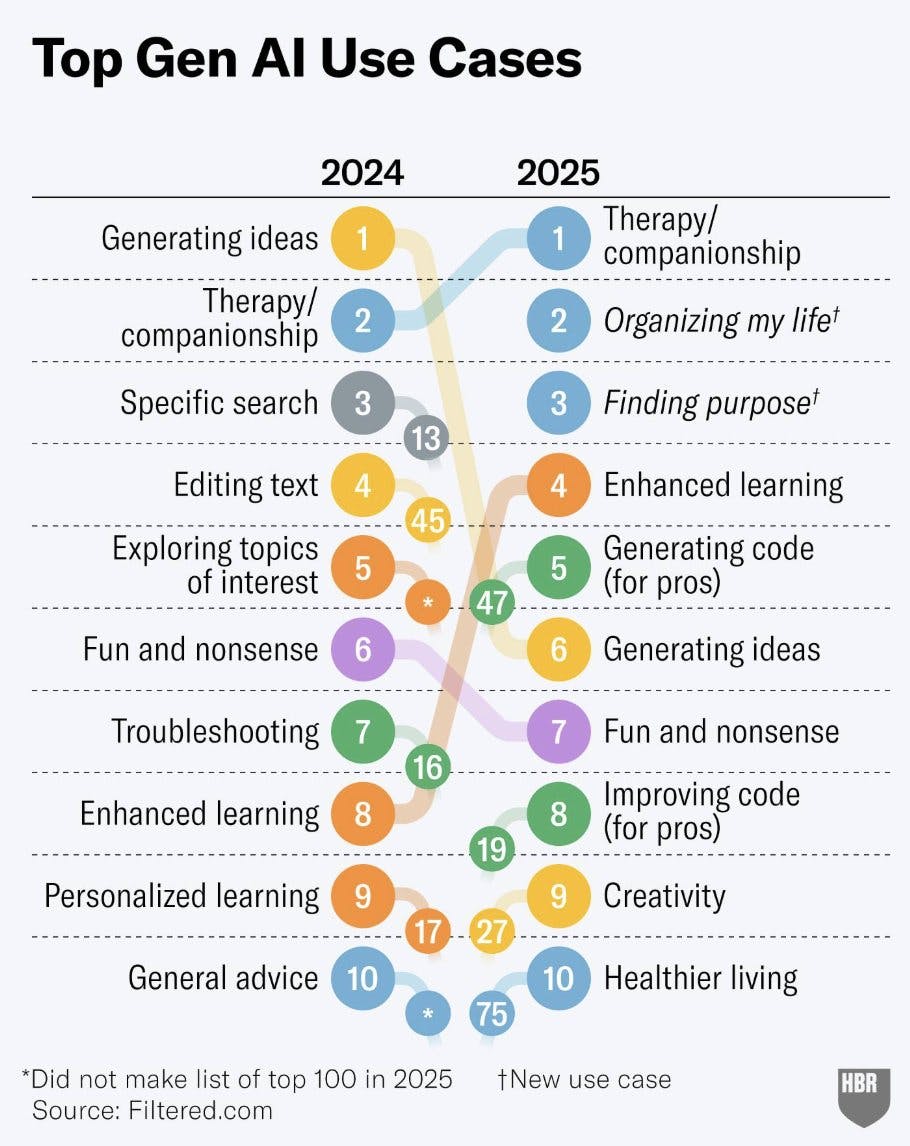
Chat GPT becomes a therapist.
Why do people trust AI so much, even though they are uncomfortable sharing sensitive data?
I understand that AI can be more tolerant of answers and create a certain sense of security, but it is still a system that can be hacked.
Aren't we sharing too much with artificial intelligence?
The last thing I am sharing – the infographic by Harvard Business Review on how we started using AI in 2025 compared to 2024:
454 views
Replies
AINave
It's an interesting paradox. From my perspective, I see AI primarily as an information aggregator and don't personally view it as a substitute for human emotional support.
However, I can tell you that Data Privacy is just a myth. We are all willingly or unwillingly giving away our data to all major companies in the world. So, to me, sharing with an LLM doesn't feel significantly different or riskier than other online activities.
minimalist phone: creating folders
@ramitkoul I saw this image on Twitter: https://x.com/sergeynazarovx/status/1927692919835664870
Your words reminded me this post :D
Product Hunt
Well, based on that infographic, I use AI very differently than most people haha. I'd say my usage is 95% data/coding related and writing cleanup/brainstorm. For anything personal, I'm definitely on team human.
minimalist phone: creating folders
@jakecrump I think that you got it right. Data-related things are good to abstract from (or thanks to) ChatGPT.
On the other hand, I feed ChatGPT with personal data, so I am a good sample for your surveys/experiments/data abstraction. :D The universe is balanced.
It's a long debate but I still prefer to use remote staffing to manage AI tasks so human and AI are total different subjects in some fields.
I reckon it's a combination of the lack of consequences when over-sharing with a third party (the faceless chat aspect also contributes to that - it's easier to divulge private info over a phone call than with cameras on) and the speed of response that validates the situation while offering some break to the paralysis or thought spiral.
minimalist phone: creating folders
@ranahmbg Probably. I have noticed one pattern (at least in myself): the better I know a person, the more embarrassed I feel about sharing something private.
Just a theory but ...
Maybe people do some quick mental accounting and try to find a balance of risks.
Yes, there are risks to giving up some privacy. And when/where people can be noisy about those risks, they will be. But there are also risks to not getting help with possible health issues, relationships, issues, etc. People probably perceive the trade-off of privacy for assistance to be quite often worthwhile. At least, in the moment.
Anyway, we give up our privacy regularly in the modern urbanised industrialised services-based world. It's not just an AI thing. We are surveilled by video cameras, fill out long forms and answer experts (doctors, etc) almost any question they ask us truthfully. I think complete privacy, though desirable, is a relic of a prior time period, in which conditions (all things considered) I would prefer not to live.
The real problem is not loss of privacy itself, but managing the consequences of loss of privacy. Limiting harms and trying to find optimal trade-offs. Personal security without loss of liberty. Financial upside but protection from scams. etc.
minimalist phone: creating folders
@conwy I think that people trust doctors more because there is a "limited capacity" of sharing health records (but also a limited knowledge of solving them). When you share something with GPT and a big company, information like yours can be widespread and possibly shared on higher levels. I do not know how to express it properly (need to train my English) LOL
Pokecut
While AI might feel like a safe confidant, it’s really better suited for crunching data and tackling practical tasks than for handling our messy, deeply human emotions. For those personal, raw moments, humans still hold the edge, with all our flaws and warmth intact.