


To hard paywall or not — that is the question!

According to @RevenueCat 's State of Subscription Apps 2026 report, "hard paywalls convert 5x better than freemium, but with significantly wider variance."
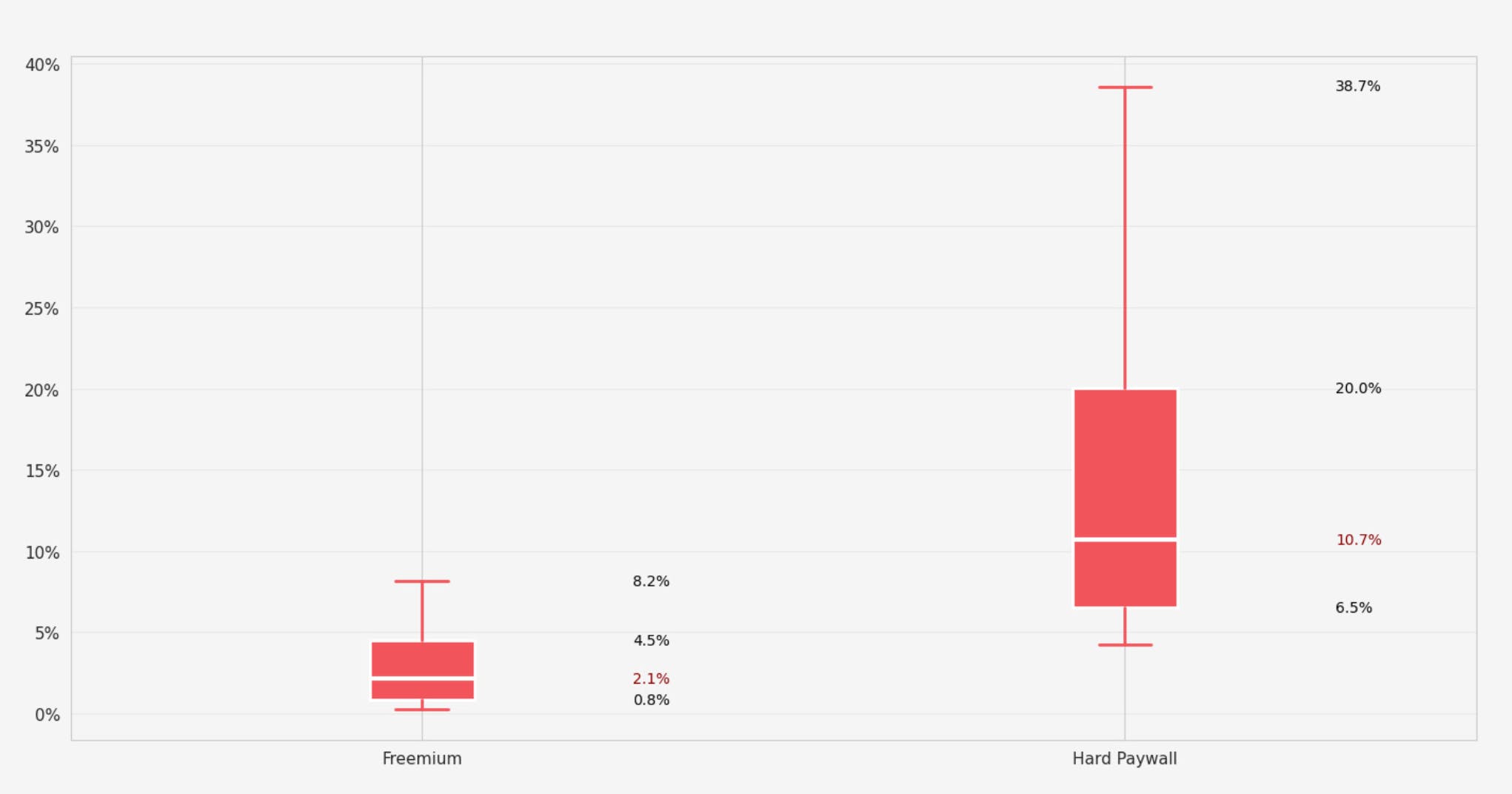
Day 35 download-to-paid, freemium vs. hard paywall
Does access method impact download-to-paid conversion within 35 days?
Quoting the report:
Median D35 conversion sits at 10.7% for hard paywalls. Freemium is 2.1%.
That gap alone should make you pause.
But the more revealing part is the distribution. Hard paywall top decile apps approach 40% conversion. That’s insane. Even the lower end performs at roughly double the freemium median.
Behaviour isn’t changing — it remains heavily front-loaded (it’s the same story every year, and people still don’t believe it).
Around 50% of paid conversions happen on Day 0. Trial starts overwhelmingly happen on Day 0. Cancellations cluster there too, especially on short trials, where over half occur within hours.
Onboarding is faaaar more important than most teams treat it. The first few minutes need to build trust, interrupt default behaviour, and show value quickly. If a paywall appears before context is established, it feels jarring. When onboarding builds momentum first, conversion looks very different.
Across trial lengths, access models, categories, and regions, the pattern holds: structural choices set the ceiling early.
If you want to make money in 2026, start with Day 0.
I've been coaching founders who launch on Product Hunt to relax their hard paywalls in service of a more effective launch.
As I understand it, being featured in the leaderboard requires offering a product that people can use right away, because why would someone upvote a product if they can't try it?
I presume that a hard paywall isn't disqualifying, but my sense is that it might hurt leaderboard performance.
What's your take, and what would you recommend to someone launching on Product Hunt?
Replies
The Day 0 stat points at something precise: where does your aha moment sit relative to the paywall? Hard paywall before first value delivery = paying for a promise. Right after it = catching someone who just felt it. Building a travel planner, that moment only lands when you see the itinerary — the wall has to come after. The structural design question isn't hard vs. free, it's: at what point in your specific flow does the user first say "oh, this is what it does"?
the revenueCat data is interesting but kind of misleading for AI products specifically. when your COGS are basically zero (traditional saas), freemium makes sense because serving free users costs almost nothing. but if every API call costs you real money in inference, a generous free tier can bankrupt you before you find PMF.
i run AI tools where a single heavy user on a free plan can cost me $40-50/mo in compute. learned the hard way that usage caps matter more than the paywall question itself. the real move for AI products is probably a hybrid: let people see output quality for free (cached samples, limited generations) but gate actual usage. that way you get the conversion benefits of "try before you buy" without bleeding money on power users who never intend to pay.
for PH launches specifically i think a 7 day trial with no credit card beats both hard paywall and full freemium. people can try it, upvote honestly, and you dont lose your shirt.
Raycast
@umairnadeem very salient point — traditional SAAS without AI costs is a completely different calculation!
BrandingStudio.ai
Launched brandingstudio.ai on Product Hunt yesterday, so this thread is hitting differently.
We went with a free tier that lets people complete the first module, BrandDNA, in full. They get real, substantive brand strategy insights before ever seeing a paywall. The reasoning was exactly what Gianmarco said: the aha moment has to land before you ask someone to pay. For branding that moment is when the strategy clicks, when someone reads their brand positioning and thinks "yes, that's exactly it." A hard paywall before that feels like paying for a promise.
The RevenueCat data is compelling, but I think the variance is key. Hard paywalls work when the product category is already understood and the user arrives with intent. They struggle when you're in a category people haven't fully mapped yet, like AI branding, where showing beats telling every time.
For PH specifically, David's point about desktop context matters too. PH traffic is mostly founders and makers evaluating tools, not casual mobile browsers. That audience wants to poke around before committing. Blocking them on Day 0 probably costs more upvotes than it gains in conversions.
The onboarding quality argument feels like the real conclusion though. A hard paywall with exceptional Day 0 onboarding probably outperforms freemium with mediocre onboarding every time. The model matters less than whether someone feels value before they're asked to pay.
How about the Free Tier. Not the Fremium but absolutely Free to use?
Raycast
@colenikol what about it? I mean, if you're not a business, you probably don't need to worry about this topic.
Paywalls are tricky. Hard paywalls can protect revenue, but they also reduce discovery and user trust early on. A lot of successful products seem to win first with value, then introduce monetization later.
Another insight from the report I found interesting is that the battle for the subscriber is usually decided in the first session. A huge number of conversions happen immediately after onboarding, meaning the product either demonstrates value right away or it doesn’t. Going with the numbers, it looks like a hard paywall may have less of an impact than the immediate perceived value of the product.
We went freemium with Hello Aria and it’s been the right call so far — but I’ll be honest, it took us a while to commit.
Hard paywall made us nervous because our product requires some habit formation. You need to use it for a few days to "get it" — blocking people before that moment kills conversion before it starts.
But free forever with no limits is just charity. So we landed on: free core, paid for depth. The free tier is genuinely useful, not a crippled demo. Paid unlocks calendar sync, team features, and priority AI.
What we noticed: users who stay free for 7+ days convert at a much higher rate than those who try to upgrade on day 1. The free tier is doing its job — building the habit. The paywall is working by staying out of the way.
Starnus
Nice points. I think we have a lot being inherited from the SaaS model, which was basically rent a server for $50–$500 per month, host hundreds or thousands of users, and make 60–90% margins on a few paid clients, and easily give away Freemium or Free Trial access.
But now we're moving to AI-first solutions, burning through tokens, integrating with multiple API sources, which are 95%+ paid services, etc.
This means, from the moment the user lands and starts doing anything, your bill goes up, and either you must have millions to subsidize, or you are forced to charge clients.
You don't have the budget to let 100 users use it for free with zero buying intentions, so 5–10 might convert.
I think token costs will go down, API prices might come down too (not talking about LLMs, but other API accesses, like SaaS APIs, data providers, etc.), and eventually we might relax the cost prices, but we must know a fundamental difference between AI-first solutions and SaaS:
SaaS is a tool, and you ARE paying for it from the moment you land — it's just your time!
AI-first solutions are meant to SAVE your time, so again, you probably should pay from the moment you land on the product, but this time it's a tangible fractional price, which is just a small portion of the time you're saving.