

Hi Product Hunt, I'm Linden. I started IFTTT 16 years ago.

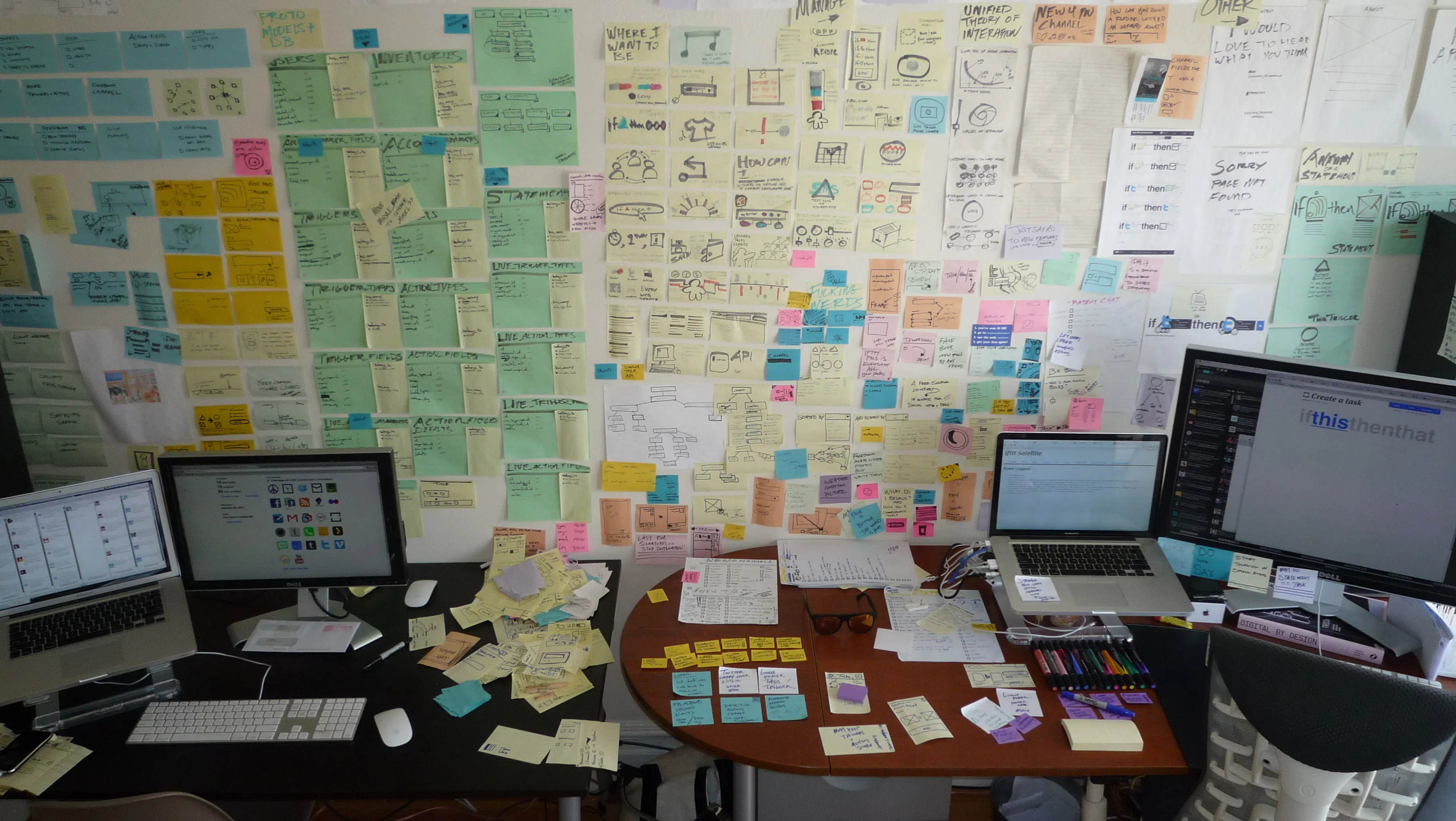
In 2010 I covered a wall with sticky notes. Some sketched the database: users, triggers, actions. Others sketched what it might feel like: a triangle for "if," a circle for "then," and a lot of questions. Back then I called each automation a "statement." Today they're Applets. That wall turned into a side project I called "ifttt," and I've been working on it ever since.
Right now I'm thinking about personal AI. AI agents got very good at answering, and at acting when you ask. But they still wait for you to ask. Most of the tools they use, MCP (Model Context Protocol) included, can't start anything on their own yet.
I think the next step is AI that watches for the "this" and reliably does the "that," on terms you set and understand. For a person, not just a company.
I'm here to see what you're building with AI and automation, and to learn from it.
To start: what's one thing you wish happened automatically?
Replies
The one this and that I have built is a date. My app reads birthdays and anniversaries out of the phone's calendar, a model turns a calendar line in any language into a type and a name, and three days before the day and on its morning a push suggests a song for that person. Two lessons that may map onto personal AI. The that has to know what already happened: if a song for that date was made in the two weeks before, the reminder stays silent, otherwise the automation nags you about the thing you just did. And I first sent the reminders only to people who had not subscribed, as a sales message, which was wrong. A reminder is part of the product, so now paying users get it too and spend their week's credits on it. The this is the cheap part. The hard part is a that which knows when to shut up.
@gbasovv Hi George, I really like your point that the hard part is knowing when to stay quiet.
We learned the same thing over 16 years. The Applets people keep running are the ones that don't bother them. If one pings you about something you already did, you turn it off fast.
@ltibbets Thank you Linden, that matches what I see in a smaller way. Two details I built around exactly that "you turn it off fast" moment. The reminder has a hard cap, one push three days before and one on the morning, nothing else about that date, so the worst case is two messages and not a drip. And when a person removes a holiday or a calendar date from the list, it is marked dismissed rather than deleted, because the next sync with the calendar or the holiday table would bring a deleted one straight back, and a reminder about a thing you explicitly threw out is the fastest way to lose the whole channel. The quiet part of an automation turned out to need more code than the loud part.
@gbasovv Dismissed instead of deleted is a great detail. Bringing back something a person already threw out is the fastest way to lose them. And I like your line that the quiet part needs more code than the loud part. That's been true for us too.
@ltibbets Thanks Linden. Sixteen years of people quietly switching Applets off must be one of the best data sets on what an automation is allowed to do. If you ever write about the signs that told you an Applet was about to be turned off, I would be the first to read it.
First, I view IFTTT as one of the OG's for workflow agents. Reliable, useful, deploying a builder/owner centric approach - a personal deterministic agent more than a decade before personal AI agents were even on the horizon. @ltibbets you have been a relentless builder and pioneer.
Hmmmm....one thing.....likely out of scope, but I would like every single piece of data about my human body collected and centralized for analysis, alerts, etc. - source my doctor, my Garmin watch, labs, procedures, you name it. As it stands, it feels like I have more intentional and complete information about my Land Cruiser than my body.
I look forward to the answers you get.
@paulreddick Hi Paul! So good to see you here, and thank you, that's really kind. "A personal deterministic agent" is a better description than most of the ones we've written ourselves.
I'd want that too. Garmin, labs and your doctor's portal each have part of the picture, but none of them look at the whole thing. I'd love to hear about a new lab result or a bad week of sleep without having to go looking. And the Land Cruiser line made me laugh.
IFTTT's UX was magical. Well done. :)
Top of mind for me right now: It's shocking how inefficient most SMBs are, even when I'm trying to give them money. AI phone calls might solve some of the coordination challenges but it's a multi-channel problem where businesses often need you to provide specific information, create online accounts, verify receipts of emails, etc.
@rrhoover Hey Ryan, great to hear from you, and I hope you're doing well! Thanks for the kind words about the UX. That means a lot coming from you.
That's especially true for businesses that barely live online. Paying a contractor or booking a dentist can mean a phone call, a text with a photo, a PDF form, and a payment link that shows up in your email a day later. An AI can handle any one of those. The hard part is following it across all of them until it's done.