

I changed FounderMind from a startup scorecard into an assumption map
When I first started shaping FounderMind AI, it was tempting to make the output simple:
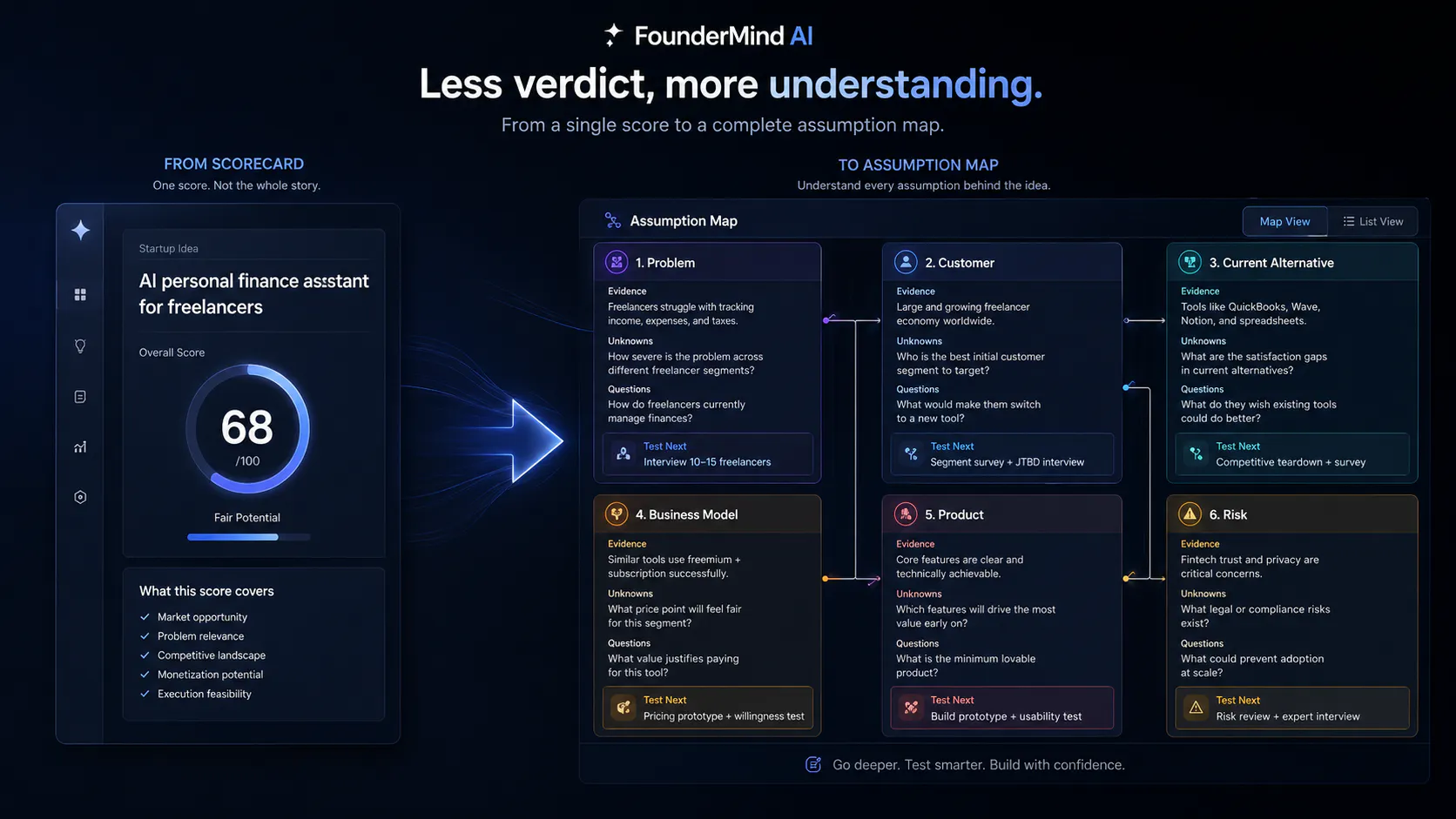
Here is the idea. Here is the score. Here is the verdict.
It looks clean.
But the more I worked on it, the more I disliked what that format encouraged.
A founder could see a strong score and walk away thinking:
"Looks good. Time to build."
That isn't really the decision I want the product to help with.
So I started changing the workflow.
Instead of making the score the center, I'm experimenting with an assumption map.
The idea gets broken into areas like:
Problem
What needs to be true for the problem to actually matter?
Customer
Who has this problem strongly enough to care?
Current alternative
What are they doing today?
Business model
What needs to be true for someone to pay?
Product
What needs to work for the solution to be useful?
Risk
Which assumption could weaken the entire idea?
The output can then point toward:
"Here is what you know."
"Here is what you are assuming."
"Here is what you should probably test next."
That feels more useful to me than pretending an AI can predict whether a startup will succeed.
This is one of the product changes I'm currently exploring with FounderMind at Evolvix AI.
I'm deliberately keeping it in the build-in-public stage because I want to learn where this actually helps founders and where it creates unnecessary complexity.
If you were evaluating your own startup idea, would an assumption map be more useful to you than a single overall score?
FounderMind AI:
https://www.producthunt.com/products/foundermind-ai
Replies