


Looking for Feedback on Our AI Visibility Optimization Product (Launching in April)
We have released the MVP version of Dageno AI.
Right now, the biggest challenge for us is that only a small number of users have tried the product so far. Because of that, we're not fully sure what the experience looks like from a user's perspective or what areas still need improvement.
Before our official launch, we want to make sure the product delivers a good experience, so we'd really appreciate any feedback, suggestions, or ideas from the community.
Overview: Understand Your Brand’s AI Position in One Minute
The Overview module has a very clear goal: to help users quickly grasp their brand’s overall performance and trends within generative engines.

1.1 Four Core Metrics
The Overview page focuses on four key metrics: Visibility, Citation, Share of Voice, and Sentiment.
Visibility: Indicates the proportion of relevant AI responses that actually mention your brand. A higher value means your brand is “seen” more frequently by AI within this domain.
Citation: Measures, among all responses mentioning brands, how many include a link pointing to your official website or domain. This reflects not just exposure, but the degree to which AI treats your brand as a credible source.
Share of Voice (SOV): Represents your brand’s “voice share” within AI narratives—the probability that AI mentions your brand rather than a competitor when answering a topic-related question.
Sentiment: Captures the emotional tone of AI mentions—positive, neutral, or negative—showing how AI portrays your brand.
Together, these four metrics answer the two most fundamental GEO questions: How frequently does AI mention the brand? and In what tone and context is the brand represented?
1.2 Trends and Competitor Comparison

The trend charts combine time-series data with competitor benchmarks, enabling users to:
Assess whether overall performance has increased or decreased over the recent period
Compare the current cycle to previous periods to verify if recent content or market actions were captured by the AI ecosystem
Differentiate short-term fluctuations from sustained structural changes
For example, when a brand launches new content or product lines, users can directly observe whether these actions are reflected in AI responses—not just in traditional SEO rankings.
1.3 Visibility Rank: Industry Position from AI’s Perspective

Visibility Rank places your brand alongside major competitors on a single industry leaderboard, helping users to:
Quickly identify the brand’s position in AI search and Q&A scenarios
Discover brands with high visibility and citation rates
Reverse-engineer competitors’ content structure and layout strategies to inform their own GEO efforts
For service providers, this leaderboard clearly demonstrates a brand’s real position in AI, moving beyond simple keyword ranking tables.
Note: Clicking “More” takes users to the full Leaderboard panel, providing a more detailed view of all rankings.

Topic Performance: From Keywords to Question Semantics
The Topic Performance module analyzes from the perspective of how AI understands user questions.

In this module:
A Topic is a collection of semantically related questions—essentially, all the variants a user might ask AI around the same need.
A Prompt is the specific query a user inputs into AI in real-world scenarios.
For each Topic, the system displays:
Visibility, Sentiment, Average Position, Citation Rate
Real Search Volume (Volume)
Search volume reflects the actual global user demand for that question and also indicates the topic’s competitive intensity and potential business value.
From this perspective, users no longer optimize isolated keywords. Instead, they can:
Prioritize filling high-volume topics where current visibility is low
Identify questions that are closer to the decision-making end of the funnel, where investing in content and source authority is most worthwhile
Analytics: Multi-Dimensional Understanding of Gaps and Changes
The Analytics module is Dageno AI’s core analysis layer, designed for daily operations, growth monitoring, and performance review.
3.1 Multi-Dimensional Visibility: Visibility / SOV / Rank

Within Visibility, users can compare their brand’s performance against competitors across dimensions such as time, topic, and platform. They can also compare the current period to the previous period while tracking industry ranking and trend changes.
This helps answer questions like:
Is your brand’s overall performance in AI responses improving or declining?
Are recent content or market initiatives effective?
Which competitors are quietly gaining traction and deserve early attention and analysis?

The Share of Voice (SOV) panel focuses on how much of the AI narrative on a topic is about your brand. Unlike raw exposure metrics, SOV more accurately reflects real conversational authority.
The Average Position panel shows, when AI cites different websites as sources for answers, what the brand’s average position is. The higher the position, the more likely your content will be adopted by users.
We also provide Topic Visibility Rank, helping users identify:
Topics where they already have a clear advantage and can further invest
“Blue Ocean” topics—moderate search volume, low competition, but where the brand has yet to secure a meaningful position
Additionally, Dageno AI allows users to switch to a competitor perspective, examining AI visibility from the competitor’s point of view. This is possible because we not only monitor your data but also crawl and analyze all major competitors’ data.


3.2 Prompts Analysis: Identifying Real Opportunities at the Prompt Level
The Prompts Analysis module drills down to the individual Prompt—the exact question users enter into generative AI platforms. This is the smallest verifiable unit in GEO, showing exactly which queries drive visibility and conversion potential.

Important ⚠️: Every Prompt comes from client-side, real-world Q&A data, rendered in real time. This ensures the data reflects the original responses, not a sampled set or a manually curated keyword library.
For service providers delivering tangible results to clients, logging into the platform and opening this panel allows them to demonstrate GEO performance concretely.
Each Prompt provides three key dimensions:
Brand Mention: Whether AI mentions the brand; absence indicates a clear gap.
Positioning: If mentioned, the brand’s rank within the response and its gap versus competitors.
Source Gap: How many citations in AI responses come from the brand’s own website versus competitors, reflecting authority differences.

For example, in the domain of “Image to Video Animation”, how can you evaluate GEO performance?
You don’t need abstract metrics—simply filter relevant Prompts in the panel to see:
Which key queries currently don’t mention your brand at all
Which queries mention your brand, but rank 8th, 9th, or 10th, with primary traffic captured by competitors
Which responses consistently cite one or two competitors’ websites while rarely referencing your official content
For service providers, the benefits of this panel are:
You can map results directly to verifiable Prompts, showing clients how you systematically reduce mention gaps and source gaps
After each optimization cycle, monitoring can be rerun, and the updated Prompt list and metrics reflect real-time changes. Clients can log in to see progress without the need for extensive screenshots or PPT reports
This is particularly valuable for content teams: rather than working on abstract “topics,” they can focus on high-value Prompts, creating more precise pages, case studies, or solution content.
3.3 Query Fanouts: Revealing AI’s Research Depth

The Query Fanouts module focuses on the “research pathways” AI uses when generating answers. Specifically, it tracks the number of sub-queries AI initiates and the websites it references to produce a response.
This module provides insights such as:
The number of fanouts and trend changes across different platforms (e.g., ChatGPT, Grok, Perplexity)
Query Fanouts ranking per Prompt, reflecting the research depth behind each question
If a high-fanout topic rarely cites brand content, it indicates the topic has high research depth and decision-making value, yet the brand is absent in these scenarios. Such topics are usually prioritized to improve visibility and authority.
3.4 Platforms Analysis: Assessing Platform Preferences

The Platforms module presents a comprehensive view of brand performance across different AI platforms through a matrix, including: Visibility, Share of Voice, Average Position, Citation Share, Sentiment Score, and corresponding Rank trends.
This analysis helps clarify:
Which platforms are favorable for the brand and where influence can be amplified
Which platforms favor competitors and require targeted content or source supplementation
How to allocate GEO resources efficiently under budget constraints, prioritizing high-value platforms rather than distributing evenly
3.5 Sentiment Analysis: Systematic Management of Brand Reputation in AI
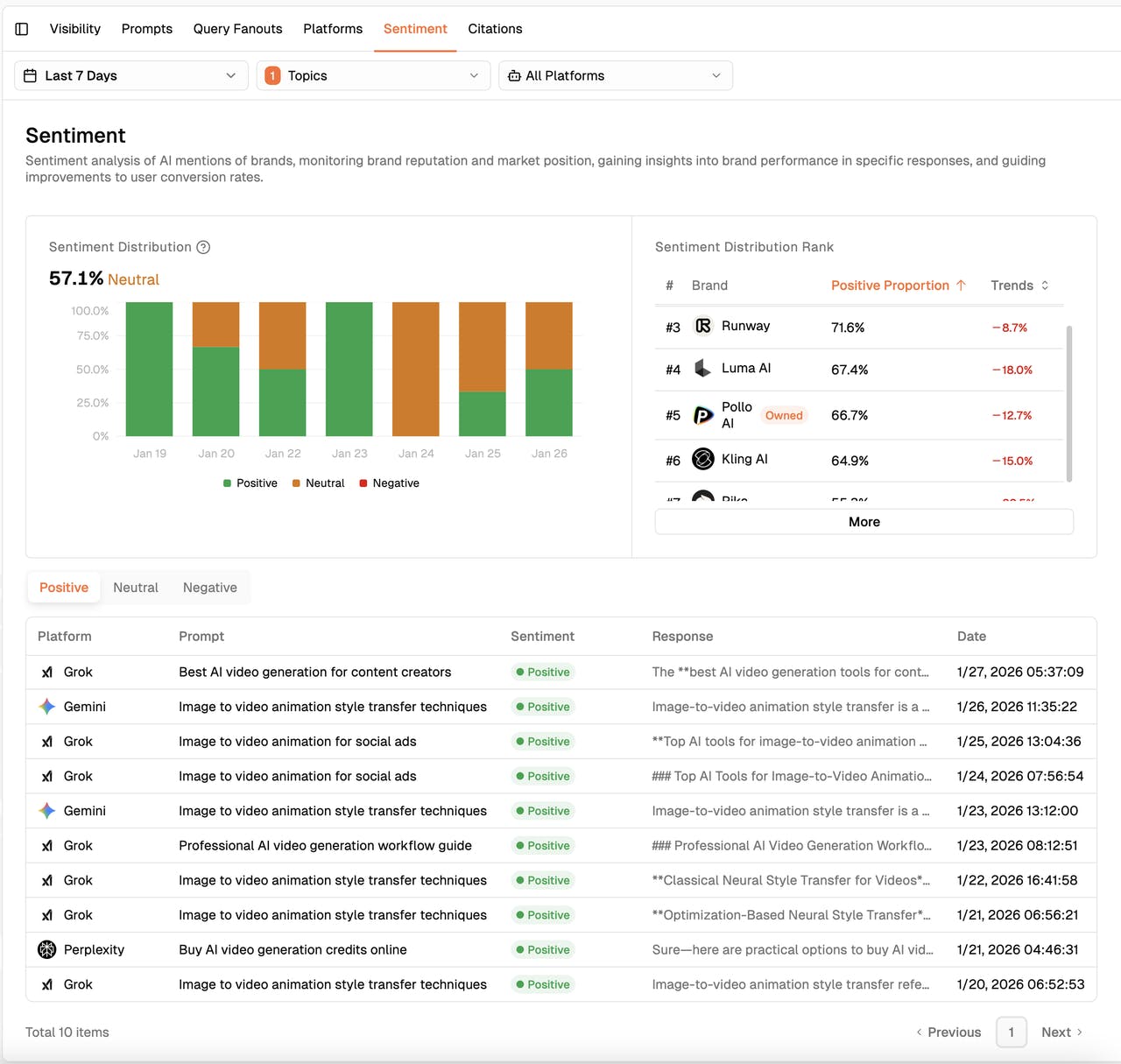
The Sentiment module independently displays the emotional distribution and trends of AI mentions for the brand. Analysis covers overall sentiment scores and can drill down to individual Prompts, helping identify whether AI is reinforcing brand strengths or amplifying potential negative signals.
This module can be used to:
Implement brand defense in critical scenarios (e.g., after-sales, compliance, risk management)
Detect early signs of negative trends and mitigate potential impacts through content optimization or PR interventions
3.6 Citations Analysis: Identifying AI-Recognized Authoritative Pages

The Citations module breaks down AI citation data, showing the domains and specific pages where brand content is referenced in AI responses.
This analysis enables:
Identifying frequently cited internal pages: Understand content structure and characteristics for replication and optimization
Assessing external authority endorsements: Evaluate the value of maintaining or deepening partnerships with external sites that cite the brand
Competitor benchmarking: Compare domains cited for competitors to learn about backlink strategies, media outreach, and content development approaches
Opportunity: From Prompt Gaps to Actionable Opportunities

Building on Prompts Analysis, the Opportunity module automatically aggregates scattered Prompt gaps into a prioritized action list. Each opportunity corresponds to a specific prompt or user question.
The system calculates the following metrics automatically:
Brand Gap: For each Prompt, how frequently is your brand mentioned compared to top competitors? Many rows will show “Competitor 100%, You 0%,” representing a clear visibility gap.
Source Gap: Within AI responses to a given question, how many citations come from competitors versus your brand? A “Competitor 100%, You 0%” scenario indicates that AI considers only competitors a trusted source for this topic.
Platform Coverage: The right-hand side highlights which AI platforms the opportunity appears on—Gemini, ChatGPT, Grok, or Perplexity—helping prioritize which channel to focus on.
Opportunity scores incorporate search volume, intent type, funnel stage, brand/source gaps, and other dimensions to evaluate value and urgency, guiding execution order.
By using the Opportunity module, strategy shifts from experience-driven to data-driven: focus only on real user queries, already answered by AI, where competitors occupy space and the brand is absent, enabling efficient resource allocation. Each opportunity can be traced back to the Prompt, platform, and source gap, providing clear communication and a measurable optimization process.
For brands: Use it as a monthly content planning tool to continuously pursue high-priority opportunities
For service providers: Directly demonstrate high-value gaps and optimization results to clients, ensuring outcomes are verifiable in real time without manual report creation
Brand & Config: Turning GEO into a Continuous System
The Brand & Config module provides foundational settings for all analyses, including brands, Prompts, competitors, and monitoring configurations:
Brand Management: Set brand name variants and official domains to ensure comprehensive and accurate data capture and recognition
Prompt Management: Configure key Prompts for monitoring to track long-term visibility and conversion potential
Competitor Management: Add or remove competitors to keep leaderboards and comparative analyses aligned with the real market
Monitoring Settings: Customize monitoring frequency and scope, concentrating budget on the most critical platforms, topics, and regions
Through this module, GEO is no longer a one-off project—it becomes a sustainable, continuously running system with automatic updates and real-time insights.
Replies