


The Era of the "Prompt Wrapper" is Over? How Vertical AI Wins
"So, how is this different from ChatGPT?"
This was likely the most frequent question AI founders heard from investors and customers over the past year. If the early days of AI were about selling "novelty," today it's about solving "real problems that cost real money."
As Big Tech dominates the Horizontal AI battleground, where should startups look?
Here's my take on where the real opportunity lies.
1. The Era of "The Great Polarization"
Today's AI market isn't just shifting; it is polarizing.
With massive foundation models acting as the new "AI OS," Big Tech is devouring the general-purpose service area with overwhelming capital. In this landscape, solutions sitting in the "Messy Middle"—offering mediocre, generalized functions—will lose their footing and vanish.
The market is splitting into two surviving groups:
1) Big Tech (The Horizontal Giants): Broad and Shallow
ChatGPT, Gemini, and Claude have already absorbed general tasks like email writing, translation, and basic coding.
→ There is no room left for simple "Wrapper" services.
2) Vertical Startups (The Deep Specialists): Narrow and Deep
Areas too complex, highly regulated, and requiring deep domain expertise for Big Tech to touch. This is where the opportunity lies—Regulated Industries. The "Depth" that Big Tech cannot replicate becomes our Moat.
2. Why Vertical Now?
The real pain points are hidden in the field.
Industries like manufacturing, law, IP, and healthcare have complex workflows and regulations that generic AI simply cannot penetrate.
"Review this contract." (✅ Generic AI can do this)
"Draft a response to a USPTO Office Action based on our firm's specific IP style and claim structure." (❌ Generic AI fails here)
Enterprises want "Agents that Work," not just Chatbots.
Companies are looking for Specialized Agents that complete complex tasks from start to finish, not just bots that spit out ideas. In regulated industries where labor costs are high and documentation is heavy, the ROI of AI adoption is immediate and undeniable.
3. The 4 Winning Formulas for Vertical AI SaaS
To lead the market, a Vertical SaaS must meet these four criteria:
1) Workflow Capture (Own the Process)
Don't just answer questions; software-ize the industry-specific process itself. When customers start and finish their work within your tool, Switching Costs skyrocket, creating a powerful Lock-in effect.
2) Data Moat (Structure the Knowledge)
LLMs are commodities. The real competitive advantage is "Structured Internal Knowledge." Only services that structure and learn from a client's past documents and implicit guidelines can deliver differentiated results.
3) Human-in-the-Loop (HITL)
In regulated industries, "Full Automation" is both a fantasy and a risk. The answer is "AI Draft + Expert Approval." This structure minimizes hallucination risks and allows experts to take final responsibility, significantly accelerating adoption.
4) Provable ROI
"Cool tech" doesn't generate revenue.
Formula: (Reduced High-Cost Labor + Risk Mitigation) > SaaS Subscription Fee
If you can prove you save 40-80% of a high-billable expert's time, the wallet opens.
4. Why Patenty.ai? (Our Bet on This Market)
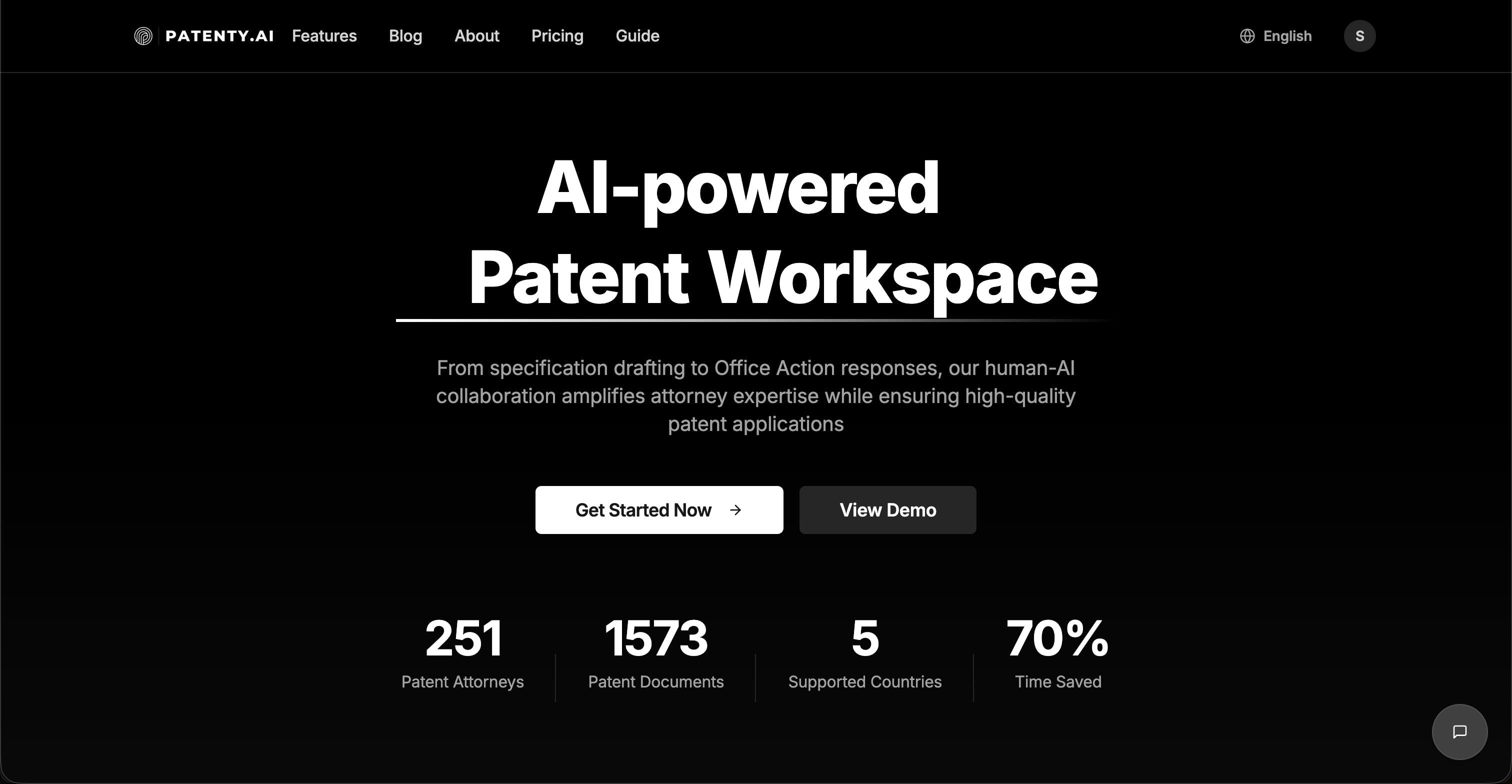
I present Patenty.ai as the proof of this investment thesis. Patenty.ai is not just a legal assistant; it is a Vertical AI that has drilled deep into the highly specialized field of Intellectual Property (IP).
1) Solving High-Cost Structures in Regulated Industries (ROI)
Patent drafting is a high-expertise, high-cost task. Patenty.ai automates the core drafting process, offering clear cost reduction and productivity gains—not just administrative support.
2) Domain-Specific Workflow
Generic LLMs fail to understand the strict logic of patent claims or drawing descriptions. Patenty.ai offers a UX and Agent optimized for the patent process, allowing patent attorneys to cut drafting time by 75%.
3) Data Moat & Customization
Every firm has a preferred "drafting style." Patenty.ai learns this to generate results that feel "native to the firm." This creates a moat that competitors cannot easily cross.
4) HITL for Experts
We do not replace patent attorneys. We turn them into "Super Attorneys." By having AI handle the heavy lifting (drafting) and experts handle the review, we lower barriers to entry while maximizing value.
Closing Thoughts
The battle for startups is no longer about "who can be broader," but "who can go deeper."
Follow our journey at @Patenty.ai
Replies