
Launching today

Angy
Multi‑agent pipelines w/ AI‑driven scheduling + safety check
42 followers
Multi‑agent pipelines w/ AI‑driven scheduling + safety check
42 followers
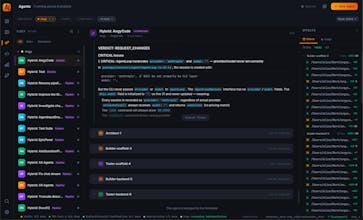
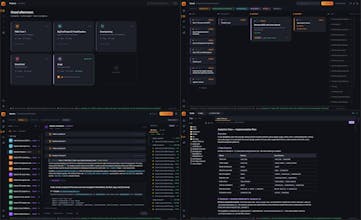
Angy is an open-source fleet manager and IDE for Claude Code. Single-agent tools often generate code that fails at integration. Angy fixes this by orchestrating a deterministic multi-phase pipeline (Plan → Build → Test) featuring an adversarial Counterpart agent that strictly verifies all code. Using Git worktree isolation, multiple agents can build on your repo in parallel without branch conflicts. Stop fixing AI hallucinations and let Angy autonomously ship verified full-stack features.


Angy
The adversarial Counterpart agent that strictly verifies code before shipping is the missing piece in most AI coding pipelines — the Architect → Counterpart → Build → Test deterministic loop with a gatekeeper that blocks merges until satisfied should catch the integration failures that single-agent tools routinely miss when generating code in isolation. The fact that Angy bootstrapped its own development after just one day of initial Cursor work is a compelling proof of concept; with the integrated scheduler running epics overnight, how does the Counterpart agent handle ambiguous requirements — does it flag spec gaps back to the user, or does it interpret intent and proceed autonomously?
Angy
@svyat_dvoretski
Angy assumes users know what they're doing — it's modeled on my own workflow after years of AI-assisted development. There are two paths:
1. Detailed spec mode
My specs often come from prior chat sessions with agents where we examine the problem together (the most fun part of AI dev, IMO). The result is a very detailed planning file — I've tested up to 1500 lines of spec — which I then hand to an epic: "read this and implement it." Here, the Counterpart's job is to ensure the Architect doesn't deviate from the spec. After implementation, it verifies the code matches the spec exactly. The Counterpart is the only persistent session (with resume) across the entire epic lifecycle.
2. Vague spec mode
When specs are loose, the Architect drafts a plan and the Counterpart — armed with an adversarial system prompt designed to catch inaccuracies and traps — iteratively improves it. This phase mimics what I'd do in a chat with Claude: look at what the model says and push back.
So it's designed for both cases. Outputs may differ, but either way it should outperform a single direct agent.
Hi guys, congrats on the launch!
I love the concept of the product you are building.
Could you please tell what are your thoughts on how to compete with bigger developer tools? Wouldn't they ship same features in the next few releases?
Angy
@rustam_khasanov
Thank you so much!
Angy was born because, for economic reasons, Claude Code is much more affordable than Cursor, but I (who last year was in the global top 7% of Cursor users) don't feel comfortable reasoning with agents inside a terminal.
So I thought I'd build a UI on top of CC, and then it occurred to me to make it truly "something different" from the classic IDE approach, not just a better chat window, but a fleet manager with scheduling, specialist agents, and multi-phase pipelines.
I believe the only way to compete is to create something open source, like Angy, so that more people can shape their environment. The agent loop of Cursor and CC isn't public: if Angy can break through in the open source world and people start contributing their own pipelines and workflows, I think we'd have a chance.
@alice_viola_setti I was just yesterday looking for a solution to visualize agent work. And it seems like... I searched in Claude, searched in ChatGPT, and each of them offered their own solution that didn't really satisfy me. So listen, great idea. I think this definitely needs to be tried, especially for overnight runs.
Angy
@slavaakulov
Thank you so much, really.
It's helping me a lot to reduce the cognitive load of managing multiple projects at once, seeing the delegation tree and having a Review column where finished work lands is a different workflow than watching a single agent in real time. I'm also doing much longer runs than I could with Cursor.
If you try it and like it, please send me your feedback. I'm biased and 100% don't notice problems it might have.