
Architecto
Design, review, and document cloud architecture with AI
88 followers
Design, review, and document cloud architecture with AI
88 followers
Describe what you want to build. Architecto generates the architecture, runs security and cost analysis, and creates technical docs. One platform for design, review, and documentation across clouds.




Free Options
Launch Team

Customer.ioAutomate Messaging Everywhere — Startups Get 12 Months Free
Promoted
Hey Product Hunt 👋
The problem we solve:
Every engineering team eventually needs to design, review, and document cloud architecture. Today that means stitching together 5-6 tools: a diagramming tool, spreadsheets for cost, separate security reviews, docs in Confluence, and compliance checklists in yet another system.
What Architecto does:
One platform where you describe what you want to build and get a reviewable architecture.
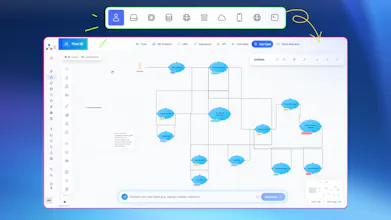
→ Design: Architect AI generates cloud architectures from natural language. Flow IQ handles flowcharts, UML, sequence diagrams, ERDs, and 4 other diagram types. DB Visualizer covers data architecture.
→ Review: Cost Estimator, Threat Analyzer (STRIDE), Scalability Analyzer, Security Posture, Compliance Checker (SOC 2, GDPR, HIPAA, PCI-DSS), and Drift Detector all run against the same architecture.
→ Document: CoDocs generates docs from code repos. HyperDocs creates visual-rich design documents with AI.
→ Govern: Cloud Discovery, IaC Orchestration, Anti-Pattern Detection, and Architecture Diff keep everything aligned.
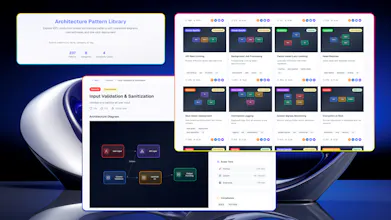
Free plan available - 4 diagrams, 200 AI credits, 240+ architecture patterns, and the full learning system (1,000+ quizzes, 20K flashcards).
Would love your feedback. What's the first thing you'd want to try?
The fragmentation problem you described is real and I felt it building DocMetrics alone. Diagramming in one place, cost thinking in a spreadsheet, security considerations in my head, documentation always last and always incomplete. The tax of switching between tools is not just time it is context. Every switch breaks your thinking.
To answer your question directly — the first thing I would try is the Drift Detector. Not because it is the most exciting feature but because it solves the most painful silent problem. Architecture decisions made in week one slowly drift from what is actually running in production and nobody notices until something breaks. Having something that flags that drift continuously is the kind of thing that prevents the 2am incident six months later.
The compliance checker covering SOC 2 and GDPR in the same workflow as design is genuinely smart for startups trying to sell to enterprise. Those compliance requirements usually show up as a surprise after you have already built something and retrofitting them is painful.
One honest question — how does Architecto handle architectures that evolved organically without ever being documented? Most real systems were never designed top down. They grew. Does Cloud Discovery work backwards from what is actually running to create the baseline?
Drift Detector is the one that instantly clicked for me. Docs and actual architecture diverge ridiculously fast. Within a few weeks, nobody trusts the diagram anymore 😅
Also like the idea of running STRIDE + compliance checks on the same architecture you designed, not as a separate “we’ll do it later” step (which usually never happens).
Cloud Discovery might be the sleeper feature though. Joining a legacy system where the “architecture” lives in 2 senior engineers’ heads is way too common.
Curious how reliable the reverse-engineered architectures are in practice. If that’s even ~80% accurate, this becomes insanely useful.