
Atoms
Turn your ideas into products that sell
1.5K followers
Turn your ideas into products that sell
1.5K followers
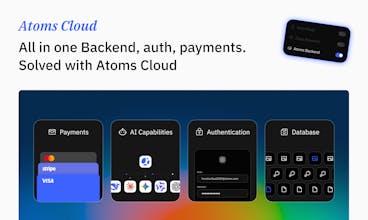
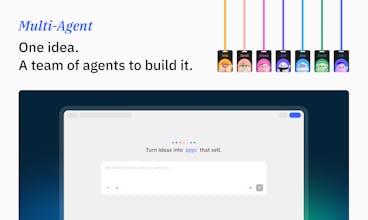
Atoms is a vibe business team that turns your ideas into business. It researches your market, designs the product, builds frontend and backend, connects auth and payments, and ships a live app you can charge for, not just a prototype




Noiz AI
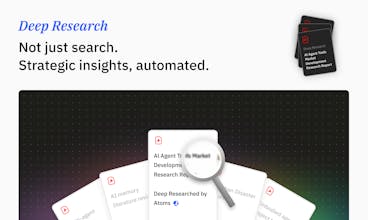
The deep research angle is what stands out for me. So many tools just rush to generate UI and code. Having something that tells me when an idea is weak before I invest time is super valuable.
Atoms
@vega_chan
Totally agree, and thank you. We’ve seen too many “instant build” tools push you into shipping something before you’ve sanity-checked the market.
Atoms tries to earn the right to build by doing research first: clarifying the target user and pain, checking alternatives, identifying a realistic distribution path, and then proposing a tight MVP. And if the idea looks weak,
we’d rather say that early and suggest a better angle than generate a shiny prototype that goes nowhere.
@vega_chan Thank you, that means a lot. We’ve seen too many tools rush to UI and code and skip the hard question of “should you build this at all.” Our goal is to help you sanity-check the market and distribution early, then scope a tight MVP based on that.
@vega_chan Thank you, that means a lot. We agree the best outcome is not more UI faster, it is knowing when the idea is weak early, with clear reasons and assumptions. We try to make the research agent surface red flags, unknowns, and what would need to be true before you invest more time.
MGX (Now Atoms)
@vega_chan Thanks, that’s exactly the goal. We try to surface the weak links early by making assumptions explicit and stress testing the market, positioning, and distribution before committing to a build.
minimalist phone: creating folders
In what is this different from V0 and similar?
Atoms
@busmark_w_nika
Great question. Tools like v0 are amazing for fast UI and prototyping.
Atoms is built for the “idea to business” loop: it starts with research and product scoping, then carries that context through build, backend essentials like auth and payments, and finally launch and distribution (SEO/growth). So the goal isn’t just a nice UI, but something closer to shippable and monetizable.
@busmark_w_nika Great question. v0-style tools are fantastic for fast UI and prototyping. Atoms is built for the full idea to business loop: research and scoping first, then build with the “messy middle” like auth, payments, deployment, and a distribution plan so it’s closer to something you can ship and charge for.
@busmark_w_nika Great question. Tools like V0 are awesome for generating UI and code quickly. Atoms is aiming to be a full AI business team workflow, research, positioning, product spec, build, then go to market outputs like landing copy and distribution plans, with the goal of turning an idea into something you can actually ship and charge for. If you tell me what you use V0 for today, I can map the overlap and the differences more concretely.
MGX (Now Atoms)
@busmark_w_nika Great question. Tools like V0 are excellent at generating UI and front end artifacts. Atoms is focused on the end to end workflow: research, product decisions, build plan, and then shipping toward something you can actually launch and monetize, with the assumptions made explicit.
The idea of having an AI team that actually focuses on the P&L and making a business profitable is a fresh take. How do you handle the trade-offs when the AI team suggests something that might be faster to build but less ideal for long-term GTM strategy?
Atoms
@valeriia_kuna
Great question, and this trade-off is exactly where most “autonomous” systems go wrong.
In Atoms we try to handle it in a few explicit ways:
• Separate “ship fast” choices from “hard to undo” choices
We’ll move quickly on reversible work, but we surface high-impact decisions (positioning, ICP, pricing model, acquisition channel focus, data model, auth/payments approach) for your approval instead of silently optimizing for speed.
• Make the trade-off visible, not implicit
When the team proposes a faster path that could hurt long-term GTM, we present it as options with pros and cons, and we ask you to pick the priority (time-to-ship vs GTM leverage vs maintainability).
• Keep a GTM constraint in the plan
If your goal is SEO, PLG, or a specific channel, we treat that as a constraint upfront so build decisions align with distribution, not just engineering convenience.
@valeriia_kuna Thank you, and great question. When we see a “faster to build” option that could weaken long-term GTM, we try to make that trade-off explicit instead of hidden. We surface options with the key assumption behind each, and we ask you to pick the priority for this iteration, for example fastest signal vs channel fit vs maintainability. For irreversible choices, we add a checkpoint so you can approve before the team commits.
@valeriia_kuna Thanks, and yes this trade off is the core. We make the team propose options with the “why” behind them, what you gain now, what you pay later, plus the key assumption. Then you can choose to bias toward speed, or toward long term GTM and moat, rather than the system silently picking the fastest build.
MGX (Now Atoms)
@valeriia_kuna Great question. We try to make the trade off explicit: what you gain in time and cost, and what you may lose in positioning, distribution leverage, or defensibility. Then we anchor on your goal (quick validation vs long term GTM) and document the key assumption so you can revisit it once you have signal.
@alittlepig @iris_atoms @sarah_atoms @zongze_x
thanks for the deep dive! Really love the logic of keeping high-impact things like pricing or data models as human checkpoints while letting the AI run in Race Mode for the reversible stuff. That's cool!
BTW I have to say – your team's profile pictures are so cool! Great vibe all around and great ream work also here on PH!
Atoms
@alittlepig @iris_atoms @sarah_atoms @valeriia_kuna
Thank you, really glad that governance approach resonates. Keeping pricing and core data decisions as human checkpoints is how we try to stay fast without being reckless.
And appreciate the kind words on the profile pictures and the vibe. The team had a lot of fun with those, and PH has been an awesome ride so far.
Atoms
@kilpatrick
Thank you so much. Great question, and it’s the right bar to hold us to.
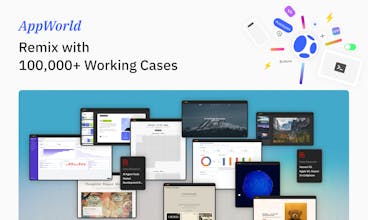
We’re actively compiling a set of real end to end case studies with links and clear breakdowns of what Atoms did vs what the human decided, plus what worked and what didn’t. Some early projects are public already, and a few are still in private beta while teams finish polishing.
@kilpatrick Thank you so much. Great question, and it’s the right thing to ask. We’re putting together a set of real end to end case studies with live links and a clear breakdown of what Atoms did vs what the human decided. Some early projects are already public, and a few are still polishing before they open up to new users. If you share what type of business you’re most interested in, I’ll point you to the closest examples we can share right now.
@kilpatrick Thank you so much. We are still early, but yes, we are collecting and sharing real shipped examples and case studies as they go live. If you tell me what kind of business you want to see (B2B, prosumer, DTC), I can point you to the closest examples we publish next.
MGX (Now Atoms)
@kilpatrick Thank you. We are still early, so we are careful about overclaiming, but we’re working on publishing concrete case studies and public demos of what “launched via Atoms” looks like end to end. If you share what kind of business you want to see (B2B, consumer, niche tools), I can point you to the closest examples we can share right now.
Market research and SEO are real pain points for OPC teams, and an all-in-one approach makes a lot of sense. But stitching together so many expert-level workflows is hard. How do you manage the domain expertise across research, SEO, and content creation?
Atoms
@daxin_wang
Totally agree, stitching these workflows together is the hard part.
Our approach is to treat this as a coordinated team, not a single model trying to do everything:
specialist agents own each domain (research, product, engineering, SEO, analytics), with a Team Lead agent keeping the overall goal and constraints consistent
each domain runs with structured checklists and outputs (for example research generates positioning and target queries, SEO turns that into an information architecture, content maps back to distribution intent)
we keep a shared project memory so later steps reuse earlier assumptions instead of re-inventing them
we validate with “execution reality” so content and SEO plans stay aligned with what we can actually ship and measure
@daxin_wang Totally agree, that stitching is the hard part. We manage it by treating Atoms like a coordinated team: specialist agents for research, product, engineering, SEO, and analytics, plus a lead agent that keeps a single source of truth for assumptions and decisions. The key is making the handoffs explicit so SEO and content stay tied to the actual product, ICP, and distribution strategy.
@daxin_wang You are right, it is hard. Our approach is to use structured playbooks per domain, require sources and citations in research, and keep SEO and content tied to the same ICP, positioning, and keyword intent so they do not drift. We also surface uncertainty and “needs human judgment” flags when the system cannot reliably know.
MGX (Now Atoms)
@daxin_wang Totally fair concern. We handle this by splitting work into specialist agents with clear scopes and checklists, then forcing the output to cite sources, state assumptions, and pass consistency checks across steps. When the domain is niche, we rely more on your context and iterate with tighter feedback loops instead of pretending generic knowledge is enough.
FastMoss
Congrats on the PH launch — I’m genuinely intrigued by how you’re framing this as an “AI business team” instead of just another code generator. A lot of tools can spit out UI and even decent scaffolding, but the real pain is stitching everything together into something you can actually ship and charge for. If Atoms can consistently help with the messy middle (decisions, trade-offs, wiring auth/billing, deploying without everything breaking), that’s a huge unlock for solo builders.
Atoms
@31xira
Really appreciate this, and you described the problem perfectly. The “messy middle” is where most projects stall.
Atoms is designed to make those parts more repeatable: we keep research and product decisions attached to the build, surface trade-offs for approval instead of silently deciding, and try to automate the boring but critical wiring like auth, billing, and deployment with production-friendly defaults. We’re still iterating hard on consistency, so if you try it, your feedback on where it breaks or feels uncertain would be incredibly valuable.
@31xira Thank you, and you nailed the pain. The messy middle is where most prototypes die. We try to make those decisions and trade-offs explicit, keep research and scoping connected to implementation, and use production-friendly defaults for things like auth, billing, and deployment so it’s easier to get to something stable. Consistency is a big focus for us right now, so if you try it, your feedback on where it feels unclear would be incredibly valuable.
@31xira Thank you, this means a lot. The “messy middle” is exactly what we want to solve: making decisions explicit, showing trade offs, and handling the unglamorous wiring like auth, payments, deployment, and go to market steps so solo builders can ship something real.
MGX (Now Atoms)
@31xira Thank you, this is exactly the pain we’re targeting. We’re trying to make the messy middle explicit: decisions and trade offs, plus reliable wiring for auth, billing, and deployment so you end up with something you can actually ship and charge for. If you try it, I’d love to hear where the workflow still feels fragile.
RiteKit Company Logo API
I've been building with Atoms for sevral days, pleased so far, even did your survey, hoping to hear back on whether it was accepted (search from my ph username for that).
Best of luck with the launch and building this out further!
Atoms
@osakasaul Thank you for spending the time, and for doing the survey. We really appreciate it.
@osakasaul Thank you for spending the time, and for doing the survey too, we really appreciate it. We’re reviewing submissions in batches. If you can reply with your PH username, I’ll help make sure we locate your survey and get you an update.
@osakasaul Thank you for building with Atoms for several days and for filling out the survey, that really helps. We review submissions in batches, so it can take a bit. If you do not hear back soon, please DM me your signup email or a screenshot of the confirmation and we will check it for you.
MGX (Now Atoms)
@osakasaul Thank you for taking the time, and sorry you have not heard back yet. I will make sure the service team can find it and follow up.