
Cognitum Metaharness
AI meta-harness: npx/MCP, memory, learning & signed releases
7 followers
AI meta-harness: npx/MCP, memory, learning & signed releases
7 followers
🛠️ The meta-harness for AI agents — scaffold your own focused, branded agent harness with its own npx CLI, MCP server, memory, learning loop, and witness-signed releases. Works with Claude Code, Co...




Launch Team

AWS Startup AdvisorPersonalized AWS guidance that meets you where you’re already building
Promoted
Hey Product Hunt! 👋
Meet MetaHarness — an open-source toolkit for turning your repository into a custom, branded AI agent harness.
The idea is simple: your agent should understand your project, work within your rules, and ship under your name.
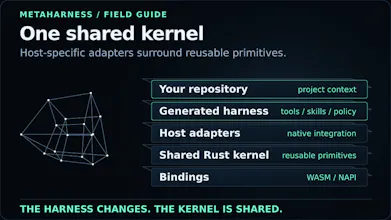
🛠️ Build: Generate a harness with its own CLI, MCP server, project memory, and repository-specific skills.
🛡️ Govern: Set tool permissions and policies, with release verification and witness-signed provenance.
🧬 Evolve: Darwin Mode tests changes to the harness and keeps improvements that pass evaluation and safety gates. The harness evolves while the underlying model stays the same.
🚀 Ship: Customize it, package it, and give your team a shared starting point they can run with one command.
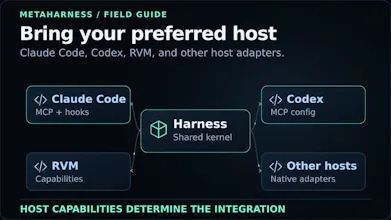
It works with Claude Code, OpenAI Codex, pi.dev, Hermes, OpenClaw, and more.
Try it: MetaHarness Studio
Explore the code: GitHub
Learn more: MetaHarness
What would you build a harness for first? We’d love to hear which workflows and integrations would make it useful for your team.
Your repo. Your rules.
Hey Product Hunt, Dragan here.
I’m on the Cognitum One team, and I’m looking at this release through a quality engineering lens.
When an agent works on a repository, the model is only part of what determines the result. The context it receives, the tools it can use, the rules it follows, and how we check its work all matter.
MetaHarness brings those pieces together around your repository. It generates a starting harness with agents, skills, commands, MCP tools, and scoped memory that you can inspect and adapt, rather than assembling everything from scratch.
What interests me most is how that harness can evolve. Darwin Mode provides a sandboxed path for trying changes, with gates around what gets accepted. That gives us something concrete to evaluate: did this change help on the work we actually care about?
Flywheel connects those experiments into a repeatable learning loop: run, measure, mutate, verify, and promote. It compares candidate changes against a fixed baseline and evaluation gates, keeping a traceable record of what was accepted and why. For me, that is an important part of the story: useful improvements can carry forward, while changes that fail the checks can be rejected rather than quietly becoming the new default.
A generated harness still needs testing against your project. As someone building Agentic QE systems, I see a useful place for our testing experience here: choosing meaningful checks, finding where a candidate fails, and deciding which changes deserve to move forward.
Try it on a repository you know well, and tell us what fits and what needs adjusting. We value your feedback.
Excited to see MetaHarness launch today! 🚀
The idea is simple: every repo gets its own AI agent harness, with a branded npx CLI, an MCP server, project-scoped memory and skills based on how the repo is actually laid out. It works with Claude Code, Codex, pi.dev, Hermes, OpenClaw and more.
A few of my favorite parts:
- npx metaharness score <repo> gives you a report card before you build anything: how well a harness fits, how safe the tools are, and a rough cost per run.
- Darwin Mode tries changes to the harness in a sandbox and keeps only the ones that measurably improve results. The model stays the same; the harness gets better.
- Witness-signed releases, and it's fully open source (MIT).
Give it a try with npx metaharness or the browser Studio. Curious what repo everyone builds a harness for first!
Nick is the man!