Dash0 nails it as an observability tool, especially for teams already using OpenTelemetry. With native PromQL, there’s no need to learn new syntax or naming – it just fits. Traces are super clear, making it straightforward to spot slow routes and see how services are interacting. Plus, setup is fast, support is solid, and the team keeps shipping new features. Overall, Dash0 makes troubleshooting faster and easier, no frills needed.






Hi Product Hunt, Liat here, PM for SLOs at Dash0.
We built this because "is the service reliable enough?" kept getting three different answers from three engineers. With AI writing more of the code, releases are faster and the blast radius is less predictable, so you need a contract that is not a vibe. An SLO is that contract: a target, a rolling 28-day window, and the error budget that falls out of it. When the budget is healthy you ship. When it is burning you slow down. That is observability-first development, and it is how engineering and the business end up looking at the same number.
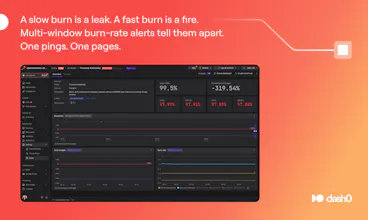
The proactive part is burn rate. Instead of paging on one bad minute, Dash0 derives fast and slow burn pressure from every SLO with multi-window alerts. Fast burn is a fire and pages you. Slow burn is a leak that would quietly break the promise by the end of the window, so it opens a ticket before users notice.
For the technically curious: pick a service, describe good and total events with two plain PromQL label selectors, set a target. Dash0 builds and manages the recording rules behind it, so there is no plumbing. Every SLO gets a burndown, remaining error budget, and pre-filled burn-rate check rules. Create them in the UI, with Agent0, or as OpenSLO YAML, API and Terraform. 25 SLOs per organization, included.
Would love to hear how you define reliability today, and what you would want an SLO product to do next.
Really happy to see this out in the wild! I’ve been working on the engineering side of SLOs at Dash0, and it’s been a pretty interesting journey getting all the pieces together.
One of the things we cared about was making SLOs feel like a natural part of the observability workflow rather than yet another isolated system.
Very curious to hear how people are using it in practice, especially at scale. Feedback, weird use cases and edge cases are all very welcome :)