We just launched @Dograh , the open-source alternative to Retell and Vapi for building voice agents.
Self-hostable, so you own your stack and your data.
We started it out of rage - every tool was too expensive, too closed, or scammy (addon after addons).
So we open-sourced every line from day 0, on one belief: no company should own voice AI.
Big labs are lobbying with govts to ban open source.
More open source is how we fight back.




Construct Computer
This is a great direction for voice AI!
Do you have better support for multi-step conversations as well?
Dograh
@ankushkun Thank you for your query. We actually have first class support for multi step conversation. When the entire industry was doing one monolithic prompt for voice agent, we and few others (like Bland) were doing natively multi node agents which broke a big monolithic prompt in multi step conversation.
This was specially challenging with models like Gemini Realtime which does not allow updating agent prompt in between conversation, but we figure out some hacks which allows our multi step conversation to work well with them (reconnecting with context playback and compaction).
Dograh
Hi @ankushkun we support multi step conversations extensively.
Infact with Dograh you can build multi-step conversations for real time/speech-to-speech models as well (apart form cascade)
Dograh
@ankushkun Yes, Dograh supports multi-step conversations and customizable workflows for different use cases.
Dograh
@ankushkunAdding to this, each step is its own node, so you can branch on the caller's response and call APIs mid-flow.
The part that makes it genuinely better to build with: test it as a text chat instead of dialing in each time, edit any message on the fly to see the LLM's generation and refine your prompt right there, and add a QA node to auto-check each step. Iterating on complex flows gets much faster.
Construct Computer
THanks you for all the replies, that's amazing!!
@sabiha_khan4 @sandeep_vemu @pritesh_kumar3 @a6kme1
SigNoz
What do you lose when you move to speech to speech?
Dograh
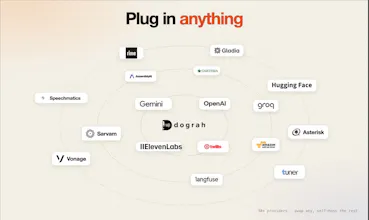
@ankitnayan - Thanks for your comment. Speech to speech are excellent models which offer language switching and lower latency. Many labs are working on Speech to Speech models, like @Google (Gemini Live), @OpenAI (OpenAI Live), @Grok (Grok AI) etc. @Dograh support these and many more.
The only challenge currently is that you cant use custom cloned voice with them, and the tool calling can sometimes be a bit unpredictable. However, we are seeing some very rapid progress in the space and these are bound to improve in short term.
Dograh
@ankitnayan Mostly control. Speech-to-speech is faster and handles language switching well, but you currently give up custom cloned voices and some predictability around tool calls. The gap is closing quickly, though.
Dograh
@ankitnayan While we have seen S2S win on latency and 'humanness'. Having said that tool calling and instruction following is not upto mark with LLM's in cascade approach. However with
@Dograh we ship the ability to break S2S stream accross multiple agents instead of 1 end to end stream and thus give you minute control over your instructions - shorter context and minimal instruciton following - thus enabling premium grade performance with S2S models.
We will be weleasing benchmarks soon . Keep an eye out :)
Dograh
@ankitnayan one addition - with s2s you also lose per-stage visibility. with a cascaded setup you can trace STT/LLM/TTS separately when something goes wrong, with S2S its one end-to-end model, so debugging a bad response gets harder.
Hey guys, congratulations on the launch! Curious to know how are you guys priced compared to Vapi or Retell.
Dograh
@seomaxtech Thank you for your message.
Our cloud offering is priced at 1 cent per minute of calling if you bring your own keys for models compared to around 5 cents per minute from Vapi and Retell.
If you use Dograh managed models, our model usage is priced at around 7 cents per minute compared to around 8 - 12 cents per minute from Vapi and Retell.
Dograh
@seomaxtech Our cloud offering costs $0.01 per minute with your own model keys, compared with around $0.05 per minute for Vapi and Retell. With Dograh-managed models, it is around $0.07 per minute, compared with roughly $0.08 to $0.12 per minute. And we can go much lower with an increase in volume.
@sandeep_vemu Got it. thanks!
Dograh
@seomaxtechLet us know if you encounter any issues while trying the platform..
Dograh
@seomaxtech to summarise what the team said - self-host it and it's free forever, or use our cloud at 1¢/min + model usage. Your call on ownership vs. convenience :)
Dograh
Thanks @seomaxtech . With your own model keys, Dograh is ~$0.01/min vs ~$0.05/min on Vapi/Retell.
Swytchcode
This is really nice. Do we need to provide custom data for training or is it ready from the go?
Dograh
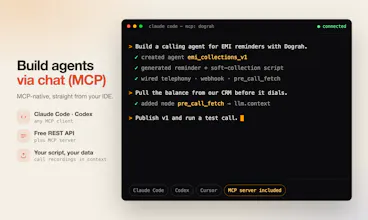
@chilarai - We ship with an MCP server that can help you build an agent on Dograh. While we dont expect you to bring in earlier conversation recording or custom data, if you have them, the coding agent (using Dograh's MCP) can extract signals and context from there and be able to create an agent which works better for your use case.
You can always find more help on our Slack community.
Dograh
@chilarai its ready from the go - you can build and test any voice agent for your use ccase - within 90 seconds (90sec is our SLA).
Give it a spin here: app.dograh.com
Dograh
@chilarai It’s ready to use out of the box, so no custom training data is required. You can still connect your own data and customize the agent for your use case.
Dograh
@chilarai just wanted to add - there's no training step at all. An agent is a prompt plus a workflow, so customising it means editing nodes: seconds, and reversible. For your own specifics you'd use the knowledge base rather than training data. Cheers.
Ota
Congratulations on the launch. Operationally, what’s the difference between scaling inbound versus outbound?
Dograh
@bobaikato - Thank you for your comment.
Inbound volume needs to scale more dynamically and is not in operator's control while outbound volume can be controlled by the operator.
Example: If there is a big event in town, a car dealership might get many more calls than they usually do on a normal days.
So, when it comes to scaling, the inbound needs to be more elastic and responsive, while the scaling requirements for outbound can be preplanned and provisioned.
Dograh
Thats an excellent question @bobaikato
Its mostly around agent building.
In general more receptive about AI agents in inbound calls( e.g. Customer support etc) rather than outbound calls (e.g. Insurance reminder etc)
In outbound we have seen that obsession around getting the first 15 seconds right works best. While in inbound scoping and being abl to handle variety of queries and handoff ecomes critical.
Dograh
@bobaikato Inbound requires elastic capacity because call volume can spike unexpectedly. Outbound is easier to forecast and provision since the operator controls the call volume.
Dograh
@bobaikato I wanted to add that there's no training step when building a voice agent at Dograh. An agent is a prompt plus a workflow along with configurations, so customising it means editing nodes: seconds, and reversible. For your own specifics you'd use the knowledge base rather than training data.
Dograh
@hannesh - Thank you for your message.
We have given a lot of thought to how call transfer is configured and works on @Dograh. You can not only set up static destinations but also resolve dynamic destinations based on the call context. The experience is very seamless for the caller. We have the option to provide a transition message - like "Please hold on while I transfer your call to a live agent", and if anything breaks during the transfer, we have a very graceful fallback also which can be controlled by the prompt.
Dograh
@hannesh thanks! from the caller's side it's pretty smooth - they hear hold music while we dial the destination in the background, and you can configure a heads-up message first so it's not abrupt ('connecting you to our billing team now'). importantly, we don't just throw the call over the wall - Dograh actually dials the destination and waits for it to answer before bridging the caller in, so they're never dropped onto a dead or unavailable line. there's also a configurable timeout in case nobody picks up. the one gap today is context isn't automatically passed to the human once connected, but that's very much in our roadmap.
Dograh
@hannesh The transfer is seamless for the caller. Dograh plays hold music while dialing the destination and only bridges the call once someone answers. You can also configure a short transition message, timeout, and fallback behavior.
@pritesh_kumar3 This looks very promising. Will users be able to build agents without writing any code
Dograh
@dipanshu_kushwaha5 Thanks for your message.
Yes. 100%. Dograh is to voice agents what @n8n is to workflow automation. You can either decide to visually build voice agent using Dograh UI or you can use MCP tools offered by Dograh (cloud or self hosted) to talk to your coding agents to build an agent for you. And all of these play really well with various telephony providers so you can go to production with least friction.
Dograh
@dipanshu_kushwaha Yes, you can build voice agents visually in Dograh without writing code. You can also use Dograh’s MCP tools with coding agents if you prefer.
Dograh
@dipanshu_kushwaha5 To add one more layer - it's no-code even after you build. There's a Test Chat mode where you can edit or replay any turn in a past conversation and Dograh regenerates the agent's replies and node transitions from that point, so you can debug and refine logic without touching code. Makes it easy for non-technical folks (support/ops teams) to actually own the agent long-term, not just the initial build.
Dograh
Yep @dipanshu_kushwaha5 , it’s fully no-code, with visual building and testing built in.