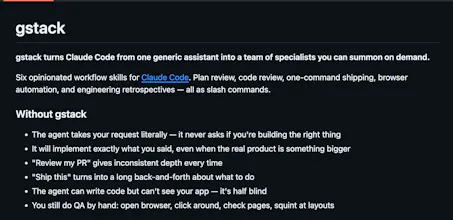
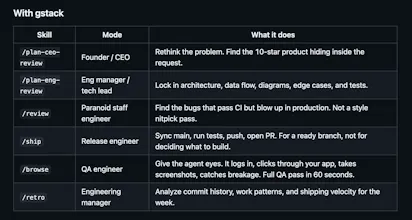
gstack turns Claude Code from one generic assistant into a team of specialists you can summon on demand. Six opinionated workflow skills for Claude Code. Plan review, code review, one-command shipping, browser automation, and engineering retrospectives — all as slash commands.
No reviews yetBe the first to leave a review for GStack
The specialized roles approach makes sense - a generic agent trying to do plan review and code review simultaneously often gets pulled in too many directions. Separating these into opinionated specialists with slash commands gives you predictable behavior without losing flexibility. The sub-200ms Chromium daemon for browser automation is a nice touch - most solutions add significant latency here. Does the engineering retrospective skill integrate with version control to automatically surface what changed between sessions?
Report
The six opinionated slash commands approach is brilliant for reducing context-switching overhead. What I find particularly compelling is how this mirrors the 'specialized agent' pattern we're seeing succeed elsewhere - rather than one generic assistant trying to do everything, you get focused tools for plan review, code review, and shipping.
Curious about the engineering retrospective command - does it pull from commit history to generate insights, or is it more manual reflection-based? The browser automation aspect sounds powerful for QA workflows too.
Report
The real gem here isn't just replicating Garry's setup—it's that someone finally packaged the actual prompt engineering patterns that separate "AI writes hello world" from "AI builds production features." I've been manually maintaining a similar Claude configuration for months and the context switching overhead is brutal. Does this handle multi-file refactoring across large codebases, or is it optimized for the YC startup sweet spot of <50 file projects?
Report
The separation of planning, review, and shipping into distinct slash commands is a smart design choice. We've seen the same pattern in our own agent workflows — a single generic session trying to hold architecture context while line-editing code always degrades quality.
How does GStack handle state handoff between skills? For example, if /plan produces a spec, does /ship automatically pick up that context or do you need to manually bridge them?
Report
Splitting planning, review, and shipping into separate slash commands is a great design choice. We've seen the same pattern in our own agent workflows: a single generic session trying to hold architecture context while also line-editing code always degrades quality on both fronts.
How does GStack handle state handoff between skills? For example, if /plan produces a spec, does /ship automatically pick up that context or do you need to manually bridge them?
Do you think a solo founder can run a startup using gstack?
Report
Garry's previous /plan-exit-review skill for Claude Code helped me fix a stubborn bug in the stateful voice agent for lawyers who are looking to improve their law practice and I just shipped a big new feature using the GStack. Ran this with Conductor and I had to rethink how many employees do I actually need for my startup.



The specialized roles approach makes sense - a generic agent trying to do plan review and code review simultaneously often gets pulled in too many directions. Separating these into opinionated specialists with slash commands gives you predictable behavior without losing flexibility. The sub-200ms Chromium daemon for browser automation is a nice touch - most solutions add significant latency here. Does the engineering retrospective skill integrate with version control to automatically surface what changed between sessions?
The six opinionated slash commands approach is brilliant for reducing context-switching overhead. What I find particularly compelling is how this mirrors the 'specialized agent' pattern we're seeing succeed elsewhere - rather than one generic assistant trying to do everything, you get focused tools for plan review, code review, and shipping.
Curious about the engineering retrospective command - does it pull from commit history to generate insights, or is it more manual reflection-based? The browser automation aspect sounds powerful for QA workflows too.
The real gem here isn't just replicating Garry's setup—it's that someone finally packaged the actual prompt engineering patterns that separate "AI writes hello world" from "AI builds production features." I've been manually maintaining a similar Claude configuration for months and the context switching overhead is brutal. Does this handle multi-file refactoring across large codebases, or is it optimized for the YC startup sweet spot of <50 file projects?
The separation of planning, review, and shipping into distinct slash commands is a smart design choice. We've seen the same pattern in our own agent workflows — a single generic session trying to hold architecture context while line-editing code always degrades quality.
How does GStack handle state handoff between skills? For example, if /plan produces a spec, does /ship automatically pick up that context or do you need to manually bridge them?
Splitting planning, review, and shipping into separate slash commands is a great design choice. We've seen the same pattern in our own agent workflows: a single generic session trying to hold architecture context while also line-editing code always degrades quality on both fronts.
How does GStack handle state handoff between skills? For example, if /plan produces a spec, does /ship automatically pick up that context or do you need to manually bridge them?
Manufact (mcp-use)
Do you think a solo founder can run a startup using gstack?
Garry's previous /plan-exit-review skill for Claude Code helped me fix a stubborn bug in the stateful voice agent for lawyers who are looking to improve their law practice and I just shipped a big new feature using the GStack. Ran this with Conductor and I had to rethink how many employees do I actually need for my startup.