
Launched this week

Jupid
File your taxes with Claude Code
885 followers
File your taxes with Claude Code
885 followers
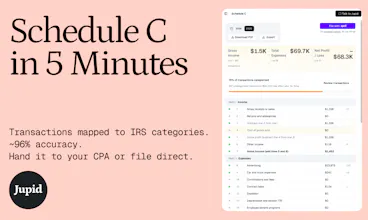
No matter how powerful LLMs get, they are objectively bad at financial transactions. Context loss, inconsistent categories, no memory between sessions. Jupid fixes the data layer. Connect your bank — it learns your business and every vendor relationship once, then remembers forever. Transactions mapped to IRS Schedule C categories (~96% accuracy). Missed deductions found: $1,249/year average. File your Schedule C in 5 minutes. Works with Claude Code. Free trial + 50% off first 3 months.






Spiritme
What about using an LLM with a vector database for persistent context? Seems like that would solve the memory problem without a new product.
@nikita_bogdanov1 Great technical question. Vector search helps with recall but doesn't solve the categorization consistency problem. You need structured vendor-to-category mappings that update deterministically, not probabilistic retrieval. We tried the RAG approach early on - it hallucinates categories at scale. The data layer we built is more like a traditional database with LLM-powered onboarding, not a vector search.
The vendor relationship memory approach is clever. I've hit the exact context drift problem — paste 6 months of transactions into Claude, works great until it starts re-categorizing the same coffee shop three different ways. Modeling context around counterparties instead of individual rows is a much smarter data structure for this.
@letian_wang3 Yes, that’s exactly the point. Transactions alone are not enough for proper categorization or stable memory. That’s why we took a completely different approach and work with counterparties and relationship memory.
I already use claude code a lot for my tax calculation, but looking forward to close the gap and solve it end to end with agents. Best of luck!
@arseny_info Would love to have you as one of our first users, Arseny! Unfortunately, for now we only connect to US banks via Plaid. However, we work perfectly with any CSV exports — you can just drop your bank statements and we'll process them as if it were a regular bank connection.
@arseny_info Arseny, would genuinely love to hear about your setup — always curious how other devs approach this. CSV works perfectly on our end, so no US bank needed. Drop us a line if you want to try it.
Venture Roof
The 'Works in Claude Code' angle is interesting. What does that actually look like in practice?
@dimakim You open Claude Code in your project, and you can ask things like 'what were my top 5 expenses last month?' or 'am I on track for quarterly estimated taxes?' - using your real bank data, not hypotheticals. It's your financial data available as context wherever you code. For founders who live in the terminal, it means never switching to a separate accounting app.
Pulse App
Congrats with the launch - great product!
Does it handle estimated quarterly taxes?
@esmentoza Yes, we do estimated taxes — both monthly and quarterly, no problem!
Spellar AI
How does it handle transactions that could go either way? Like a laptop that's both personal and business?
@zinovii_z This is a tricky one, for sure. Telling personal from business on a single transaction is hard. But we have two things going for us. First — the account type. If you separate business and personal accounts, that's the simplest path. Second — and this is our key technological advantage — we don't work with transactions. We work with counterparties. So in the laptop case: if we see an Apple transaction for $2,000, and we understand your profile — say you're a software company with developers — we can reasonably assume that an Apple purchase at that price point is likely an eligible business expense. We can't say with 100% certainty, obviously, but the counterparty context makes the prediction much more accurate.
HopShop
Good luck with the lunch. Does it sync with the accounting softwares,or I need to change it with your soft?
@tigran_chakhalyan1 Not necessarily! We have integrations with QuickBooks and other solutions where you can set up your own categorization system. We act as the categorization and data processing engine, sending ready-to-use transactions into your existing product.