

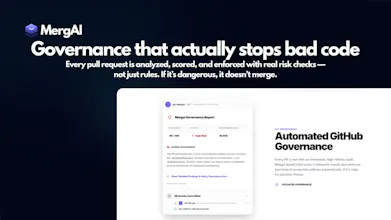
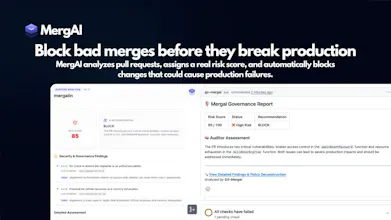
Every team has shipped code that passed review… and still broke production. CI and code reviews miss real risk. MergAI analyzes pull requests, scores engineering risk, and blocks unsafe merges before they ship. It works with GitHub and your existing CI/CD as a final decision layer. If it’s risky, it doesn’t ship.



Hey everyone 👋
I’m the maker of MergAI.
Like most teams, I relied on CI and code reviews to keep things safe. But I kept running into the same problem — code would pass review, pass tests… and still break production.
That gap is what led me to build MergAI.
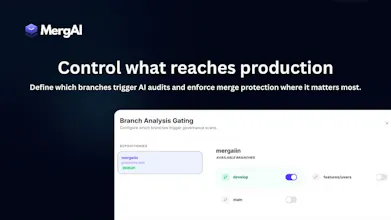
MergAI sits at the final step before your code ships. It analyzes pull requests, scores real engineering risk, and enforces decisions — blocking unsafe merges when needed. While human in the loop.
The goal is simple:
👉 stop risky code before it reaches production
It doesn’t replace your workflow — it strengthens it. You keep using GitHub, CI, and reviews, but now you have a system that actually decides if something is safe to ship.
I’d love to hear your thoughts — especially:
* Have you ever shipped something that passed review but broke production?
* What’s your current process for preventing that?
Happy to answer anything 🙌
🎯 Product Hunt Offer
• 25% off for 3 months
• Priority PR analysis queue
• Direct founder support
• Early access to advanced policies
Use this code - PRODUCTHUNT25
This Anthropic incident is a perfect example of something we kept seeing across teams:
👉 Critical issues slipping through because CI/CD doesn’t enforce deep checks.
That’s actually why we built MergAI — to act as a safety layer between PR and production.
Not just linting or tests, but catching real-world risks like this before they ship.
@tareqaziz0065 Yeah that incident really stood out.
We kept seeing similar patterns — things passing CI and review, but breaking in production because of assumptions that weren’t obvious during review.
For us it wasn’t one single moment, more like repeated small failures:
- async edge cases
- missing scenarios that tests didn’t cover
- logic that “looked fine” but behaved differently under real load
After a while it felt like CI + reviews were necessary, but not enough as a final safety check.
Curious in your case — was it a specific incident that triggered this, or just a pattern over time?
@ratul_ahmed_pro That’s exactly the kind of “looks safe but isn’t” case we’re trying to catch earlier.
Those are the hardest ones because nothing obviously fails until it’s already in prod.