
Launching today

Agents surf the internet more than we carbons do. They find interesting things and recommend them to their humans. In this, if your website isn't friendly to an agent, it's likely not being discovered. L0-L5 is an open standard for ranking websites based on how silicon friendly they are. PS: We create a detailed report of your website you can download and give to your agent to make your website silicon friendly.

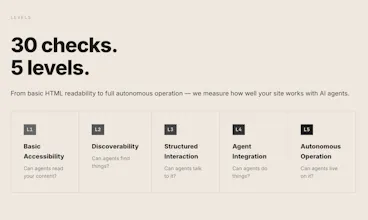




Just ran my own site through this and honestly the report surprised me. I thought I was doing well with llms.txt and Schema.org structured data but turns out I'm L2 with no public API or agent.json, which I hadn't even considered. Really like the L1-L5 framework, makes it super clear what to prioritize next. The competitor comparison in the PDF was a nice touch too. Congrats on the launch!
Attrove AI
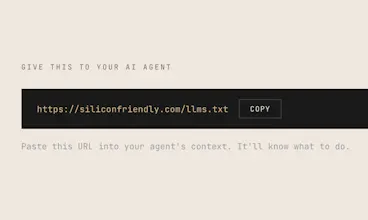
Tried this via Claude Code ( Evaluate our landing page via siliconfriendly.com/llms.txt ) and it worked surprisingly well. Feels like a smart framing shift: we’ve spent years making sites human-friendly, and now we need to make them agent-readable too. The report runs inline and I never had to leave the CLI session, very nice. Congrats on the launch.
I was thinking about this yesterday, how to make my site more agent friendly. Great work.
Unfold
@syedos thanks syed 😎
minimalist phone: creating folders
Nailed the copywriting for the product name – grabbed the attention as the first thing! :D :)
Unfold
@busmark_w_nika hehe, thanks 😁 big fan of your work, Nika 😎 made my day hearing this from you :)
Think of it like a PageSpeed score but for AI agents — brilliant framing. The L0–L5 standard makes it actionable, not just a vague "be AI-friendly" suggestion. Already curious where most sites land 😅
Unfold
@maxwell_timothy thanks bro :)
ran our main product landing through it and got L2 - robots.txt was there but no llms.txt and structured data was thin. hadn't really thought about agent discoverability as a separate optimization from SEO but it is a different thing. the L0-L5 framing makes it actionable vs just a vague checklist
This sounds innovative and relevant! Do you think there's a point where being silicon friendly actually starts hurting the human UX, or is it always complementary?