
Launched this week

Sitewatch
Website monitoring that catches what uptime tools miss.
8 followers
Website monitoring that catches what uptime tools miss.
8 followers
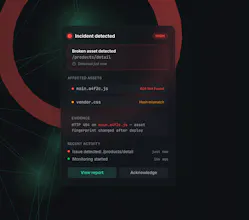
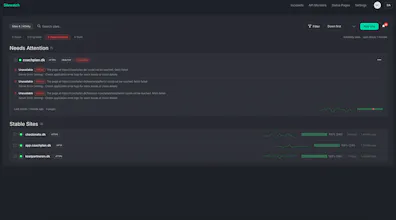
Sitewatch checks whether your website actually works — not just whether it responds. Sites can return 200 OK while serving broken bundles, wrong MIME types, redirect loops, or stale cached content. Users see a blank page. Your uptime tool says green. Sitewatch verifies critical assets load correctly, follows redirect chains, fingerprints content to detect silent changes, and checks from multiple regions. When something breaks, it classifies the root cause with fix guidance for your stack.
Apparent for Gmail
Upvoted! Just launched today as well.
@apparentforgmail Thanks for the upvote :) Just sent one in your direction as well :)
Really like the positioning here the gap between 'server responded' and 'page actually works' is something most teams don't think about until a user reports a blank screen.
Curious how it works, is this synthetic testing on a schedule, or more of an agent actively crawling and validating? Also wondering how it compares to front-end observability tools like Sentry or Embrace.io for catching these kinds of issues. Are teams meant to use this alongside those tools or as a replacement?
@aissam7 Thanks! Really appreciate the kind words.
To answer your questions:
It's scheduled synthetic checks — we run the full detection suite every 5-30 minutes from multiple regions. No agent or snippet to install. You add a URL and we start checking.
On Sentry/Embrace, they're complementary, not competing. Those tools catch errors after they happen in a user's browser. They need real user traffic to trigger. Sitewatch catches the problem before users hit it — or at least within minutes of a deploy going wrong.
Think of it this way: Sentry tells you "47 users got a TypeError on the checkout page." Sitewatch tells you "your checkout page is broken right now because a JS bundle is 404'ing after your last deploy"... ideally before those 47 users ever see it.
Most teams running Sentry would benefit from both. Sentry for runtime errors in application code. Sitewatch for structural failures, broken assets, MIME mismatches, stale CDN content, redirect loops... The stuff that returns 200 OK but means the app never even loads enough for Sentry to initialize.