

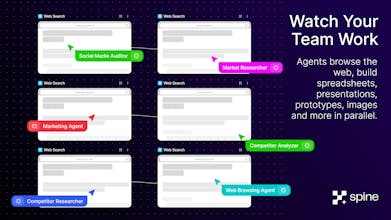
Spine is a visual workspace for managing and deploying swarms of AI agents that can complete complex tasks from start to finish. Agents can browse the web, conduct deep research, build 50-page strategy documents, generate detailed presentations, create interactive prototypes, and more — with one single prompt.
This is the 4th launch from Spine. View more
Spine Swarm
Launched this week
With Spine, you can manage and deploy swarms of AI agents that complete complex tasks from start to finish. Agents browse the web, conduct deep research, build 50-page strategy documents, generate detailed presentations, create interactive prototypes, and more — all with one prompt. The result: Auditable work on a visual canvas that’s far more thorough, accurate, and complete than what you get from ChatGPT, Gemini, or Claude.



Free Options
Launch Team / Built With


Working on Spine made me realise how different things get once you move from one model to many agents. A lot of the engineering ends up being orchestration routing tasks across models, coordinating long-running jobs, and keeping outputs structured so other agents can build on them.
It’s interesting watching it break down larger tasks and assemble real outputs research reports, strategy docs, prototypes, landing pages, and slide decks.
I’ve also been using it for engineering workflows like researching systems, summarising docs and blogs for quick reads, getting perspectives from multiple agents with different personas, generating quick prototypes, and thinking through edge cases.
Would love to see people try workflows like this too.
Pretty fun system to build and work on.
Spine
I'm on the team at Spine but I also use it constantly for my own work. What I keep coming back to is how visual everything is — agents do the heavy lifting, and you get real deliverables on a canvas you can actually look through, rearrange, and build on. If you've ever wished you could just watch AI work and step in when it matters, that's basically this.
Copus
The idea of spinning up specialized agents in parallel and picking the best model for each step is really smart. Most AI tools try to do everything with one model, which leads to mediocre results across the board. The visual canvas where you can watch agents work in real time is a nice touch too — transparency in how AI arrives at deliverables builds a lot of trust.
Spine
@handuo Thanks! Looking forward to seeing what you build!
Spine
@handuo Thanks Handuo! That's exactly the insight behind Spine — different tasks need different models, and forcing one model to do everything is a compromise. The canvas transparency was a deliberate design choice too; we think if you can't see how AI got to an answer, you can't really trust it. Appreciate the support!
AutonomyAI
Love it! Can't wait to try this out on marketing ops.
Supported and shared on our channels. :) Best of luck!
Spine
@lev_kerzhner Thank you! Appreciate your support.
Spine
Engineer on the team here,
One of my favorite moments while building Spine was the first time we ran a task and just… watched agents work for ~30 minutes assembling a full research doc and slide deck.
With Spine Swarm, it felt less like prompting an AI and more like assigning a project to a small team who do their job incredibly good.
Interesting system design here.
From the description it feels like Spine behaves closer to an orchestration layer coordinating swarms of agents rather than just a typical AI workspace.
Curious how the team internally thinks about that distinction.
Looks dope guys. What are cases you think this would outperform (either in accuracy, cost, latency, etc.) something like Claude Code subagents or agent teams?