
Launching today

talat
Realtime meeting notes that don’t leave your Mac
87 followers
Realtime meeting notes that don’t leave your Mac
87 followers
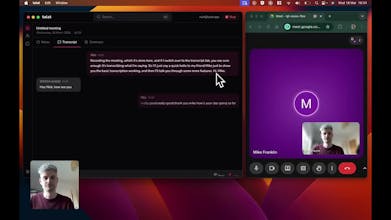
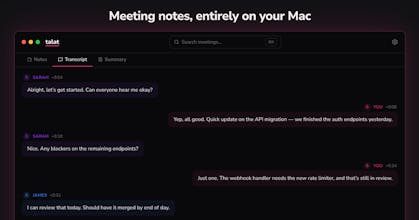
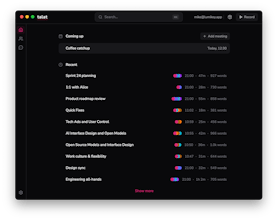
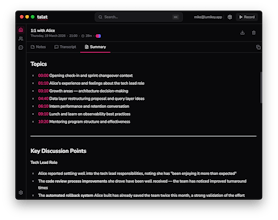
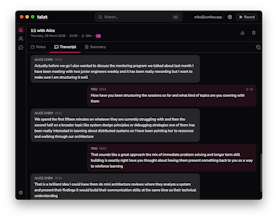
talat captures your microphone and system audio, transcribes both sides of every conversation in real time, and turns meetings into searchable, editable notes. It's powered entirely by your Mac's Neural Engine: your audio never leaves your machine. Choose custom LLM providers, write custom summarisation prompts, auto-export to Obsidian, push meeting data via webhooks, or query your history through an MCP server. It runs alongside Granola and other tools, so you can try it without switching.
The privacy angle here is underrated. Most notetakers treat "your data" like a byproduct. You're treating it like it belongs to you — because it does. What I'm curious about: do you think local-first transcription changes how people actually speak in meetings? Like, does knowing nothing leaves your machine shift the quality of what gets said?
fitIQ
@julian_francis thanks Julian!
I'm not sure if it changes how people speak. I think it's enough of a shift that we won't really know for a while. But I'm excited to find out!
fitIQ
Product Hunt
fitIQ
@curiouskitty I would expect the breaking point to be one or more of:
deciding that they don't want their voice, notes, transcripts or summaries routed through and hosted on someone else's servers
deciding that they've had enough of paying for another monthly subscription
deciding that they don't want to put up with the artificial limits imposed by the current 'plan' they're on (e.g. restricted access to meeting history)
deciding that they want to fully own their experience, not just their data
I run meetings in two languages — some fully in Czech, some in English. Does the transcription handle both well, or is it optimized mainly for English?
fitIQ
@klara_minarikova Hi Klara!
In truth, as a team of two who are native English speakers, we haven't yet done much multilingual testing. Here's what I can tell you:
By default, the transcription model is English-only, but:
You can change it to a model which supports 25 European languages (here's a link: https://huggingface.co/nvidia/parakeet-tdt-0.6b-v3)
I know that the realtime 'preview' transcripts we show, which appear as people speak, won't work unless the language is English, but those preview transcripts get corrected when the speaker stops speaking. So the non-English experience at the moment will work if you select the multilingual model, just without words being transcribed as they are being spoken.
Earlier today, Michael (a few comments up) asked about this very same thing, so I immediately added a task to our backlog to improve the user experience and journey here for multilingual or non-English meetings. I expect it to ship in a release or two's time, so if not tomorrow, probably Monday.
But the TL;DR: yes, it will work, but not quite as polished an experience as English-only.
Does it support English only?
fitIQ
@michael_vavilov the default model is English-only for faster transcription and slightly higher accuracy, but you can switch to a model which is almost as good and works across 25 European languages (https://huggingface.co/nvidia/parakeet-tdt-0.6b-v3). The only thing you lose is the realtime previews as people are speaking, but once they stop, what they said will be transcribed properly.
really like the privacy-first direction here. having realtime meeting notes that stay fully on-device feels like a big win, especially for people who are not comfortable sending sensitive conversations to external servers. the obsidian export and custom prompts are a nice touch too. how has the response been so far from people already using granola or similar tools?
This is a very thoughtful take on AI meeting notes. The fact that everything stays on the Mac makes the product immediately stand out, especially for users who care about privacy and control. I also like that you are positioning it as something that can work alongside existing tools instead of forcing people to switch. Do you see talat becoming more transcript-first over time, or is improving summary quality still a major focus?