TeX2Vid converts LaTeX research papers into narrated source-grounded videos. With four video formats: Teasers, Shorts, Highlights, and Video Abstracts, every claim, result, figure, table, are sourced from the paper. Teasers and Shorts are suitable for social media and Highlights and Video Abstracts can be submitted to conferences and journals. The users can edit slides, swap figures, record their own voice or use default AI voice.
No reviews yetBe the first to leave a review for TeX2Vid: Convert papers into videos
Maker
📌
Researchers spend months conducting research and writing papers, then publish them, which are read by very few people. If these papers are converted into narrated videos, they can reach more people and can have more impact on researchers as well as the general public. However, we researchers are hesitant to spend additional time creating a video. To make the process easy, SheQAI Research created TeX2Vid that converts LaTeX files into faithful source-grounded videos with no invented results or claims. Every figure, result, and claim comes from the original paper.
If you have any feedback, comment here or DM me. We highly appreciate your feedback.
SheQAI Research is based in Edmonton, Alberta, Canada; we aim to build infrastructure for scientific and scholarly communication.
Report
Maker
Generic video generation tools produce some made-up results even when the source papers are passed to them. SheQAI's TeX2Vid fills this gap and converts complex LaTeX source files into paper-grounded videos using a multi-actor critic architecture, where all (writer actors’) responses are passed to critics with both stochastic and deterministic layers for evaluation. The process runs multiple rounds so that the final output includes all claims, results, figures, and tables exactly as in the paper; after that, the Beamer slides are built, the audio is synthesized, and the video is finally rendered. The final rendered video is again passed to an independent critic, who deterministically checks that the claims are faithful to the source paper. TeX2Vid supports most of the major journals and conferences’ style files across subjects.


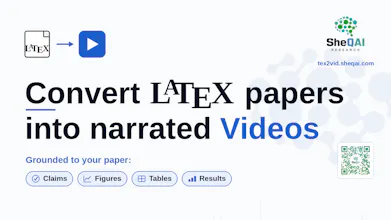



Try it today at https://tex2vid.sheqai.com.
If you have any feedback, comment here or DM me. We highly appreciate your feedback.
SheQAI Research is based in Edmonton, Alberta, Canada; we aim to build infrastructure for scientific and scholarly communication.
Generic video generation tools produce some made-up results even when the source papers are passed to them. SheQAI's TeX2Vid fills this gap and converts complex LaTeX source files into paper-grounded videos using a multi-actor critic architecture, where all (writer actors’) responses are passed to critics with both stochastic and deterministic layers for evaluation. The process runs multiple rounds so that the final output includes all claims, results, figures, and tables exactly as in the paper; after that, the Beamer slides are built, the audio is synthesized, and the video is finally rendered. The final rendered video is again passed to an independent critic, who deterministically checks that the claims are faithful to the source paper. TeX2Vid supports most of the major journals and conferences’ style files across subjects.