A year ago, an AI/LLM Gateway felt like a thin layer: auth + simple routing across a few model providers. That era s over. As teams ship agentic apps with many moving parts (models, tools via MCP, prompts, guardrails) the complex problems are now control, standardization, and observability.
What a modern gateway really does:
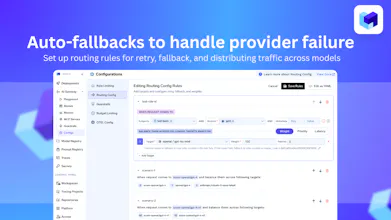
Unified interface & routing: Swap models/providers without code changes; policy-based routing (latency/cost/quality), failover.
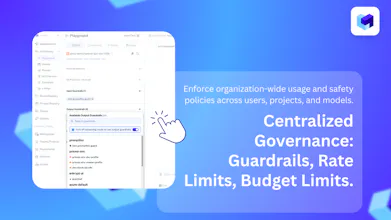
Centralized access & governance: One place for keys, RBAC, per-team quotas, audit logs, and data residency.
Guardrails at the edge: PII redaction, safety/moderation, jailbreak & prompt-injection checks, tool permissioning.
Experimentation & evals: Prompt/version management, playgrounds to connect models + MCPs and build agents
Deep observability: Traces for prompts/responses/tools, tokens/cost, latency SLOs, drift signals; caching/rate-limits/batching.






Looks solid. What could be the inherent advantage though against setting up something like LiteLLM which I believe is open source?
TrueFoundry AI Gateway
@vysakh_t Great question! LiteLLM is awesome for getting started, but teams quickly outgrow it as they scale.
What we focus on is everything needed for production-grade, enterprise AI:
Multi-region + low-latency routing and data residency guarantees
Deep observability — per-tool/per-model traces, guardrail logs, cost metrics, MCP-level telemetry
Enterprise-grade auth (OAuth2, DCR, , RBAC) and secure MCP server management
Reliability features like automatic failover, fallback routing, and rate-limiting by model/team/user
Support + SLAs that large enterprises require when AI becomes mission-critical
LiteLLM is great for experimentation — TrueFoundry is built for operating AI at scale across many teams, regions, tools, and compliance environments.
TrueFoundry AI Gateway
Hello Product Hunt Community, Nikunj - cofounder & CEO.
Today's launch is super close to my heart, not just as a product but as a package of learnings we have been fortunate to accumulate working with Enterprises. Those who have been building at cutting edge, and have shown the courage to reverse decision they previously believed to be correct. Best illustrated through an example of a real customer conversation with timelines.
June 2024: Customer (building a scaled use case): "We will never use Gateway. It lies on the critical path of the request and is such a thin layer that we will own this part ourselves. Model inferencing, GPU management is a different story".
Sep 2024: Customer (As Sonnet, o1 were getting launched): "These APIs keep changing, models keep getting outdated - Gateway is becoming a pain to maintain"
Nov 2024: Customer (As other teams started to ask for inferencing): "Its one thing to support one use case through the Gateway but as we are becoming a platform, now we need a lot more visibility and control layer".
Feb 2025: Customer (As the gateway went down and they started losing $6k / second): !
May 2025: Customer (As MCPs started becoming popular): "Its becoming impossible to catch up with the market, scale the Gateway reliably, and add the right controls for satisfying varying requirements from different teams. @nikunj_bajaj are you all continuing to build the Gateway?"
May 2025: Nikunj: yes, we are.
June 2025: Customer: Started migrating prod traffic to TrueFoundry AI Gateway.
July 2025: Customer: Observability, governance controls became a critical part of their workflow.
Oct 2025: Customer: First MCP driven application launched to prod.
Nov 2025: Customer (over a dinner): I remember having a conversation with you about 1.5 years back thinking we will run our own Gateway. Glad we shifted :)
We have learnt so much in terms of how to build the right design on our AI Gateway, access controls, authentication / authorization and making it compatible with existing Enterprise stacks on MCP Gateway, very difficult data residency requirements, how certain guardrails don't "just work" etc. etc.
And this launch marks the joint success of our collaboration with many other early adopters of TrueFoundry who have helped us build and shape our AI Gateway. Cheers to our customers.
Really cool work! Excited to see its growth!! What is the most common Guardrail rule F100 companies use to prevent unexpected agent recursion or tool-call looping?
TrueFoundry AI Gateway
@swecha_sanjay07 thanks! The most common pattern we see to prevent recursion or tool-call loops is simply setting limits on how many times an agent is allowed to invoke tools within a single run.
Most teams start with straightforward guardrails like:
max tool-call depth (e.g., don’t allow a tool to trigger another tool more than N levels deep)
max tool-call count per request (stop execution once a threshold is hit)
These guardrails catch almost all accidental loops without needing anything more complex.
The developer experience look really clean! One API key, one endpoint, and access to multiply models with consistent logging is exactly the simplicity terms need. I'm curious about latency - what kind of over head should teams expect when routing through the gateway with guardrails enabled? Excited to check this our!.
Congratulations on the launch, @agutgutia and the @TrueFoundry AI Gateway team! I am looking forward to trying this out. It is very timely. Does it include a RAG repository or any integrations with vector databases?
TrueFoundry AI Gateway
@tim_ep1 Yes - we do support RAG out of the box. However, this is not included in AI Gateway offering.The product includes RAG templates and integrates with any vector database, so you can plug in retrieval workflows without changing your existing setup.
Claap
TrueFoundry AI Gateway
NovaSynth by Noveum
This solves a real problem. Congrats on the launch @agutgutia @nikunj_bajaj @deeptishukla I’m curious how TrueFoundry’s AI Gateway manages policy enforcement and observability when multiple agents and models are chained together, does it maintain full traceability through the entire workflow?
TrueFoundry AI Gateway
@nikunj_bajaj @deeptishukla @harkirat_singh3777 Thanks so much! Yes - the Gateway maintains full end-to-end traceability, even when multiple agents, tools, and models are chained together.On the observability side, each step is captured as a unified trace, so you can drill into prompts, responses, tool outputs, and fallbacks across the entire workflow.