
Launched this week

ZooClaw
Your proactive team of AI specialists in one place
1.3K followers
Your proactive team of AI specialists in one place
1.3K followers
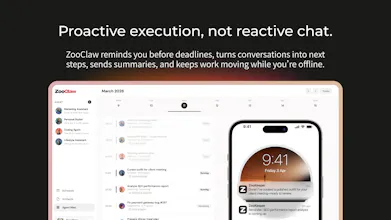
ZooClaw is a single entry point to a team of AI specialists. Ask in natural language and your task is routed to the right agent, each with structured domain knowledge and a native-sounding voice. Built on OpenClaw, it stays synced with the latest models and can fall back to top open-source models, so work keeps moving. No setup, no deployment, no API keys, no token anxiety.




Really liked the story, especially the part where your HR lead kept iterating and actually built something usable, that feels pretty engaging. wonder what part do non tech users usually get stuck on when they try to build their first agent?
ZooClaw
@colin_yu_123 Honestly, the hardest part isn't a step in the process — it's that most people never think they can build one, so they never even start. What amazed me was watching our HR lead guide her "Soulmate" through a conversation and end up with a fully functional agent — scripts, skills, everything. The best part? She didn't even realize what she'd built until we pointed it out. That moment stuck with me: when the barrier is low enough and building feels like just having a conversation, people's creativity becomes the only real limit.
congrats on the launch, the proactive scheduling angle is genuinely different from most agent tools i've seen.
one thing i'm curious about though. "zero token anxiety" sounds great as a user but someone's eating that cost. is there a usage ceiling on the free tier, or are you subsidizing compute to grow and then switching to a credit model later? asking because i've watched a few AI tools launch with generous free tiers and then hit a wall when the unit economics catch up.
not trying to be cynical, honestly excited about what you're building.
ZooClaw
@futurestackreviews This is exactly the right question to ask — we've watched the same pattern play out.
We run our own GPU cluster with heavy inference optimization, so our cost structure is pretty different from teams relying on proprietary APIs.
When credits run out, we don't shut the agent down — we keep a generous baseline of tokens from top open-source models flowing so the agent stays always-on and proactive. An agent that goes dark when credits run out kind of defeats the purpose.
We're absorbing some of that cost, yes — but we think it's sustainable.
the "no token anxiety" line hits hard. constantly monitoring usage across different APIs is such a productivity killer. how does the fallback to open-source models work when the main ones are overloaded? does it maintain quality or just keep things moving?
ZooClaw
@piotreksedzik Glad it resonates! Just to clarify — the fallback kicks in when credits run out, not due to overload. We run our own GPU cluster with inference optimization, so we can serve top open-source models at quality levels that handle real work. Of course it won't perform as well as the best proprietary models, but your agent stays functional and proactive regardless. That's the whole point.
This is really cool. Can a specialist hand off part of a task to another one mid-conversation?
ZooClaw
@ermakovich_sergey Exactly — like a real team! Not there yet, but inter-agent communication and coordination is our next big focus. Stay tuned!
Looks cool, is this built on openclaw?
ZooClaw
@james001 Yes! We track OpenClaw closely and stay up to date. The idea is zero friction — no setup, no token anxiety, just open it and your specialist agents are ready. Safer too :-p
Features.Vote
the "no token anxiety, no setup" angle is genuinely clever positioning. most people who'd benefit from a multi-agent setup are scared off by the infrastructure overhead, and removing that friction to get to an immediately useful team of specialists is the right instinct.
the tricky part will be routing quality on ambiguous or cross-domain requests. a single entry point works cleanly when tasks are discrete, but "help me prepare a business case for this new feature based on our usage data" spans writing, analysis, and product thinking at once. getting the routing to coordinate across agents or correctly decompose the task is where these systems tend to fall apart, and the failure mode isn't obvious to debug.
ZooClaw
@gabrielpineda 100% agree — routing on ambiguous, cross-domain tasks is genuinely hard, and the silent failure mode makes it even trickier to fix.
Our current thinking: the missing piece is goal ownership — having a coordinating layer that holds the intent end-to-end, not just dispatches tasks. And making that layer transparent and correctable, so when it drifts, users can actually see why and step in.
Still a hard problem we're actively working through. 😊
Fish Audio
ZooClaw
@hehe6z Thanks a lot! Really appreciate the support! Can't wait to hear what you think of ZooClaw!