
AI's next top models
gm legends. It’s Sunday.
This week: what people are saying about Claude Sonnet 4.6, vibe coding’s potentially parasitical relationship with open source, six new OpenClaw tools, and why one founder thinks AI coding is better for website building than…website builders. Plus, five of our favorite launches from the past week.
It’s a whole vibe below. But you can’t code it. You have to read it.
P.S. Launching soon? We’d love to hear about it → editorial@producthunt.co 🫶
3 micro takes on Claude Sonnet 4.6
This week, Anthropic upgraded its Claude Sonnet model for the first time since September. Sonnet is known for being faster and cheaper than Claude Opus (which got its own upgrade this month). The tradeoff is that it’s not quite as “intelligent.” It just got the Jason Bourne upgrade and now feels plenty smart.
The reviews are still coming in for Sonnet 4.6, but early returns suggest this update is pretty…pretty…pretty good:
- Chris Messina writes: “Super interesting to see the focus on task execution in the launch materials for this one — definitely moving Claude into the personal productivity space (i.e. to be used to ‘execute work’) rather than just a conversational sidekick!”
- Gowtham Shankar calls it “a massive step forward — the 1M token context window alone is a game changer for long-document workflows. What really stands out is that Anthropic is closing the gap with Opus-level intelligence at a much more practical price point. Coding, reasoning, and computer use all feel noticeably sharper.”
- Rahul says: “It's solving bugs just as well as Opus was, and maybe expectation bias, but seems to be just as good as Opus 4.5.”
Not to be outdone, Google dropped Gemini 3.1 Pro on Friday. Which raises the question: What’s the real difference between all these models?
- Gianmarco Carrieri believes that “for 95% of real applications, the difference between GPT-5.3, Sonnet 4.6, and Gemini 3.1 Pro is negligible. What matters is reliability, cost, and speed — not who wins on ARC-AGI-2.”
Is vibe coding killing open source?
Tanzil Chowdhury is concerned about how vibe coding is quietly undermining the tools it relies on. He draws on a recent research paper and points to Tailwind CSS: It has more users than ever, but its revenue and traffic have dropped so much that it had to lay off most of its engineering team. That’s because models can generate Tailwind code so that people no longer have to visit the docs or get exposed to its paid products. If this keeps up over the long term, the raw material to make new stuff may not be able to afford to exist.
In the short term, Tanzil wants to know: “What open-source project do you think is most at risk next?”
Framer 3.0 put a design agent on the canvas
Framer 3.0 is the design agent for every step from idea to launch, and it works alongside you, not instead of you. Describe the site, watch the agent build real pages on the canvas, then edit anything it made: breakpoints, components, code, CMS, SEO. Branching gives it a safe place to take the big swings so you merge only what you want. Already living in Claude, Cursor or Codex? Point them at Framer and ship from wherever you work. Not just vibes, a full platform. (sponsored)
‘We paid $25k for our website. I vibe-coded a new one in 2 days’
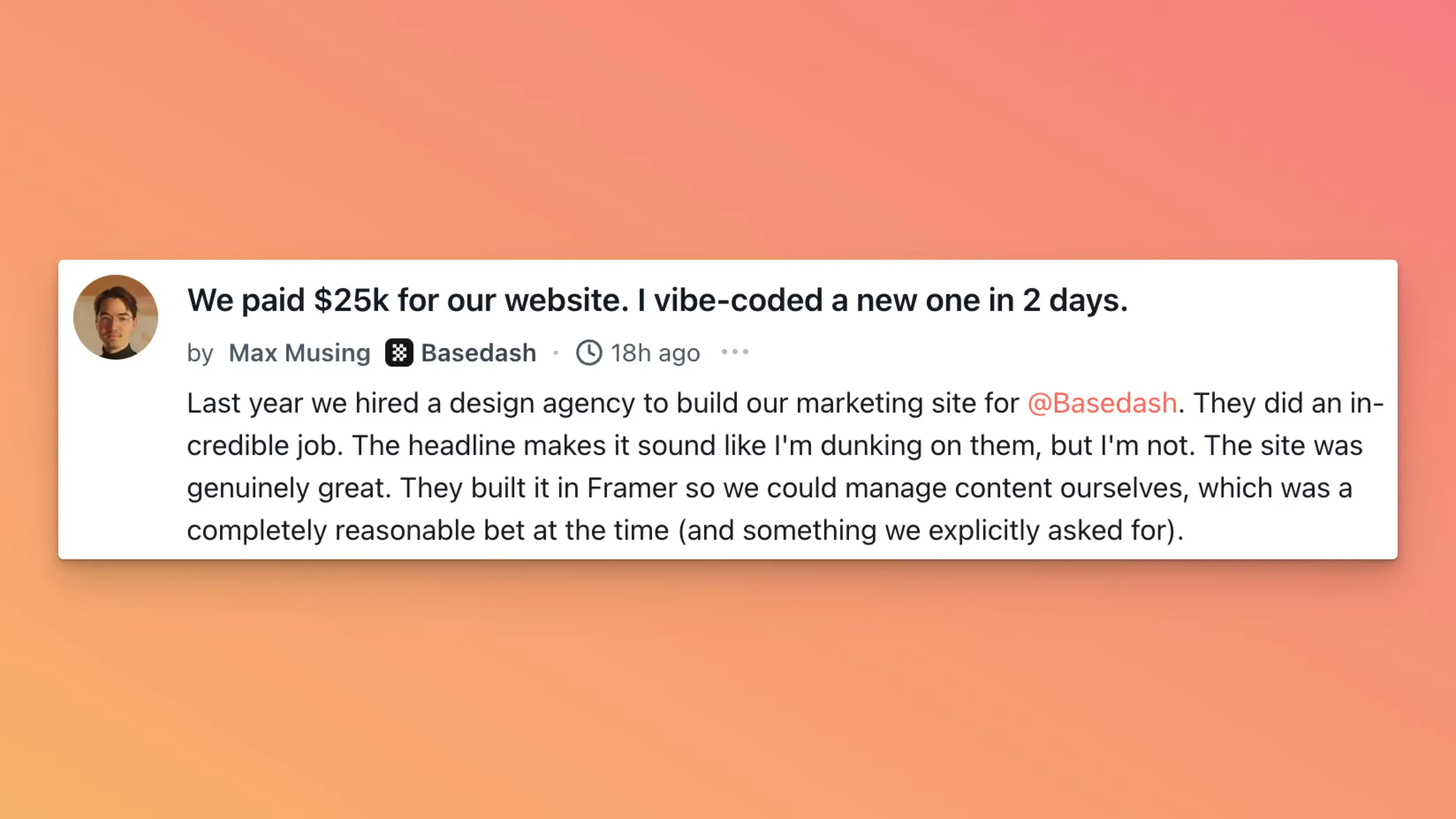
Max Musing from Basedash paid $25,000 for a beautiful Framer site. But, ironically, Max and his team stopped editing it because Framer was a no-code tool, and he was a coder. He didn’t know how to use it. Now that AI coding has become a viable alternative to no-code, he rebuilt the 865-page website in two days using Cursor and GPT-5.3 Codex. (Sidenote: GPT-5.3-Codex Spark launched this week.)
The big argument of the post is that, although no-code used to be seen as the low-friction option because it kept maintenance and developer bottlenecks to a minimum, now AI coding feels lower friction.
Agree? (Or does that take rub you the wrong way?)
Play the Claw machine
OpenAI this week announced it’s hired Peter Steinberger. Peter is the engineer behind OpenClaw, the AI agent framework that’s been powering a ton of bot experiments. OpenClaw will stay open source while Peter merges with OpenAI, meaning that OpenClaw can continue to provide fodder for new launches. This week alone on Product Hunt, we saw:
- ClawMetry, an open-source dashboard for OpenClaw
- ClawStreet, a trading platform for agents to buy and sell stocks, crypto, and commodities (with pretend money)
- Atomic Bot, a free, open-source tool for opening OpenClaw in one click
- Chowder, an API for managing your OpenClaw instances
- VidClaw, an open-source Kanban dashboard for keeping tabs on your agent
- Clawi, a tool to quickly launch an OpenClaw assistant
Leaderboard highlights


Every Sunday
Everything you missed this past week on Product Hunt: Top products, spicy community discourse, key trends on the site, and long-form pieces we’ve recently published.