
China makes a move
gm legends. It’s Sunday.
This week: DeepSeek launches its latest AI model, an app that helps you understand more of what you read, what the data really says about startup scalability, and a better way to find the product you’re looking for. Plus, five of our favorite launches from the past week.
This is the newsletter you’re looking for, legend. Enjoy.
P.S. Launching soon? We’d love to hear about it → editorial@producthunt.co 🫶
DeepSeek and ye shall find

Chinese AI company DeepSeek this week previewed its latest LLM models, the eponymously named DeepSeek V4 Pro and Flash.
When V3 launched last year, many people wondered whether American-made models could compete with DeepSeek, which built its own data centers to train its models.
V4 isn’t quite prompting the same existential questions. According to DeepSeek, it’s beating other models at reasoning and is comparable on coding, but is behind on knowledge tests and can only handle text, instead of images, audio, and video.
Moreover, it’s not like those other companies are standing still. This same week, we saw notable launches like:
- OpenAI pumped out GPT-5.5 and ChatGPT Images 2.0, an updated image model with a built-in reasoning step which promises better layouts and results that look more like what you’re asking for.
- Anthropic shipped Claude Desktop Buddy, a tiny physical companion for Claude that sits on your desk, connects to the desktop app, and reacts to what’s going on so you can see activity without staring at a screen the whole time.
Still, not everything needs to be the best to compete. DeepSeek does exceptionally well on price and context. It’s cheaper than GPT, Gemini or Claude, and the models support context windows larger than 1 million tokens — you can give it a ton of data to play with.
Doomscrolling in a suit

Sahil Das is a high school builder in Ethiopia who’s worried that the onslaught of online content and AI summarization tools aren’t making us more productive — we just think they are. He writes:
Most reading is wasted time unless you pay the toll of a thought. We’ve been trained to treat information like groceries—something to be "captured" and "stored". We use AI to summarize complex texts because we want the "insights" without the effort.
But AI summarization is hollow. It provides an illusion of understanding while burying your own diversity of thought. When you outsource synthesis to an LLM, your brain never has to do anything with the information.
Storage without synthesis isn't learning. It’s just doomscrolling in a suit.
His solution is pretty freakin’ cool.
Framer 3.0 put a design agent on the canvas
Framer 3.0 is the design agent for every step from idea to launch, and it works alongside you, not instead of you. Describe the site, watch the agent build real pages on the canvas, then edit anything it made: breakpoints, components, code, CMS, SEO. Branching gives it a safe place to take the big swings so you merge only what you want. Already living in Claude, Cursor or Codex? Point them at Framer and ship from wherever you work. Not just vibes, a full platform. (sponsored)
The cost of technical debt: A longitudinal study of 100 startups

By Imed Radhouani, co-founder of Rankfender
We analyzed the codebases of 100 startups that hit a scalability wall.
The goal was not to find the most exotic bug. The goal was to find the most common, expensive, and preventable patterns of failure.
The results were almost identical across 85% of them. Here is what the data says.
The Timeline to Failure
- Months 1–6: Everything worked. Fast releases. Happy customers. No time for architecture.
- Months 7–12: Progress slowed. Strange bugs appeared. "Fix it later" became the motto.
- Months 13–18: Every new feature broke three existing ones. Deployments became stressful.
- Months 19–24: Hired more engineers. They just maintained the mess. No new features shipped.
- After 24 months, reality left only two choices: rewrite the system from scratch or watch the system die slowly.
Product Hunt goes AI…in our own way
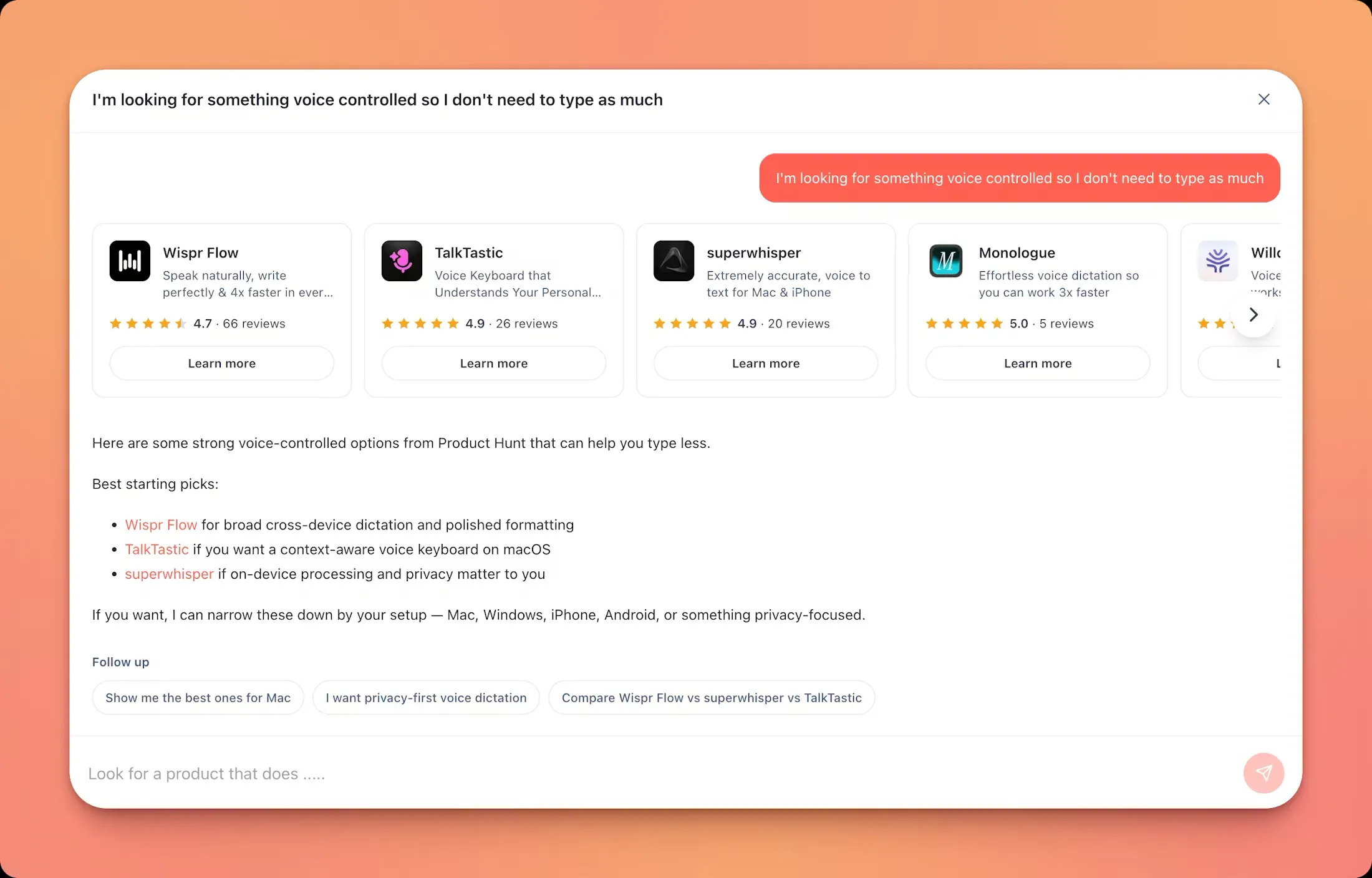
We might be a tad biased, but we think Product Hunt is great. But there was this little nagging feeling on one shoulder — we can’t remember which — saying, “There’s literally more than a million products on our platform. Wouldn’t it be nice if it were easier for people to find the exact one they’re looking for? Not just on launch day, but any day.”
So we’ve launched Ask Product Hunt AI. To find the right product, just ask.
Leaderboard highlights


Every Sunday
Everything you missed this past week on Product Hunt: Top products, spicy community discourse, key trends on the site, and long-form pieces we’ve recently published.