The Roundup
Everything you missed this past week on Product Hunt: Top products, spicy community discourse, key trends on the site, and long-form pieces we’ve recently published.

Pry yourself away from Elon's Twitter drama today and check out Eurekaa.io, especially if you’re a content creator and don’t like wasting your time.
But first... ⚡️ CAT NIPS ⚡️
- Know thyself! Dimensional uses a suite of assessments to understand your personality and those around you better.
- designstripe created an in-browser tool for beautiful mockups (no software needed).
- Lex will help you decide what to write about and remember things that can help you craft your piece.
- Clockr helps you create a plan to alleviate difficulties your family may face after you're gone.



Tbh founder Nikita Bier is back with Gas, a new social app that de-throned TikTok and BeReal. Read more below.
But first... ⚡️ CAT NIPS ⚡️
- Talking Photo lets you create portrait speaking videos that lip-sync to your own text or audio input.
- For all the Arc Browser die-hard stans, this Boost Kit offers a collection of tools to change a website's theme and inject new features by copying & pasting code snippets.
- Lyft launched Parking to help you find and reserve the best parking spots around town.
- Designers, check out this free and open-source Figma plugin that lets you rename all your layers in one click.


From Meta’s new $1,500 headset to Elon Musk’s “Burnt Hair” perfume, last week was an action-packed week. Microsoft joined the mix with its annual 3-day Ignite conference — here’s the biggest news from Day 1:
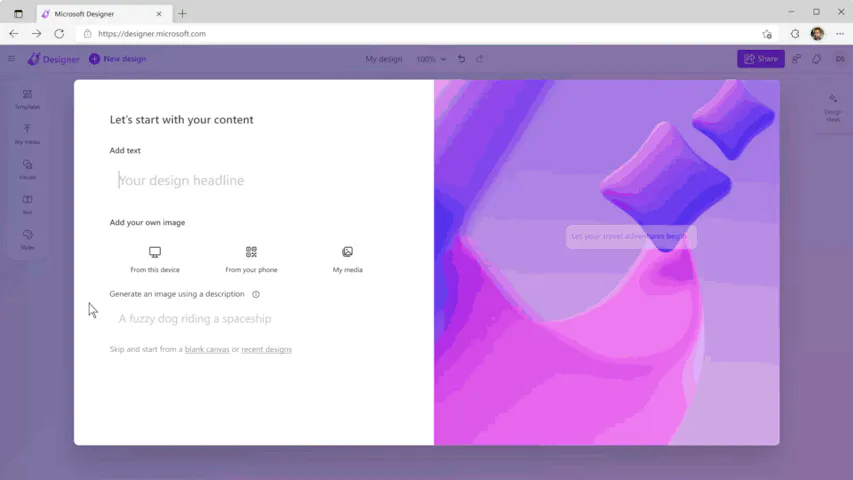
Microsoft’s committed to making OpenAI’s tech accessible with a new design app powered by DALL-E 2. Microsoft Designer is a free, AI-powered graphic design app that helps you design high quality social media posts, digital postcards, and more. Mohit Anand, a Product Manager at Microsoft, launched Designer on Product Hunt and said that its purpose is to “empower anyone to create designs with ease, using the power of AI.”
“With ‘start from scratch’ within Designer, you can simply describe an image you want to see, and the app does the work for you to create something totally unique,” said Liat Ben-Zur, Corporate Vice President, Product Marketing
Designer also uses AI to make template suggestions as you build out a presentation in PowerPoint, and the team plans to eventually integrate Designer into Microsoft Edge. We wonder how Canva users will feel about this. 👀
For lovers of both the Apple ecosystem and Xbox, Apple Music is now available on Xbox consoles. Next year, Apple Music and Apple TV will launch across Windows. iCloud is also coming to Microsoft devices — the new iCloud for Windows app will enable Apple users to see their iPhone pictures and videos on the Photos app in Windows. This is the crossover we knew we needed.
In hardware, the Surface Laptop 5, Surface Pro 9, and Surface Studio 2+ are also on the way.
But Designer’s use of DALL-E will likely go down as the show stealer this Ignite. Early adopters so far are excited and discovering the product’s capabilities, like a Send to Phone feature.
“Keen observer!” responded Mohit Anand. “You can just send your created design to your phone with a simple scan of QR code :) Hope you like it.” He also notes users can access the product “Soon!... Just add your email… and we'll let you know when you've got access. 😊”



If your NFTs have taken a nosedive, you may have given up on investing and abandoned FinTok for good.
It’s easy to become discouraged, but makers continue to create products that help individuals start investing, regardless of the negative economic outlook.
As a hybrid between online learning and crypto/NFT platforms, Continuum is one of the more unconventional ways to get started with investing. Users can complete short-form courses on topics like the basics of cryptocurrency and NFTs, and then get paid in crypto and/or NFT rewards. The Continuum team’s goal is to “democratize creative education to create new pathways to financial freedom for all through the pixelated economy.”
Real estate has been a huge topic this year as millennials are starting to purchase homes, though investing is still unreachable for many. Makers Ming Zhu and Jack Donnell picked up on this and created FundHomes to help people build wealth by investing in top-performing Airbnbs. With Fundhomes, you can purchase shares of vacation homes and get returns without the responsibilities of home ownership.
Proptee is an NFT-based real estate investing platform that lets you buy fractionalized NFTs associated with EU, USA, and UK residential and commercial real estate and earn rental rewards for it.
Bloom Stock Market Game is a simulated stock market game that lets you compete with friends by simulating investing in over 4,000 stocks.
With more than half of US households owning stock and 16% of American adults having used crypto before, it might be worth learning how to build your own portfolio.



Nowadays, practically anyone can develop a SaaS product or an app without any programming experience, and some of the biggest companies continue to roll out DIY solutions.
Two months after the launch of its no-code pricing table, Stripe added to its no-code suite with a new customer portal that lets customers manage their own billing details. Business owners can create a link to a secure, prebuilt customer portal and share it with their customers, allowing them to manage their payment details, invoices, and subscriptions.
The ability to expedite those tedious processes is key— 90% of no-code users attribute faster business growth to the usage of no-code tools and 28% of people say they use no-code tools because it’s the fastest way to get things done. According to a recent report from Gartner, it’s expected that 70% of new applications will use no-code or low-code tools by 2025, up from 20% in 2020.
So whether you’re just starting your app or adding to your no-code stack, here are a few of the latest options:
Teta is a no-code tool that allows you to build iOS and Android apps, dark-mode included. Maker Gianluca d’Ottavio says that Teta is not just for design, but is a Flutter-esque, full-stack tool with integrations like in-app purchases with PayPal, in-app subscriptions, Google Maps, and more. It’s also equipped with real-time collaboration abilities and widgets that help with interface-building.
Maker Ufuk Dag and his team wanted to make AI more accessible, so they built Cameralyze. The no-code AI builder helps makers create different types of AI apps, including face detection, face blurring, and object recognition.
WotNot is a no-code bot builder that helps businesses build bots for a variety of use cases like lead-generation automation, customer support, and appointment booking.


Ever heard the saying “friendship is not about who you’ve known the longest, but who’s shown up for you when it mattered?” Let’s apply that to your toolstack. Yes, you may feel bonded to the productivity tool you’ve used for the past 5 years, but maybe you’re missing out on something that meets more of your needs.
Check out some recent community preferences that are alternatives to popular products. 👇
Artboard Studio is like two design favorites meshed into one; Maker Mucahit Gayiran combined the Figma-eque design experience with features that resemble After Effects to help designers turn into animators. It’s cloud-based and works with vectors, images, and videos so you can design anything from Instagram Stories to stationery items.
Looking for an alternative to Typeform or Google Forms? Feathery is a low-code option that connects to over 2,000 tools and helps developers build complex forms.
Cal.com, the open-source alternative to Calendly, re-launched this month with support from investor Alexis Ohanian, and is now available for individuals. You can tailor links per scenario, automate your workflow, avoid meeting overload with buffers between meetings, and more.
Slack is a favorite amongst many for its team-building capabilities, but it’s not the only tool that can help your remote team bond together. Kosy is out of beta and helps remote teams collaborate and have fun together. Teams can build a virtual workspace and keep chats and meetings within Kosy.
If you’re shipping an app and looking for an alternative to Firebase, Appwrite launched last week. The open-source tool provides developers with authentication, databases, storage, and real time capabilities to build web and mobile applications.
Will you befriend any of these tools?



Let’s face it– many things in life are about who you know, not what you know. Unfortunately, not everyone’s a bubbly extrovert or a natural-born LinkedIn star.
Online networking isn’t a one size fits all philosophy and what works for someone else may not work for you. Maker Peter Johnston had his own gripes with the online networking space, so he created Polywork last year and the word even landed a spot in the dictionary. Now, it’s officially out of beta. ”We started Polywork because we were frustrated by the limited ways existing professional networks allow us to express ourselves (i.e. they focus on job titles and schools attended),” says Johnston.
The Polywork team wants to empower professionals to represent who they are beyond their job titles. They believe that “by empowering people to tell their story and connect with others, we might be able to make the world more productive.” The platform’s features reflect that.
On Polywork, you don’t have to rely on vanity metrics to succeed (they don’t exist). Its “highlights” feature allows you to showcase a timeline of your proudest projects and its profile setup lets you tell the world that you’re both a software engineer and a bookworm. It also caters to the professionals that haven’t found any luck with existing tools and helps them explore more than just full time opportunities. If you’re only looking for a founder to speak on your podcast or you just need mentoring, Polywork could help.
With 28% of job seekers reporting that the job search has negatively impacted their mental health, having new players in the space doesn’t feel like a bad idea. 🤷♀️


This year has been particularly interesting for folks interested in AI, especially when it comes to image generators. After OpenAI’s release of DALL-E 2 a few months ago, we’ve continued to see similar products spring up.
The latest one making the rounds on Twitter is Stable Diffusion, an image-generating AI from the DreamStudio team. What makes Stable Diffusion different is the fact that it’s open-source. That alone has brought up a lot of concerns as to how the tool could be used in harmful ways. But something that’s been even more controversial is how these types of AI tools might abolish creative jobs and stock image websites.
An interesting article from Washington Post tells the story of how maker Jason Allen, who runs a tabletop fantasy games company, submitted an artwork generated by Midjourney (another AI tool) and won a fine-arts competition. It’s hard to tell how this will play out in the long run and whether technology like DALL-E and Stable Diffusion will completely remove the need for creative jobs or will simply be used as a tool to enhance creativity.
Expert opinions seem to lean towards the former case. Back in April, Sam Altman, OpenAI’s CEO, shared his thoughts on the matter: “Although I firmly believe AI will create lots of new jobs, and make many existing jobs much better by doing the boring bits well, I think it’s important to be honest that it’s increasingly going to make some jobs not very relevant (like technology frequently does).”
Safety concerns around the ethics of AI could be what delays the process though. And just like ATMs replaced bank tellers, change is inevitable as technology advances.
Which camp are you in?


As much as we love fully-fledged, complex productivity apps that basically let you optimize your entire life, there’s something about simple, yet powerful browser extensions. They’re lightweight and usually don’t require you to do much, except for a few clicks – a true and tried “less is more” approach.
We’ve been watching the space closely and noting down interesting ones we’ve seen launch recently. Here are some that might make you want to go “Add to Chrome” (or whatever browser you’re using – we won’t judge, now that Internet Explorer’s dead).
AdGuard MV3 is “the first ad-blocker” built on top of Chrome’s Manifest V3. It lets you block ads, trackers, and social widgets, as well as self-defined web components and domains.
AI2sql uses AI to generate SQL queries from natural language input.
Depths is a bookmark manager for developers. The extension lets you tag all your saved resources and calculate an estimated read time, with full-text search enabled.
CSS Scan 3.0 helps you check the CSS of any element you hover over and copy its entire rules with a single click.
Slashy adds custom command functionality to Notion. It comes pre-packaged with plugins to make drawings within Notion and record your video and audio, and it gives you the ability to create your own simple commands or advanced plugins with its SDK.
Iago helps you learn new languages by overlaying subtitles on streaming websites like Netflix, Disney+, and Youtube, in both your native and target learning language.



The cool thing about the Internet is that it’s infinitely scalable. SaaS is one business model we’ve seen skyrocket in recent years. With a global market value of over $170B, the SaaS space has increased in size by around 500% over the past seven years. Not surprising, as 80% of businesses use at least one SaaS application.
Here’s a rundown of recently launched SaaS tools we think you might want to know about.
Zeda.io has been designed to help product teams collect feedback, define goals and initiatives, plan roadmaps, and write clearly-defined specs for developer and design teams to execute.
UpLink lets accountants, auditors, and lawyers request hundreds or thousands of documents from others. This removes the need for the back and forth with the client, which is usually done over email while keeping track of status in Excel.
Snackeet allows you to integrate Instagram-like stories to your website, so you can boost engagement rates, sell products, get feedback from customers, and get more leads for your business.
Changelogs & Idea Management by Ignition helps you collect and organize feature requests and prioritize your roadmap. You can use it to then announce new features via custom branded changelogs.
Kinde provides founders with the infrastructure for authentication, user management, feature flags, and billing. Kinde uses an API or SDK to integrate with your product.
Creabl is a user-behavior analytics tool that lets you know who your customers are and why they convert, monitor mouse trails and clicks, group users in specific segments, and track retention.


