Curious how this community thinks about trust/verification problems in general not just in my space (forex), but anywhere someone claims a track record (traders, freelancers, agencies, etc.).
I've been building in the forex space, where the standard "proof" is literally a screenshot of a trading account easy to fake, easy to cherry-pick, no way to independently verify. It made me think about how many other industries still run on unverifiable claims by default, and how few platforms actually build verification into the product rather than bolting it on as an afterthought (or not doing it at all).
Honestly, no. Not fully, especially if you've barely gone past "Hello World." Even with AI, one tiny bug can eat your whole afternoon, and a feature that sounds simple can take a week when you don't really know what you're looking at. You also need real exposure to how these coding agents actually work, or you'll burn through money fixing the same mistake five different ways before you figure out why.
AI closes the gap. It doesn't remove it.
What's your experience been like? Did it get easier once something clicked, or is it still a grind?
The Agent is good, if you want to build something insanely basic. Like an EdTech landing page, or an one pager for validating an idea.
For anything else, which is probably what everyone needs is super buggy. I tried to build an AI Agent that manages private keys and signs transactions for users. Replit for some reason created an app with the following things 1. Page to login/register
2. Page to generate my Keys
3. An OpenAI integration where I ask where should I store my keys and gives me an answer LOLOLOL . AI Replacing developers? NOT THERE YET.
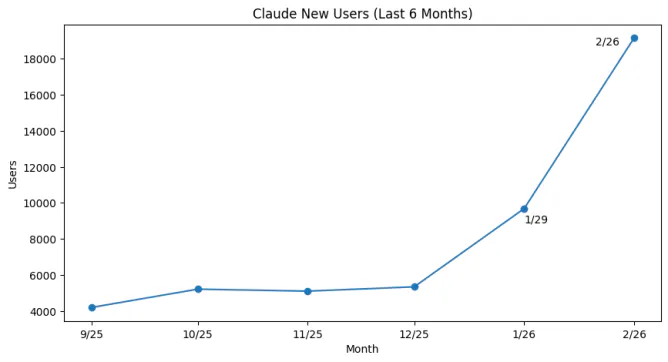
Claude's paid subscriptions have more than doubled this year. New users hit record numbers between January and February. Previous users came back in record numbers too.
I'm trying to reach out to startup people or influencers to do interviews or surveys to find out the feasibility of my product, but I'm getting a very low response rate.
I have a genuine question for builders and product managers here about the necessity of native iOS/Android apps for simple utility tools.
Years ago, if you wanted to build a smooth, high-performance tool like a video compressor, photo editor, or drawing board you had no choice but to build a native mobile app. Web apps were simply too slow and lacked access to heavy device processing.
But with WebAssembly (WASM), WebGPU, and modern browser engines, we can compile heavy native libraries and run them directly in the browser at near-native speeds.
I build faster now with AI than I ever could by hand. Things that used to take me a weekend now just take a prompt, and a lot of that is stuff I genuinely couldn't have written cleanly myself.
So part of me looks at non-technical founders asking whether they should learn to code and thinks the honest answer might be no, or at least not the way I did it. Spending six months grinding through tutorials to write code an AI will write better feels like a waste of time.
I've been scanning startup marketing sites lately (it's part of how I do outreach for my agency) and one defect keeps showing up: a page gets renamed or a route changes, nobody sets up a 301, and the sitemap keeps pointing at a URL that no longer exists.
It's invisible from inside the company. The site looks fine, every link in the nav works, and meanwhile search engines and old backlinks are quietly hitting 404s.
The fix is usually a one-line redirect. What makes it interesting to me is why it happens: renames feel like refactors, so nobody treats them as breaking changes for the outside world.
If you've ever audited someone else's site, or had yours audited, what turned up that nobody inside had noticed?
I ship a small reminder product with an MCP server, so AI agents can create reminders on a user's behalf. Two things I learned this week that I did not expect, and I would like to hear yours.
1. The description is the behaviour. My create tool said to lead with a phone call because it is the channel that gets attention. So every reminder the test agent created started with a call, even "email me the invoice on Friday". Calls are also the most expensive channel. I rewrote the description to say the chain is the user's choice, one step or several, any channel, any order, and not to add steps the user did not ask for. The next request behaved. No code changed, only words.
2. A destructive tool needs a safer sibling, and the description has to name it. My cancel deletes the reminder and its history. Pause keeps everything. Once the cancel description said in capitals that it is irreversible and that the agent should pause unless the user clearly said delete, the agent started pausing on anything ambiguous and asking first.
Both felt like prompt engineering, but they are product decisions about cost and reversibility, made in a text field most users never see.