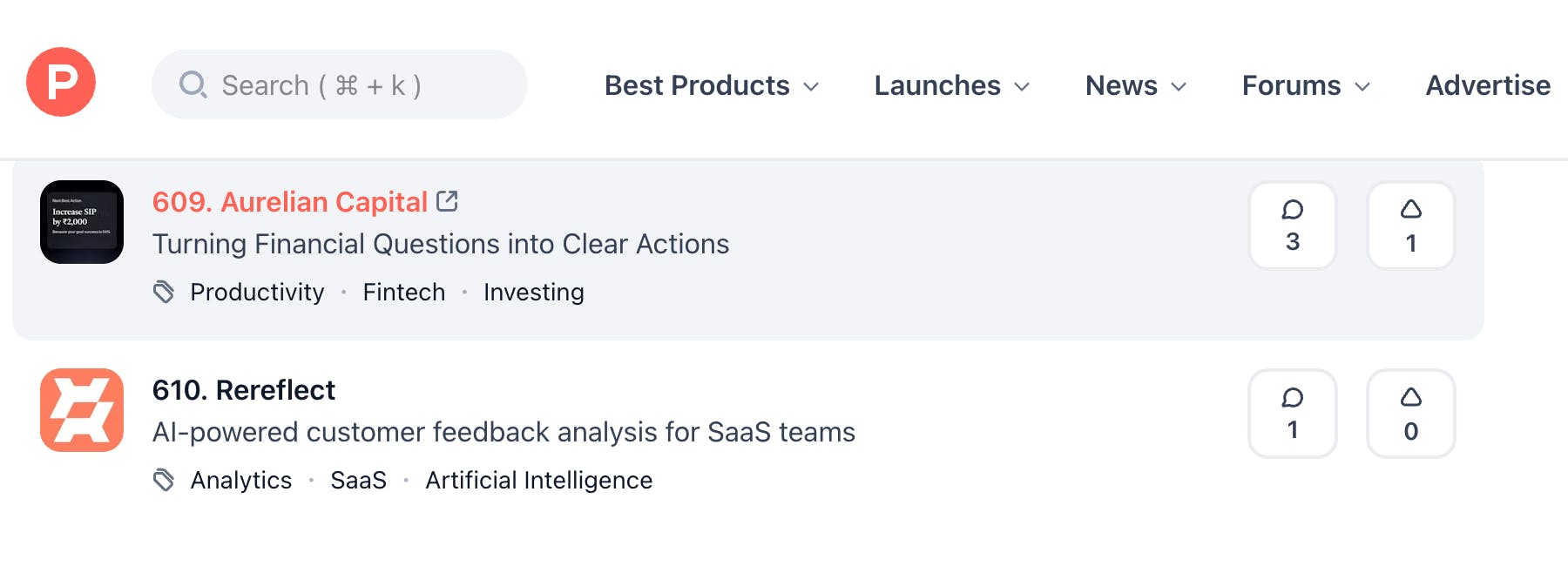
As a measure of the impact of vibe coding and the need to focus on positioning, narrative, and marketing and distribution, I noticed that that 610 products were submitted to the Product Hunt leaderboard today, but only 16 were featured which is less than 3%.
The previous high was just over 500 products in December.
A signup tells us someone was interested, but it doesn't tell us whether they reached the part of the product that helps them. A user might leave because they got confused, or simply because the product wasn't right for them.
I think a short conversation with someone who didn't finish onboarding could reveal more than a funnel number alone. But it can be hard to get a reply from someone who has already left.
How have you found the point where new users get stuck? What did you change after finding it?
When we started building our SaaS, I wanted to make sure we did everything "right." I read all the tech blogs, looked at how big companies like Netflix and Uber built their stacks, and convinced my co-founder that we needed a highly scalable, event-driven microservices architecture hosted on Kubernetes.
It took us 8 weeks just to get the infrastructure running. We spent weeks configuring Docker containers, setting up API gateways, and writing Terraform scripts. I felt like a genius. We were ready to handle millions of users on day one.
Fast forward six months. We currently have 20 active users, and our infrastructure costs are bleeding us dry. We are paying AWS $450/month for a product that generates $150/month in revenue. Even worse, every time we want to push a simple update (like changing the text on the landing page), it takes three days of wrestling with CI/CD pipelines.
Last week, I finally snapped. I spun up a monolithic app on a single $12/month server, migrated the core logic in two days, and we are shutting down the Kubernetes cluster. The new setup is blazing fast, and I can deploy updates in 30 seconds.
Online, we re constantly exposed to different takes and opinions, which can easily shape unrealistic or skewed expectations about what actually works in practice.
And it s not just life in general; it happens a lot in business too.
We often see launch posts, milestones, and success stories. What we don t see as much are honest breakdowns of products that quietly stalled or failed.
I feel there s a lot of learning hidden there about timing, assumptions, and trade-offs.