


Rethinking AI-Assisted Writing - The Editor as Shared Workspace

Introduction: The Interaction Design Problem
The rise of large language models has fundamentally altered how we approach writing. Yet, the dominant interaction paradigm—conversational interfaces like ChatGPT—presents a curious misalignment with the actual task of writing. When we examine the cognitive workflow of text creation and revision, we find that chat-based AI assistance introduces significant friction at precisely the moments when fluency matters most.
This article proposes a radical rethinking of AI writing assistance: moving from conversation to collaboration, from chat boxes to shared editing spaces, and ultimately, from AI as an external service to AI as an integrated co-pilot within the writing environment itself.
The Inefficiency of Conversational Writing Interfaces
Consider the typical workflow when using ChatGPT or similar chat-based tools for writing:
Generate initial text in the chat interface
Identify areas requiring revision
Copy the problematic section
Construct a natural language description of the desired changes
Wait for the AI to regenerate the text
Evaluate the result and repeat as necessary
This process reveals a fundamental inefficiency: spatial and contextual fragmentation. The writer must constantly translate between two distinct interaction spaces—the chat interface where AI operates and the editor where writing actually occurs. More critically, they must verbalize spatial intentions ("change the third paragraph") and contextual modifications ("make this less formal") through the inherently sequential medium of conversation.
The cognitive overhead compounds with each revision. Multiple changes require multiple conversational turns, each demanding careful linguistic specification of location, scope, and intent. The writer becomes a translator, converting their editorial intuitions into natural language instructions that the AI can parse.
The Notion Paradigm: Contextual AI Within the Editor
Tools like Notion represent a significant advancement in interaction design. By embedding AI capabilities directly within the editor, they eliminate the spatial fragmentation problem. The workflow becomes:
Select text requiring modification
Invoke AI through context menus or slash commands
Choose from preset operations (polish, expand, change tone)
Review and accept changes in place
This approach succeeds by collapsing the distance between intent and action. The editor becomes both the workspace and the interface for AI interaction. Spatial references ("this paragraph") are implicit in selection, eliminating the need for verbal location specification.
However, even this paradigm retains friction. Each AI invocation requires multiple steps: text selection, menu navigation, option selection. For frequent AI collaboration, these micro-interactions accumulate into meaningful overhead.
A New Paradigm: The Cursor as AI Invocation Point
What if we eliminate even these remaining steps? What if AI assistance were not a tool you invoke, but a presence you address?
Consider this interaction model:
The AI assistant exists at your cursor position, continuously ready for instruction. Your current line becomes the command interface. Prefix any line with @AI and what follows is immediately interpreted as a prompt, executed in context, with results appearing inline.
This design philosophy rests on several key principles:
1. Minimal Mode Switching
Traditional interfaces require switching between "writing mode" and "AI invocation mode." The @AI prefix creates a lightweight, in-line signaling mechanism. The writer never leaves the text itself; they simply address a different collaborator.
2. Spatial Immediacy
The AI operates at the cursor position—the precise point of the writer's attention. Results appear exactly where the writer is working, eliminating visual scanning and context reconstruction.
3. Natural Handoff Metaphor
The @AI prefix parallels natural collaboration patterns. Just as one might say "John, could you..." in a collaborative writing session, @AI creates a clear handoff moment. The writer retains control of the "steering wheel" but can transfer it instantly when needed.
4. Preserving Context
Because all interaction occurs within the document itself, the AI maintains full contextual awareness of surrounding text. The writer doesn't need to explain "what paragraph" or "what section"—the cursor position provides unambiguous context.
The Editor as Shared Collaborative Space
This interaction model fundamentally reframes the relationship between writer and AI. Rather than being a separate service consulted through conversation, the AI becomes a co-occupant of the writing space. The editor transforms from a personal workspace into a shared collaborative environment.
This shift has profound implications:
Cognitive fluency increases because the writer never leaves their primary task context. There's no mental model switching between "talking to AI" and "writing text."
Iteration speed improves because feedback loops tighten. Generate, evaluate, revise—all within the same visual and interaction space.
Control remains with the writer because the AI operates only on explicit invocation. Unlike autocomplete or predictive text, which constantly interject suggestions, the @AI model respects the writer's agency.
Experience and Validation
We implemented this interaction paradigm in FunBlocks AI Markdown Editor, and the results have been remarkable. Writers report a qualitative shift in how they perceive AI assistance—not as a tool they use, but as a collaborator they work alongside.
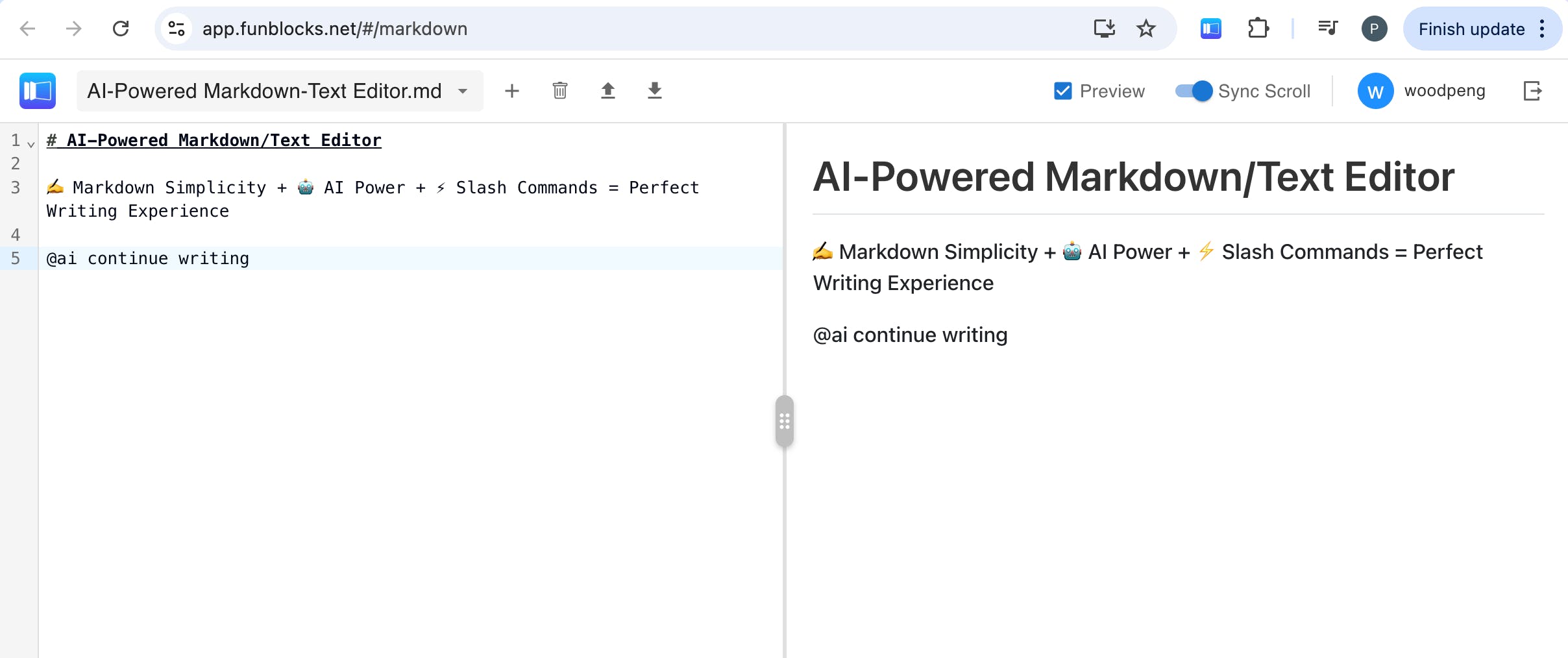
Type '@ai' to assign task to AI assistant:
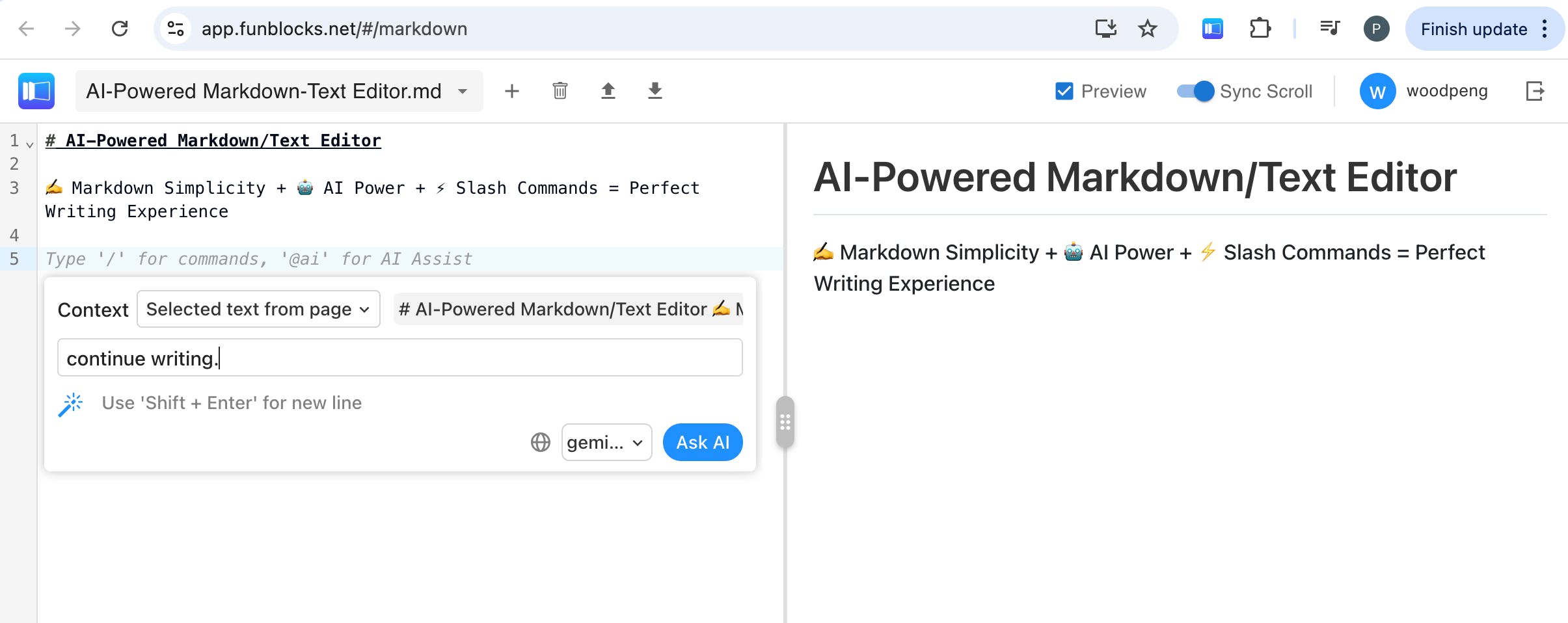
Press 'Enter', and the task was transferred to the AI assistant:
The key insight: reducing interaction friction by even small amounts creates disproportionately large improvements in cognitive flow. When AI invocation becomes nearly effortless, writers find themselves collaborating more frequently, more experimentally, and more effectively.
Conclusion: Beyond Chat Boxes
The conversational AI interface served us well as an introduction to language model capabilities. But as these tools mature and become integral to knowledge work, we must rethink the interaction paradigms we've inherited from chatbots and virtual assistants.
Writing is not conversation. It is spatial, iterative, and context-rich. Our AI writing tools should reflect these realities. By embedding AI directly within the editor—not just as a feature, but as a collaborator sharing the same workspace—we can create interfaces that amplify rather than interrupt the creative process.
The future of AI-assisted writing is not better chat boxes. It's making the chat box disappear entirely.
Replies
Hello @peng_wood, and thank you for this development, which really speaks to me. It is entirely consistent with my experience as a copywriter using your tool.
I should point out that I was led to test and then adopt your application because it offered this mind mapping function combined with content production. I am a specialist at Mind Mapping Décision (France) in the use of cartography and mind mapping systems, including those for content. I am also a trainer on these subjects.
My choice is a unique and subtle (and adjustable) balance of granularity and iteration with context control. That is exactly what I appreciate about your tool.
This is the opposite of producing a supposedly exhaustive and robust mind map, generated in 3 seconds without any target context.
I really like this idea of editorial intuition, which is the real energy and future value of the writer's deliverable.
These consistent ideas that come from afar and need to be nurtured in order to shine. Even if I'm doing marketing, educational content, or writing a short story.
An AI that resembles a dual, discreet and sensitive relationship leaves plenty of room for learning. This is very different from 99% of LLM usage to date.
Thank you for this promising development and your insights into what these support systems should be.
FunBlocks AIFlow
@denys_levassort Thank you, Denys Levassort, for your kind words and appreciation for FunBlocks AI! We are thrilled to hear that our development resonates so well with your experience as a copywriter and your expertise in Mind Mapping Décision.
Your feedback perfectly encapsulates the core philosophy behind FunBlocks AI: to empower users by assisting them in thinking and working more effectively, rather than replacing human thought. We wholeheartedly agree that in the age of AI, the ability to think critically and creatively is more crucial than ever.
It's particularly gratifying to hear that you value the "unique and subtle (and adjustable) balance of granularity and iteration with context control" – this is precisely what we strive for. We believe in giving users more agency and control in the product's design, rather than allowing complete reliance on the LLM.
Your insight into "editorial intuition" as the true energy and future value of a writer's deliverable, and the concept of an AI that fosters a "dual, discreet and sensitive relationship," truly resonates with our vision. It highlights the significant differentiation we aim for compared to the vast majority of LLM usage today.
Thank you again for your valuable insights and for recognizing the promising direction we are taking with these support systems.
@peng_wood , we'll stay in touch, and I note that this vision is often shared with design and UX profiles, as here: https://uxdesign.cc/fear-of-missing-out-on-ai-is-overshadowing-the-fear-of-losing-our-humanity-d628aacfb950. See you soon. I read your work with interest, and well beyond the mere publisher-customer relationship (very satisfied!).
FunBlocks AIFlow
@denys_levassort Yes, here I'd like to share the design philosophy and logic behind our product.