


To hard paywall or not — that is the question!

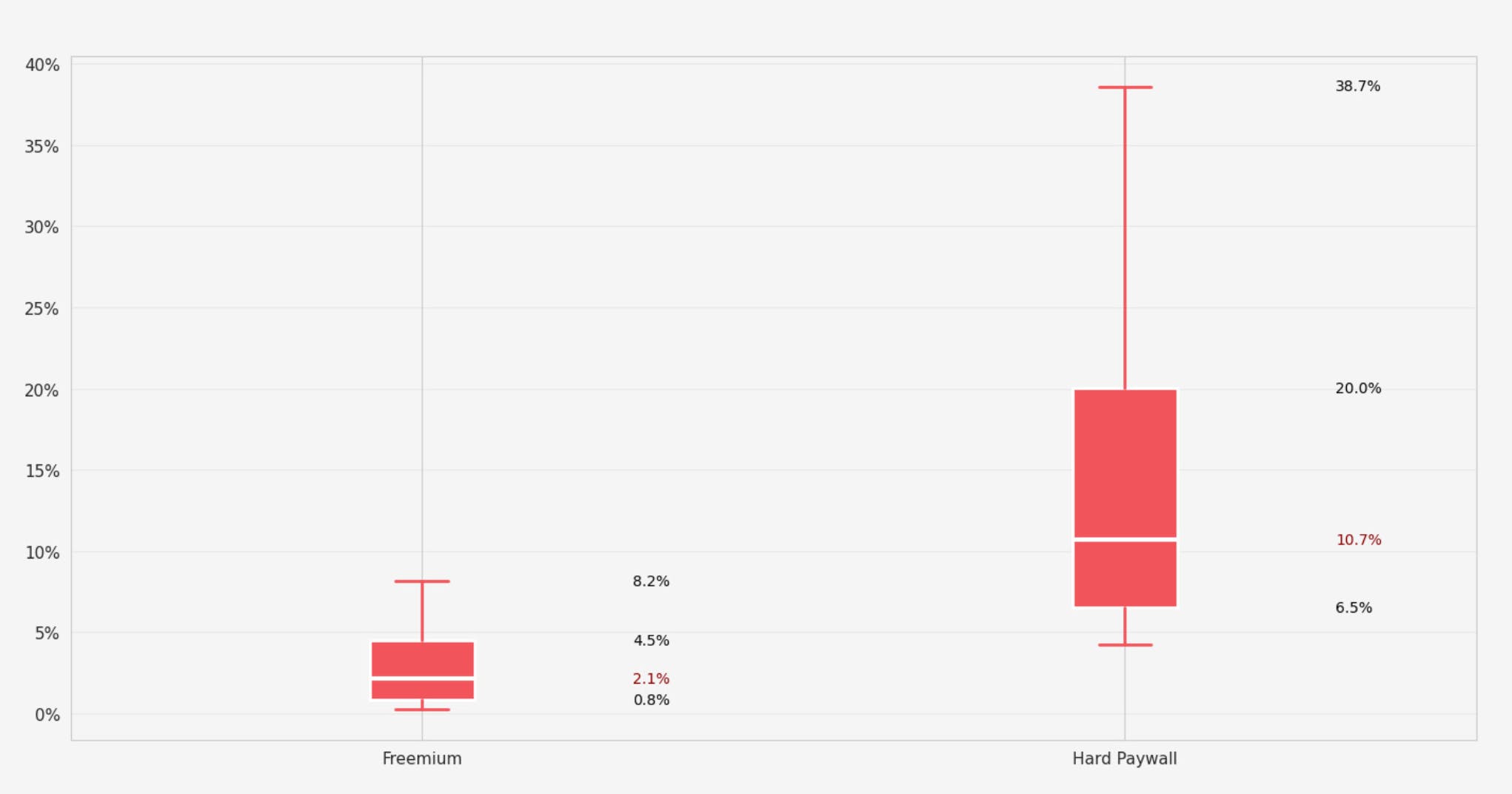
According to @RevenueCat 's State of Subscription Apps 2026 report, "hard paywalls convert 5x better than freemium, but with significantly wider variance."
Day 35 download-to-paid, freemium vs. hard paywall
Does access method impact download-to-paid conversion within 35 days?
Quoting the report:
Median D35 conversion sits at 10.7% for hard paywalls. Freemium is 2.1%.
That gap alone should make you pause.
But the more revealing part is the distribution. Hard paywall top decile apps approach 40% conversion. That’s insane. Even the lower end performs at roughly double the freemium median.
Behaviour isn’t changing — it remains heavily front-loaded (it’s the same story every year, and people still don’t believe it).
Around 50% of paid conversions happen on Day 0. Trial starts overwhelmingly happen on Day 0. Cancellations cluster there too, especially on short trials, where over half occur within hours.
Onboarding is faaaar more important than most teams treat it. The first few minutes need to build trust, interrupt default behaviour, and show value quickly. If a paywall appears before context is established, it feels jarring. When onboarding builds momentum first, conversion looks very different.
Across trial lengths, access models, categories, and regions, the pattern holds: structural choices set the ceiling early.
If you want to make money in 2026, start with Day 0.
I've been coaching founders who launch on Product Hunt to relax their hard paywalls in service of a more effective launch.
As I understand it, being featured in the leaderboard requires offering a product that people can use right away, because why would someone upvote a product if they can't try it?
I presume that a hard paywall isn't disqualifying, but my sense is that it might hurt leaderboard performance.
What's your take, and what would you recommend to someone launching on Product Hunt?
Replies
Okan
The data on Day 0 hard paywall conversions is undeniable, but a Product Hunt launch completely flips that logic on its head. If the community hits a strict paywall before experiencing the core value proposition, they usually just bounce and withhold their upvote. I always recommend building a temporary bypass, like a generous free trial or a completely unlocked onboarding flow, specifically for launch day. Once the initial traffic spike settles, you can safely revert to the hard paywall to maximize your long-term revenue without sacrificing that crucial leaderboard momentum.
Raycast
@y_taka absolutely my advice as well.
Very good insights! My app (DopaLoop) has a trial period of 14 days so a user can build up their data and a routine and get first benefits. Paywall on Day 0 seems counter-intuitive as a user might not have seen any value yet (most probably).
Product Hunt
Is this correlation or causation?
Are products that can get away with hard paywalls simply ... more compelling? More compelling -> higher conversion is more believable than hard paywall -> higher conversion.
Raycast
@andrew_g_stewart actually, there was a useful discussion on this episode:
The “hard paywalls convert ~5x better than freemium” stat (10.7% vs 2.1% download→paid by day 35) is very plausibly true as a correlation in RevenueCat’s dataset, but it’s easy to over-read it as causal (i.e. “if I flip a switch to hard paywall, I’ll 5x my conversion”).
Here’s how to think about it:
What the correlation actually says
Across the population of apps they analyzed, apps classified as hard paywall tended to show much higher early paid conversion than apps classified as freemium. That’s an observational comparison, not a randomized experiment.
So the safe claim is: hard-paywall apps are different from freemium apps in ways that are associated with higher paid conversion. The paywall type may be one of those differences, but not necessarily the only or primary driver.
Why this might be causal (mechanisms that make sense)
There are straightforward reasons a hard paywall can cause higher “download→paid” conversion:
Forces the decision at peak intent. Users are most motivated right after install/onboarding. Hard paywalls capitalize on that moment; freemium defers monetization until later (and many users never come back).
Reduces “tourist” usage. Freemium lets people poke around, satisfy curiosity, then churn without paying. A hard paywall filters for buyers.
Simplifies the funnel. A single clear “pay to proceed” step often outperforms complex upgrade paths, especially for products with immediate value.
UXDesigner.top
I totally agree with you. If I’m not mistaken, the vast majority of RevenueCat’s customers are smartphone apps, where the context, format, and usage patterns are completely different from web products, especially the ones used on desktop.
That said, I’d guess most Product Hunt traffic comes from desktop, so I don’t think that data is especially useful for making launch decisions on PH. I’m actually planning to launch a tool for PMs and designers soon, built specifically for desktop use, and I’m pretty sure I’ll go with either a free plan or a trial.
Raycast
@david_martin_suarez yes, you're right — but I do wonder if a similar trend will migrate to desktop/web...
UXDesigner.top
@chrismessina I’m not sure about that. In mobile, the context and urgency are usually different from those in a desktop environment. I believe that the same user has a different approach to digital products when using a mobile device compared to a desktop device
Product Hunt
This is a really good convo to have. I'd be curious to see which products are succeeding with the hard paywall and whether certain categories benefit more than others. There's a lot of good data in the report, I'm excited to dig in.
My hunch here is that if the product is very clear on what the user can expect upon using their app then it makes a paywall easier to digest. This is also true for ProductHunt.
A lot of times, products with a strong paywall/paygate that launch on ProductHunt can have difficulty getting featured if the value, uniqueness, end result, and/or user experience isn't clear.
Understanding what a product experience will be like before purchase is imperative. If it's not clear to someone who looks at products all day, then I'd be willing to wager that it might not be for their ideal customer either.
Using clear product demos, having a detailed landing page, and passing the "mom test" are great ways to keep your pricing strategy while ensuring you have a successful product launch.
Raycast
@gabe 100% in agreement. Product Hunt sets different expectations for access and use; being out there on the internet means you may have lots of referral sources, and a heterogeneous set of people willing to pay (or not).
In my experience, if I see something on the leaderboard, I expect to be able to try and use it.
If I can't (i.e. there's a hard paywall) I'll bounce and never look back.
When we first launched in November 2025, we tried a hard paywall, and it failed miserably :)
Since then, we've moved to a much more flexible model. Some features are free, others unlock later, and we're still experimenting to find the right balance.
I don’t think we’ll go back to a hard paywall, even though many competitors in the space still use it.
Raycast
@alexeyglukharev which space are you in? Who are your competitors?
@chrismessina OceanMind. It’s a health and wellness app. Right now, we’re focusing on personalized practices to help reduce anxiety and promote calm.
Competitors include Headspace, Open, Insight Timer, and Calm.
Vozo AI — Video localization
We’ve found that removing the “try barrier” is really important. We offers both a free trial and sample outputs that users can experiment with before paying.
With tools like video translation that we provide, people usually want to see the actual result quality first. Giving them something to play with helps them understand the value much faster.
Spot on. I’m currently running a Soft Paywall for Minddraft.app for the same reason—I want users to feel the value of the AI validation before they pay.
The catch? It makes marketing feel like an uphill battle. Since we aren't 'forcing' the conversion, we need way more eyes on the product to see results. Marketing is definitely the hardest nut to crack here. Has anyone here managed to scale top-of-funnel traffic without breaking the bank on a soft paywall?
The data makes sense but I think it depends entirely on what kind of product you're building.
If your product delivers value in a single session (a tool, a converter, a generator) then a hard paywall with a trial can work. If your product is something people need to live with for a few days before it clicks, a hard paywall kills you before you ever get the chance to prove value. The user bounces on Day 0 and you never find out if they would have converted on Day 7.
For PH launches specifically, I think free access is almost non-negotiable. The community wants to try things. If they click through and hit a paywall before they can touch the product, I think you could lose the upvote and the comment.
the revenueCat data is interesting but kind of misleading for AI products specifically. when your COGS are basically zero (traditional saas), freemium makes sense because serving free users costs almost nothing. but if every API call costs you real money in inference, a generous free tier can bankrupt you before you find PMF.
i run AI tools where a single heavy user on a free plan can cost me $40-50/mo in compute. learned the hard way that usage caps matter more than the paywall question itself. the real move for AI products is probably a hybrid: let people see output quality for free (cached samples, limited generations) but gate actual usage. that way you get the conversion benefits of "try before you buy" without bleeding money on power users who never intend to pay.
for PH launches specifically i think a 7 day trial with no credit card beats both hard paywall and full freemium. people can try it, upvote honestly, and you dont lose your shirt.
Raycast
@umairnadeem very salient point — traditional SAAS without AI costs is a completely different calculation!