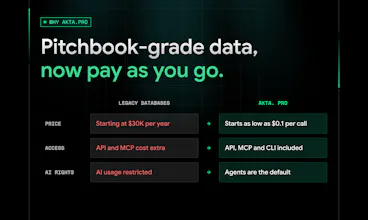
Private company data with 4x the depth and 2x the coverage of PitchBook, plus 100+ event signals and news across companies, industries, and topics. Source and diligence deals or make outreach lists and trigger outbound. Built for financial services and GTM teams, pay-as-you-go.
@nuseir_yassin1 for such instances we rely on alternative data such as social media, blogs, podcasts etc. if there is limited information the company itself. We leverage a smart validation logic - if company has very limited public data, not all parameters are populated - only the one's which can be backed by sufficient data are populated while others are left out. Prioritizing accuracy and fidelity yet retaining good fill rates.
Report
How granular are the sentiment and impact scores? Can developers access the underlying scoring fields through the API??
@zerotox Adding to Sid's point, Both come back as continuous 0–1 floats in the raw response, not bucketed labels, so you set your own thresholds instead of inheriting ours. Impact and sentiment are scored separately — a layoff is high-impact and negative, a small partnership low-impact and positive — so they're pulled apart rather than collapsed into one good/bad number. Story centrality is a third field: whether the company is the subject or just mentioned, which is usually what you actually want to filter triggers on. All exposed, all filterable at query.
Report
How do you keep the event signals fresh, especially when a company has very little public information?
@lucyjane great question. Besides leveraging alternative data from social feeds (x, LinkedIn, Youtube, blogs etc.) to supplement news / press coverage, we go beyond to find relevant event signals. We tier event signals into primary, secondary, and indirect. While there may be little coverage where the company in question is the primary subject, often times the company may be mentioned alongside other companies, although not the main subject of that signal (secondary). Further, there are indirect event signals based on broader industry (e.g., regulations, m&a) or competitors (layoffs, c-suite hiring, bankruptsy, launch, price drop) that have implications on the company being tracked.
Report
Cool. Can you set up notifications when a specific signal is triggered? And can you create custom signals?
@natalia_iankovych Custom signals, yes. Filtering happens at the query rather than from a preset list of alert types, so you define what counts as a signal. Filter across a 70+ category news taxonomy, plus IAB and IPTC codes, scoped to whatever set of companies you're tracking. So a watchlist filtered to funding and leadership changes, and a separate one for competitors filtered to product launches, are just two queries against the same endpoint.
On notifications, webhooks for signal alerts are on the roadmap. Until then you poll the news API on whatever frequency suits you, and credits are only charged on news actually returned, so empty polls cost nothing and you can run a tight loop without paying for quiet periods.
Report
@saswat_nanda2 I have a slightly different use case: I have several thousand potential clients and around 10 signals that should trigger me to reach out to them with an offer. I need to track these signals daily/weekly and receive an email notification when one of them appears. Is something like this possible?
@natalia_iankovych Yes, this is exactly what the webhooks I referred above can solve. You define a set of companies, the signals you care about, and a frequency, then get a webhook plus email notification when any of them fires. Several thousand companies against 10 signal types is well within what it's built for.
Until that ships, a scheduled poll on the news API gets you the same outcome. The filtering and company scoping is already there, and credits are only charged on news actually returned, so a daily run over a quiet list costs almost nothing.
For the email step, n8n or Zapier will do it without any code, both can run the API call on a schedule and route hits into an email.
Happy to chat over a quick call. Also, will give you a heads-up once webhooks are live.
@tmaleh_ Fair question, and and the short answer is you can see what it was drawn from.
Moat isn't returned as a single verdict. competitive_moat comes back as an array of typed entries, each tagged to a category, distribution advantage, switching costs, network effects, cost advantage, ecosystem lock-in, data advantage, with the specific reasoning attached to each. So you can see which dimensions are actually carrying the call and which are thin.
It also sits inside a broader company_assessment section, alongside strengths, weaknesses, key risks and key highlights. Those are fully source-traced, each entry carrying links to what it was drawn from, and the moat read is the analysis layered on that same evidence base. So the reasoning is inspectable by looking at what it was built from.
We built source traceability into the architecture itself. Any output meant for diligence has to be something you can audit back to what produced it.
@roopreddy Thanks Roop. That was the intent,. We wanted the choice of surface to be about how you work rather than a tradeoff, so API, MCP and CLI all return the same shapes.
@priyankamandal Thank you! Coverage was the part we spent the longest on, since a private markets API is only as useful as the tail it reaches.
Worth adding that the 20M+ isn't a fixed ceiling either. If you hit a company that isn't in the database yet, there's a company addition endpoint that takes the submission and builds the profile. It's free and asynchronous, so you fire the request and either poll the status endpoint or take a webhook when it lands.
Practically that means a miss on an obscure company becomes a short wait rather than a dead end.




Nas.com
How do you handle companies with very limited public information?
akta.pro
@nuseir_yassin1 for such instances we rely on alternative data such as social media, blogs, podcasts etc. if there is limited information the company itself. We leverage a smart validation logic - if company has very limited public data, not all parameters are populated - only the one's which can be backed by sufficient data are populated while others are left out. Prioritizing accuracy and fidelity yet retaining good fill rates.
How granular are the sentiment and impact scores? Can developers access the underlying scoring fields through the API??
akta.pro
@zerotox yes, numeric scores on a scale of 0 to 1. Raw scores are available in the api response for developers to use.
akta.pro
@zerotox Adding to Sid's point, Both come back as continuous 0–1 floats in the raw response, not bucketed labels, so you set your own thresholds instead of inheriting ours. Impact and sentiment are scored separately — a layoff is high-impact and negative, a small partnership low-impact and positive — so they're pulled apart rather than collapsed into one good/bad number. Story centrality is a third field: whether the company is the subject or just mentioned, which is usually what you actually want to filter triggers on. All exposed, all filterable at query.
How do you keep the event signals fresh, especially when a company has very little public information?
akta.pro
@lucyjane great question. Besides leveraging alternative data from social feeds (x, LinkedIn, Youtube, blogs etc.) to supplement news / press coverage, we go beyond to find relevant event signals. We tier event signals into primary, secondary, and indirect. While there may be little coverage where the company in question is the primary subject, often times the company may be mentioned alongside other companies, although not the main subject of that signal (secondary). Further, there are indirect event signals based on broader industry (e.g., regulations, m&a) or competitors (layoffs, c-suite hiring, bankruptsy, launch, price drop) that have implications on the company being tracked.
Cool. Can you set up notifications when a specific signal is triggered? And can you create custom signals?
akta.pro
@natalia_iankovych Custom signals, yes. Filtering happens at the query rather than from a preset list of alert types, so you define what counts as a signal. Filter across a 70+ category news taxonomy, plus IAB and IPTC codes, scoped to whatever set of companies you're tracking. So a watchlist filtered to funding and leadership changes, and a separate one for competitors filtered to product launches, are just two queries against the same endpoint.
On notifications, webhooks for signal alerts are on the roadmap. Until then you poll the news API on whatever frequency suits you, and credits are only charged on news actually returned, so empty polls cost nothing and you can run a tight loop without paying for quiet periods.
@saswat_nanda2 I have a slightly different use case: I have several thousand potential clients and around 10 signals that should trigger me to reach out to them with an offer. I need to track these signals daily/weekly and receive an email notification when one of them appears. Is something like this possible?
akta.pro
@natalia_iankovych Yes, this is exactly what the webhooks I referred above can solve. You define a set of companies, the signals you care about, and a frequency, then get a webhook plus email notification when any of them fires. Several thousand companies against 10 signal types is well within what it's built for.
Until that ships, a scheduled poll on the news API gets you the same outcome. The filtering and company scoping is already there, and credits are only charged on news actually returned, so a daily run over a quiet list costs almost nothing.
For the email step, n8n or Zapier will do it without any code, both can run the API call on a schedule and route hits into an email.
Happy to chat over a quick call. Also, will give you a heads-up once webhooks are live.
1752vc Pitch Deck Analyzer
This is great. Congrats, Siddhant and team.
Since those are synthesized rather than reported data, would I be able to see what a given moat call was drawn from, or do I take the field as given?
akta.pro
@tmaleh_ Fair question, and and the short answer is you can see what it was drawn from.
Moat isn't returned as a single verdict. competitive_moat comes back as an array of typed entries, each tagged to a category, distribution advantage, switching costs, network effects, cost advantage, ecosystem lock-in, data advantage, with the specific reasoning attached to each. So you can see which dimensions are actually carrying the call and which are thin.
It also sits inside a broader company_assessment section, alongside strengths, weaknesses, key risks and key highlights. Those are fully source-traced, each entry carrying links to what it was drawn from, and the moat read is the analysis layered on that same evidence base. So the reasoning is inspectable by looking at what it was built from.
We built source traceability into the architecture itself. Any output meant for diligence has to be something you can audit back to what produced it.
Documentation.AI
As a developer, having this available through API, MCP, and CLI makes the product flexible and interesting to use. Congrats on the launch!
akta.pro
@roopreddy Thanks Roop. That was the intent,. We wanted the choice of surface to be about how you work rather than a tradeoff, so API, MCP and CLI all return the same shapes.
Lancepilot
20M+ companies with 70+ fields is a serious amount of coverage. Congrats to the team! 🚀
akta.pro
@priyankamandal Thank you! Coverage was the part we spent the longest on, since a private markets API is only as useful as the tail it reaches.
Worth adding that the 20M+ isn't a fixed ceiling either. If you hit a company that isn't in the database yet, there's a company addition endpoint that takes the submission and builds the profile. It's free and asynchronous, so you fire the request and either poll the status endpoint or take a webhook when it lands.
Practically that means a miss on an obscure company becomes a short wait rather than a dead end.