Stop choosing between speed and consistency. Aproxymade brings developer-friendly application-aware edge caching to dynamic REST APIs. Our AI automatically configures caching and instantly invalidates stale data. Cut cloud costs and boost speeds globally with a simple URL swap.
No reviews yetBe the first to leave a review for Aproxymade
Maker
📌
Hey Product Hunt! 👋 I’m Markus, a founder of Aproxymade.
We built Aproxymade because of the oldest joke in computer science: cache invalidation is notoriously hard. Because the risk of serving stale data is so high, most developers completely avoid caching dynamic or authenticated API endpoints. The result? Unnecessary latency, massive database compute costs, and a sluggish user experience.
We decided it was time to stop compromising between speed and consistency. Aproxymade is an AI-powered caching and monitoring layer specifically built for REST APIs.
Here is how we fix it:
🔌 Zero-Code Integration: Just route your API traffic through our secure proxies (running on 300+ global edge locations from Cloudflare).
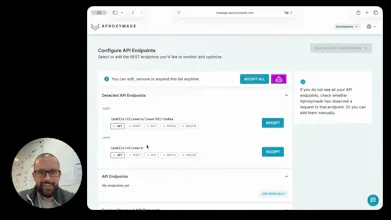
🤖 AI Auto-Discovery: Our AI automatically learns your endpoint structure and identifies the best caching strategies.
⚡ Dynamic & Safe: We safely cache authenticated data (using OpenID scopes) and instantly invalidate it the millisecond your underlying data changes.
📊 Risk-Free Observability: See your traffic metrics and measure the exact impact before activating the cache with a single click.
Whether you're running a data-heavy enterprise SaaS with complex dashboards or an e-commerce store needing to serve live inventory under heavy Black Friday loads, Aproxymade scales your infrastructure without requiring an architecture rewrite.
You can integrate Aproxymade in under 10 minutes and it's completely free for small projects.
We’d love for you to try it out and tell us what you think! I’ll be hanging out here all day to answer your questions, listen to your feedback, and talk about API performance. 🚀
Report
Maker
@syncall Exciting :) I am biased of course, as I have also done some work for the building of Aproxymade. But at the same time, I am a satisfied user also, using API caching in my other (vibe-coded) projects: e.g. the attached image shows the performance for a gradually scaling service serving illustrative images from a Supabase store. A 10% overall improvement in latency is already okay - but it is even better that actually 34% of all requests are served practically immediately, which is VERY visible difference in user experience. And that should further improve if the usage of this service further grows, which is nice :)
What’s the failure mode if the AI gets it wrong, like do you ever risk serving old data and how do you monitor that?
Report
Maker
Hey @naimz :) we have two strategies here, the first one ist that the AI model does not make the caching decisions directly, it is used to create an API model and caching strategies around it and a developer can easily understand and review both (we visualize them in our UI). The second strategy is that we forward a random sample of API calls to the origin so we are able to compare the cached version and the fresh version from the origin and calculate a consistency score.




@syncall Exciting :) I am biased of course, as I have also done some work for the building of Aproxymade. But at the same time, I am a satisfied user also, using API caching in my other (vibe-coded) projects: e.g. the attached image shows the performance for a gradually scaling service serving illustrative images from a Supabase store. A 10% overall improvement in latency is already okay - but it is even better that actually 34% of all requests are served practically immediately, which is VERY visible difference in user experience. And that should further improve if the usage of this service further grows, which is nice :)
Mailwarm
What’s the failure mode if the AI gets it wrong, like do you ever risk serving old data and how do you monitor that?
Hey @naimz :) we have two strategies here, the first one ist that the AI model does not make the caching decisions directly, it is used to create an API model and caching strategies around it and a developer can easily understand and review both (we visualize them in our UI). The second strategy is that we forward a random sample of API calls to the origin so we are able to compare the cached version and the fresh version from the origin and calculate a consistency score.