
AstroGrid
Explore the entire universe in your browser, in real 3D
130 followers
Explore the entire universe in your browser, in real 3D
130 followers
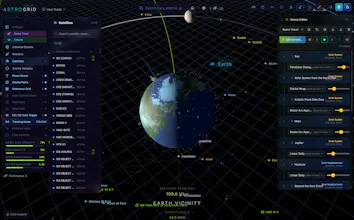
AstroGrid turns your browser into a spaceship. Fly from Earth's surface to the edge of the observable universe, all in real 3D. • 119K real stars (HYG catalog) with accurate B-V colors • NASA JPL orbital mechanics for the Solar System, in real time • 14K deep-sky objects, black holes with gravitational lensing, pulsars, supernovae, and gravitational-wave events • Runs entirely client-side. No install, no signup. Built for the curious students, educators, and space nerds.


Hey everyone,
Quick context on why I built AstroGrid : I wanted to make something for anyone who's curious about the universe, whether you're a student, a self-learner, a teacher, or just someone who likes staring at space at 2am. Every explainer I could find was either a flat textbook diagram or a YouTube video you'd zone out of in 30 seconds. I wanted something you could just grab, tilt, spin, and fly through.
It kept growing, and now it's a 3D atlas of the universe you can explore in your browser. No install, no signup. Built with classroom and self-learner use in mind.
A few things you can actually figure out by using it
Everything is based on real astronomical data (NASA JPL for the Solar System, the HYG catalog for stars, OpenNGC for deep-sky objects, LIGO data for gravitational wave events, etc.), so what you're seeing isn't decorative. It's where those things actually are.
If you teach, or you're just curious about space, I'd really love to hear what's confusing, what's missing, or what you wish you could do next. That feedback is what shapes the next update.
Thanks for taking a look.
The "flat textbook diagram → actually fly through it" reframe is exactly what's missing from most explanatory media. We've been overusing static visuals for things that only make intuitive sense in motion. Adjacent take from a different domain: I built StoryRoute (https://storyroute.netlify.app/), an interactive city-walk app that does the same thing for travel — instead of reading a top-10 list, you walk the city as a narrative. Same instinct: replace passive consumption with embodied exploration. Curious whether AstroGrid plans curated guided tours (Voyager probe trajectory, Kepler's discovery walkthrough), or stays open-ended exploration?
@samir_asadov both, free exploration is the default but theres a growing layer of scenario tours on top, voyager trajectory is already in, kepler walkthrough is on the list. thanks for taking interest!
the constellations point is the one that actually changes how you think about them permanently. once you know Orion's belt stars are at completely different distances it's impossible to unsee. curious whether the classroom use case shaped any specific design decisions, or did that come later once you saw how people were actually using it?
@liviu_chita honestly it started purely from my own curiosity. since it's a fully solo project, it wasn't really a case of designing around the classroom from the start, or shaping things based on how people reacted — it grew more from inside my head, one idea pulling the next, until it slowly became what it is now. thanks so much for taking the time to look at it.
@johnastrogrid that's actually the best way for something like this to develop. tools built from genuine curiosity tend to have a coherence that designed-by-committee products never quite get. good luck with it!
Hey John! The 'in your browser' bit is the hard part I guess! universe-scale rendering means lod strategy is the make-or-break call. Are you streaming pre-built tiles for the deep zoom, or is it procedural extrapolation outward from real catalogs (gaia, sdss) with hand-curated near-sol detail? curious how you handle the seam between real data and the procedural fill. congrats on the launch, good luck!
@hiyamojo all real celestial objects come from actual catalogs(hyg, 2mrs, sdss, jpl..), procedural generation is only used to fill large-scale structures and the truly empty regions where catalogs fade out, so the seam sits where there's nothing to compare against. stays observationally correct where it matters. thanks for the great question!
@jacksonburch no external kb behind it, all data comes from open scientific catalogs (hyg, 2mrs, openngc, sdss, nasa exoplanet archive, jpl…) bundled with the app.thanks for taking interest!