
Beezi AI
Make AI development structured, secure, and cost-efficient.
1.3K followers
Make AI development structured, secure, and cost-efficient.
1.3K followers
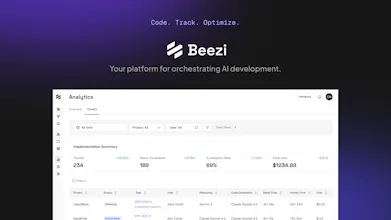
Beezi AI is a platform for orchestration of AI-driven software development. It helps teams structure tickets for better prompts, route tasks to the right models, and track AI usage and costs in real time. With the Analytics Hub, Smart Ticket System, and Model Routing Optimizer, teams reduce rework, control AI spend, and scale development with predictable, measurable outcomes. Beezi supports secure on-prem or private cloud deployment with full control over data and models.




Free Options
Launch Team

Viktor.comAn AI coworker that actually does the work
Promoted
@oleksandr_semeniuk looks solid. how does it handle edge cases where ticket requirements completely contradict each other? does it alert PM before routing to LLM?
The insight that AI amplifies whatever you give it rather than creating clarity on its own is something more people building with AI need to hear. I have experienced this firsthand building DocMetrics alone — the AI coding tools are genuinely fast but if your own thinking about what you are building is unclear the AI just gets you to the wrong place faster. The ticket clarification piece before coding starts is the part I find most interesting because most teams treat requirements as a formality rather than the actual foundation of everything that follows. Curious how Beezi handles situations where the ticket looks clear on the surface but the underlying requirement is actually ambiguous — does it flag that or only catch structural issues? Congrats on launching.
@dorrel Thanks, Brice. Your DocMetrics experience is super relevant here.
That's exactly the philosophy behind Beezi. AI is great at processing fast and catching what's easy to miss, but a human stays in control. So we built validation into every step of the workflow. Before anything moves forward, a human can review, add comments, and make fixes directly. That applies to the implementation plan, PR comments, and IDE integration.
It's not just a safety net. It's how you actually get useful output, because the human context and judgment are what make AI decisions reliable.
AI amplifies what you give it. We just make sure a human is always steering, because that's the only way AI actually gets to the real substance behind the ticket, not just what's written on the surface.
@valeriia_furmanets The human staying in control at every step is the right design principle. The temptation with AI tooling is to automate the human out of the loop to save time but the irony is that the human judgment is exactly what makes the output trustworthy. The PR comment and IDE integration pieces are smart because they meet the developer where the work is actually happening rather than asking them to context switch to another tool. Looking forward to following where Beezi goes from here.
@dorrel Thanks, Brice. You captured it perfectly. Glad the idea resonated. Excited to have you following along!
This resonates. When I was scaling an engineering org from 15 to 120 engineers, AI adoption was completely ad hoc - every team picked different models, different workflows, and we had zero visibility into what was actually working. The cost tracking alone would have saved us months of budget debates. Curious how the Smart Ticket System handles ambiguous requirements that even humans struggle to spec clearly - is it more about catching obvious gaps or does it genuinely improve prompt quality for complex tasks?
@avrisimon Thanks, Avri. Growing from 15 to 120 people while everyone uses different AI tools and models often creates chaos. That’s exactly the problem Beezi is built to solve. At that stage, simply seeing where AI spending goes can already make a big difference.
On your question: Smart Ticket System is not just about finding missing details. It is built to improve prompt quality before AI-assisted development starts.
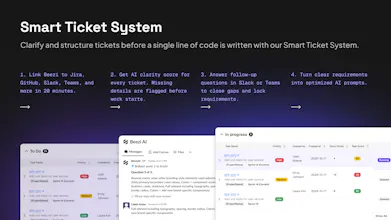
When a ticket is created in Jira or Azure DevOps, Beezi analyzes it for clarity, completeness, and readiness. It checks whether the goal is clear, enough context is included, and the task is specific enough for AI to execute well. Then it gives the ticket a quality score, so teams can quickly see what is ready and what needs improvement.
If the ticket is vague or incomplete, Beezi does not just flag it. It automatically starts a follow-up conversation through Slack or Microsoft Teams with the assigned person. The system asks targeted questions based on what is missing and continues until enough context is gathered.
This matters because unclear tickets often lead to poor prompts, more retries, lower-quality code, and wasted engineering time. The Smart Ticket System helps improve input before work begins, leading to smoother execution later.
The best results come when people and the system work together. Beezi improves the baseline quality and removes avoidable friction, while your team brings the product knowledge, priorities, and judgment that no tool can replace.
Congrats on the launch @oleksandr_semeniuk @oleglysiak @yuliia_melianytska 🎉 Most teams jump straight to prompting and wonder why output is still messy. How long does setup typically take for a team already on Jira + Slack?
@oleksandr_semeniuk @oleglysiak @kate_ramakaieva Thank you, Kate! 🎉 For a team already on Jira + Slack, setup typically takes under 20 minutes, and you're good to go. No heavy onboarding, no disruption to your existing workflow. Happy to walk you through it if you'd like to see it in action!
@oleksandr_semeniuk @oleglysiak @yuliia_melianytska thanks, will reach out for demo 🙌🏻
Interesting concept. If a company stops using Beezi AI, what happens to their stored data and history?
@kharabet Thank you for your interest. We take data security very seriously. It's a core priority for us. You own your data completely. If you ever decide to leave, your data is deleted and no longer stored.
Congrats on your launch, ticket structuring before coding is very important because tickets decide quality of code produced. I was wondering though, is manual override possible, for example in case I want to push a particular ticket?
@prateek_kumar28 Thank you, Prateek. I totally agree, ticket structuring is one of those things that really sets the foundation for everything that follows!
To your question: absolutely. With Beezi, you can choose which tickets are handled by Beezi and which ones a developer wants to take on themselves. It's not all-or-nothing. And even on the Beezi-handled side, the developer stays in control throughout, as they review the implementation plan, approve it before any code is generated, and validate the output before merging. So it's more of a collaboration than a handoff.
The real-time AI cost tracking is something I didn't know I needed until I started using multiple models for the same project and had no idea what I was actually spending.
As a solo maker, does Beezi work for individual developers or is it built exclusively for teams?
@misbah_abdel Totally relatable. Once you start mixing models, costs become invisible fast. That's exactly why we built the Analytics Hub.
Beezi was designed primarily for teams. The biggest value comes from orchestrating work across multiple people, tracking team-wide AI spend, and keeping everyone aligned through integrations like Jira, Slack, and GitHub. All without managers having to chase down what each person is actually doing.
That said, solo makers aren't left out. If you're juggling multiple models and losing track of what you're spending, the Analytics Hub and Smart Model Routing give you the same visibility. The more models in your workflow, the more Beezi helps, regardless of team size.