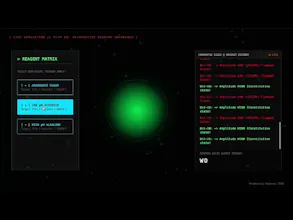
CELL is an open-source biological data storage simulator that implements low-level Verilog code directly into cellular architecture using the Cello framework. To bypass metabolic strain, it introduces an inverted CRISPRi logic gate system (0=ON/1=OFF via dCas9) that processes text strings into DNA bit-arrays. The live browser app features an interactive 2.5D interface allowing users to inject chemical triggers and decode real-time optical pulse streams back into ASCII text.
No reviews yetBe the first to leave a review for CELL//BIOLOGICAL DATA STORAGE SIMULATOR
Maker
📌
Hey Product Hunt! 👋
I’m Stephaniia, and I am incredibly excited to share CELL v4.2 with the community today!
This project started during my time at Harvard Summer School in Cambridge, where I became fascinated by a massive hardware bottleneck: silicon is hitting its absolute physical limits. Meanwhile, nature has an elegant hard drive sitting right inside living matter—DNA can hold up to 215 petabytes of data per gram.
CELL v4.2 is an interactive, browser-based Proof of Concept (PoC) designed to simulate biological data storage. It demonstrates how we can treat a living bacterium as a server by compiling low-level Verilog code into structural DNA bit-arrays using the Cello framework.
To bypass metabolic strain in living cells, this iteration introduces a simulated inverted CRISPR-interference (CRISPRi) logic loop:
- 0 = Baseline constitutive luminescence (Light ON)
- 1 = Directed dCas9 physical clamping (Light OFF)
In this live simulation app, you can manually inject chemical triggers (Sugar or Acid), watch the virtual dCas9 deadbolts clamp onto specific DNA registers, and view the automated optical data stream decode back into standard ASCII text right on your monitor screen.
Please note: This is purely a functional web simulation and software design concept demonstrating how the biological logic gate compilation operates. The repository is completely open-source for anyone who wants to explore the intersection of Computer Science and Synthetic Biology.
I’d love to hear your feedback, answer any low-level code questions, and discuss the future of biocomputing! What files would you store in a living server? 💻
Cheers,
Stephaniia
Report
Maker
Hey everyone! 👋 Creator here.
First of all, a huge thank you to the hunters for bringing CELL to the community! I’m so excited to see it featured here.
I just wanted to add a quick bit of context for those diving in: the live demo you see pinned here is an interactive simulation and a visual presentation of the concept. It’s designed to give you a clear, tangible look at how shifting computational storage to living matter actually works.
However, the real heavy lifting happens under the hood!
If you want to dig into the actual production-ready architecture, the complete Verilog source code for the Cello compiler chain is fully hosted in my GitHub repository.
For the tech and bio-hacking enthusiasts who love a good deep dive, I’ve also thoroughly documented my entire journey, the biological hurdles, and how I managed to map data registers onto living E. coli infrastructure. You can find the full step-by-step breakdown on my Medium blog (the links to the articles are baked right into the live demo interface!).
Would love to hear your thoughts, feedback, or any wild ideas you have about the future of biocomputing! Let's chat in the comments! 👇
Report
Maker
The future of data storage is just beginning
What an incredible day! As our Product Hunt launch comes to a close, we want to say a massive thank you to everyone who explored our biological data storage platform today.
DNA and biological data storage is a massive leap forward, and bringing this deeply technical concept to the PH community was a fantastic experience. While we didn't chase the top of the leaderboard today, we found something much more valuable: brilliant minds asking the right questions and early adopters who see the vision.
This launch was just Day 1. We are walking away with incredible feedback that will help us refine how the world stores its most critical data.
hank you for looking into the future with us today. Back to building! 🚀




Hey everyone! 👋 Creator here.
First of all, a huge thank you to the hunters for bringing CELL to the community! I’m so excited to see it featured here.
I just wanted to add a quick bit of context for those diving in: the live demo you see pinned here is an interactive simulation and a visual presentation of the concept. It’s designed to give you a clear, tangible look at how shifting computational storage to living matter actually works.
However, the real heavy lifting happens under the hood!
If you want to dig into the actual production-ready architecture, the complete Verilog source code for the Cello compiler chain is fully hosted in my GitHub repository.
For the tech and bio-hacking enthusiasts who love a good deep dive, I’ve also thoroughly documented my entire journey, the biological hurdles, and how I managed to map data registers onto living E. coli infrastructure. You can find the full step-by-step breakdown on my Medium blog (the links to the articles are baked right into the live demo interface!).
Would love to hear your thoughts, feedback, or any wild ideas you have about the future of biocomputing! Let's chat in the comments! 👇
The future of data storage is just beginning
What an incredible day! As our Product Hunt launch comes to a close, we want to say a massive thank you to everyone who explored our biological data storage platform today.
DNA and biological data storage is a massive leap forward, and bringing this deeply technical concept to the PH community was a fantastic experience. While we didn't chase the top of the leaderboard today, we found something much more valuable: brilliant minds asking the right questions and early adopters who see the vision.
This launch was just Day 1. We are walking away with incredible feedback that will help us refine how the world stores its most critical data.
hank you for looking into the future with us today. Back to building! 🚀