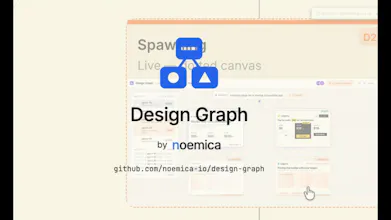
AI design tools give you pages. Design Graph gives you flows. A canvas where each node is an AI-generated screen and each edge is a user action — so you see the whole product experience, not just variants.
I used to spend my afternoons in Figma; over the last year I've been spending them spinning up HTML designs in Claude instead, building out the vision in code rather than in a vector file. That was the catalyst for this.
When Anthropic launched Claude Design earlier this week, the friction I'd been feeling with AI design tools crystallized: the best design decisions come from seeing options. Not one polished version. A handful, each with a real argument behind it.
So: Design Graph. One prompt, parallel sub-agents, real HTML pages on disk. They never see each other's work so the variance isn't noise — it's range. Then you branch. Kill what misses. Keep what's strange. Ask for three more variants of the one you love. The graph preserves every dead end as context for the good ideas.
It's a single index.html + per-project graph-data.js. Works with any coding agent. Files on disk. No account, no tokens, no quotas.
If you try it, the one thing I'd love feedback on is whether the branching flow (focus a card, ask for N more variants, filter the canvas to just the new children, pull the filter off) feels like the right atomic unit of creative decision.
Repo: github.com/noemica-io/design-graph
OpenPlugin