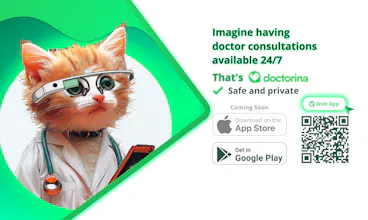
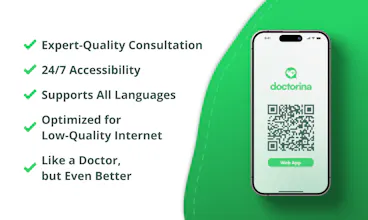
You can gain an understanding of what's happening with your health and receive high-quality recommendations. At its core, it works like having a doctor in your pocket. Our vision is to expand Doctorina into a comprehensive AI-powered telemedicine platform.
No reviews yetBe the first to leave a review for Doctorina
Congrats on the launch, guys! I actually have a personal story with your product — let me share it.
Once, my stepfather wasn’t feeling well, and we had to call an ambulance. After they had already left, I was curious to know more and decided to double-check his symptoms with Doctorina. It did an incredible job, suggesting exactly what the paramedic had said, and it also helped adjust his painkillers.
I’m truly grateful. Doctorina really helped me in a tough moment, and I hope this product goes on to support so many more people when they need it most.
Upvoted with all my heart. You are building something that truly matters.
Report
Maker
@natalliachobat Wow, thank you so much for sharing this. Your story genuinely moved us. Knowing that Doctorina could support you and your stepfather in such a critical moment means the world to us — this is exactly why we built it. We're beyond grateful for your kind words and support. Here's to helping more people when they need it most. 🙏
Report
@darya_tsaryk1 thank you for building this for people like me and my stepfather ❤️
Report
A great product for those who can't be driven to the doctors! Men, it's for us first)
Report
Maker
@serg_krasakovich hanks, Siarhei! 🙌 Exactly — sometimes getting to the doctor just isn’t an option, and we’re here to bridge that gap. And yes, men often wait the longest to ask for help — Doctorina’s got your back! 💪😄
@anton_selikhov1 Thank you, Anton! 🙌 We're on this mission with heart and purpose — and support like yours gives us an extra boost. Grateful to have you with us on the journey!
Report
Great approach with huge social impact!! Good luck guys! Your mission is noble!
Report
Maker
@sergei_lavrinenko2 Thank you so much for the kind words and encouragement! 💛
We truly believe access to medical knowledge is a basic right, and we’re doing our best to make it a reality. Grateful to have you with us on this mission! 🌍✨
Report
Really appreciate your idea, good luck with the launch!
Report
How does Doctorina ensure the accuracy and reliability of its health recommendations compared to consulting a human doctor?
Report
Maker
@antonyo_demydov Long story short ) In traditional medicine, an error is, first and foremost, the responsibility of a specific doctor for a specific decision. A physician, relying on their experience and limited data, makes a categorical judgment: they give a diagnosis, prescribe specific tests, and rule out or confirm a particular condition. This approach has a vulnerability: if the initial assumption is incorrect, it can lead to a prolonged path in the wrong direction, resulting in lost time, worsening health, or even death. This is what misdiagnosis means.
AI — at least in our case — does not allow for categorical conclusions by definition. The algorithm operates based on differential analysis and produces a range of probable conditions, ranked by likelihood, always with a disclaimer that final diagnosis requires further verification.
In other words, while a doctor might say:
“You have melanoma,”
AI would say:
“Melanoma is the most likely condition, but other possibilities include mesothelioma, squamous cell carcinoma, or a benign tumor, etc. Further examinations are recommended.”
AI doesn’t make mistakes — it provides an informational space for decision-making.
A mistake implies certainty, finality, and consequently, responsibility. A doctor assumes that responsibility. AI does not. AI does not make decisions on behalf of the user — it provides the possibility for an informed choice based on knowledge and data. It is not a “replacement for a doctor,” but rather an expansion of the user’s capabilities.
Even if the condition suggested by AI turns out not to be the final diagnosis, this does not constitute an error in the clinical sense — because the AI did not issue a diagnosis, it pointed to possible paths. This represents a fundamental ethical and legal shift in the approach to medicine.
In B2C tools, responsibility lies in the process, not in the act of conclusion.
We are not talking about a “right to be wrong,” but about the responsibility to educate. An AI tool like this provides a person with:
Awareness of the spectrum of possible conditions;
The ability to compare symptoms with potential diagnoses;
Direction toward clarification steps (tests, consultations);
Increased health literacy and personal engagement in their own well-being.
Therefore, in our understanding, an error cannot be associated with AI when used correctly — it can only arise from misinterpretation or ignoring the options it offers.



Congrats on the launch, guys! I actually have a personal story with your product — let me share it.
Once, my stepfather wasn’t feeling well, and we had to call an ambulance. After they had already left, I was curious to know more and decided to double-check his symptoms with Doctorina. It did an incredible job, suggesting exactly what the paramedic had said, and it also helped adjust his painkillers.
I’m truly grateful. Doctorina really helped me in a tough moment, and I hope this product goes on to support so many more people when they need it most.
Upvoted with all my heart. You are building something that truly matters.
@natalliachobat Wow, thank you so much for sharing this. Your story genuinely moved us. Knowing that Doctorina could support you and your stepfather in such a critical moment means the world to us — this is exactly why we built it. We're beyond grateful for your kind words and support. Here's to helping more people when they need it most. 🙏
@darya_tsaryk1 thank you for building this for people like me and my stepfather ❤️
A great product for those who can't be driven to the doctors!
Men, it's for us first)
@serg_krasakovich hanks, Siarhei! 🙌 Exactly — sometimes getting to the doctor just isn’t an option, and we’re here to bridge that gap. And yes, men often wait the longest to ask for help — Doctorina’s got your back! 💪😄
Bonding Association
Great project! Good luck 🍀
@lexy_sv Thank you so much! We really appreciate your support 🍀
Feel free to share the launch with your friends )
https://www.producthunt.com/posts/doctorina
@lexy_sv Thank you!
Talo by Palabra.ai
@anton_selikhov1 Thank you, Anton! 🙌 We're on this mission with heart and purpose — and support like yours gives us an extra boost. Grateful to have you with us on the journey!
Great approach with huge social impact!! Good luck guys! Your mission is noble!
@sergei_lavrinenko2 Thank you so much for the kind words and encouragement! 💛
We truly believe access to medical knowledge is a basic right, and we’re doing our best to make it a reality. Grateful to have you with us on this mission! 🌍✨
Really appreciate your idea, good luck with the launch!
How does Doctorina ensure the accuracy and reliability of its health recommendations compared to consulting a human doctor?
@antonyo_demydov Long story short ) In traditional medicine, an error is, first and foremost, the responsibility of a specific doctor for a specific decision. A physician, relying on their experience and limited data, makes a categorical judgment: they give a diagnosis, prescribe specific tests, and rule out or confirm a particular condition. This approach has a vulnerability: if the initial assumption is incorrect, it can lead to a prolonged path in the wrong direction, resulting in lost time, worsening health, or even death. This is what misdiagnosis means.
AI — at least in our case — does not allow for categorical conclusions by definition. The algorithm operates based on differential analysis and produces a range of probable conditions, ranked by likelihood, always with a disclaimer that final diagnosis requires further verification.
In other words, while a doctor might say:
“You have melanoma,”
AI would say:
“Melanoma is the most likely condition, but other possibilities include mesothelioma, squamous cell carcinoma, or a benign tumor, etc. Further examinations are recommended.”
AI doesn’t make mistakes — it provides an informational space for decision-making.
A mistake implies certainty, finality, and consequently, responsibility. A doctor assumes that responsibility. AI does not. AI does not make decisions on behalf of the user — it provides the possibility for an informed choice based on knowledge and data. It is not a “replacement for a doctor,” but rather an expansion of the user’s capabilities.
Even if the condition suggested by AI turns out not to be the final diagnosis, this does not constitute an error in the clinical sense — because the AI did not issue a diagnosis, it pointed to possible paths. This represents a fundamental ethical and legal shift in the approach to medicine.
In B2C tools, responsibility lies in the process, not in the act of conclusion.
We are not talking about a “right to be wrong,” but about the responsibility to educate. An AI tool like this provides a person with:
Awareness of the spectrum of possible conditions;
The ability to compare symptoms with potential diagnoses;
Direction toward clarification steps (tests, consultations);
Increased health literacy and personal engagement in their own well-being.
Therefore, in our understanding, an error cannot be associated with AI when used correctly — it can only arise from misinterpretation or ignoring the options it offers.