Questions:
-> Ubuntu + x86_64 only. No ARM, no Mac (unless you run a VM) that cuts out a big chunk of hobbyists and researchers right away
-> Prompt sensitivity is a real concern if vague prompts give generic results, the "just describe it in plain English" pitch needs some asterisks
-> Multi-robot setups are experimental, which is a big gap for anything beyond single-robot prototyping
-> Requires internet to process every prompt so your AI copilot goes dark without a connection, even for local sims
-> Still early (v1.0.15 beta) rough edges are expected, but production teams should be cautious
-> The 60% stat frames simulation as a problem to skip, not a skill to build engineers who skip that struggle badly at sim-to-real transfer
-> Terminal-only, Gazebo-specific workflow is a hard limit if your stack uses Isaac Sim or Webots
-> And any proprietary AI agent in your core workflow = vendor lock-in risk
Curious how it handles URDF validation and collision mesh accuracy?
None of these are dealbreakers for students or solo researchers. But for engineering teams evaluating it seriously, these constraints matter.
Answers:
1. Our initial reach is for robotics developers who already use ROS and simulators, so they are already on linux. Most of the robotics frameworks are optimised and built for linux. You will have a hard time figuring things out on Mac with the all the open source tools and libraries.
2. Definitely. The more articulate you are with explaining what you want, better drift will run. "describe in plain english" is to communicate that this is better than before where devs have to hustle on their own.
3. Yes, and that is why we are solving it, and making this better.
4. We are working to bring integration for local deployments.
5. We are monitoring all bugs and crashes in production.
6. The skill to master simulations is not to be skipped at all, we want to accelerate the skill up instead with Drift, so that engineers actually focus on the physics and behaviour of robots in the sim.
7. That's why we are bringing MuJoCo, Isaac Sim and other simulators and plugin support really soon.
8. If the vendors are getting your work done from months to days, that is not a worry. And we will always have competitors so you have plenty of options! :)




been wrestling with ROS simulation setup for our hardware integrations and this looks like exactly what we needed six months ago. love that it handles the OS orchestration too - that's usually where things get messy. how does it perform with real-time constraints when you're testing control loops?
Drift
Hey @piotreksedzik
Drift helps you wire up your control logic, perception algorithms or any other intelligent model to the simulation environment, and then you can start tweaking and testing various scenarios for your robot or the world, and see how your controls are performing.
Drift also helps you writing basic to medium control algorithms. We also coming up soon with easy integration of nav and manipulations plugins for specific robot use cases.
Product Hunt
Drift
Hey @curiouskitty, excellent question actually. User control and trust is of utmost importance to us. We ask the users for their permission to execute commands and edit files, because developers want clarity in the changes being done to their workspace or commands being run, as these pipelines will eventually run on the actual robot too.
Hey, drift is awesome! I'm a mac user, does drift work for me or is this linux only? A lot of great robotics tools end up being ubuntu only and it's always a pain for mac users….
Drift
@dr_dee Great question, and totally valid concern! Drift currently runs natively on Ubuntu 20.04+, but Mac users aren't left out. You can run Drift on macOS using VMware Fusion- just make sure you spin up an x86_64 Ubuntu image (not ARM) so Drift's binary is fully compatible.
If you're on Apple Silicon (M1/M2/M3), this is the recommended path and it works well. Windows support isn't available yet.
Full setup steps are in the docs at https://docs.godrift.ai/getting-started/quickstart#macos-via-vmware
It takes about 10 minutes to get running on MacOS! 🙌
@swastika_yadav1
Can I bring my own existing ROS workspace into drift, or does it only work with robots it generates itself? I have my own robot I've been working on.
Drift
@abhiranjan_mehta
Hey!
Yes, you can simply start Drift in the terminal in your workspace or VS code terminal. Drift can edit, debug, build and launch in existing workspaces.
You can ask it to edit your existing robot description files, world files, and wire up your workspace to launch with your controls.
Hope this answers your question. Let us know if you need any help!
Documentation.AI
Congrats. How Drift compares to existing ROS tooling in terms of debugging depth?
Drift
@roopreddy Hi, you can talk to Drift to get your issues resolved faster. Along with that, existing ROS tools have very limited context across the entire workspace and running nodes, whereas drift has the complete context of not just your workspace but also is trained to handle ROS and simulator related issues.
Vibe coding for robotics is a space I hadn't thought about but it makes total sense. The hard part with ROS has always been the orchestration overhead - knowing which nodes are running, what topics exist, debugging why the simulation drifted. How much of the prompt-to-simulation pipeline is Drift generating vs. stitching together existing ROS packages?
Drift
Hey @mykola_kondratiuk
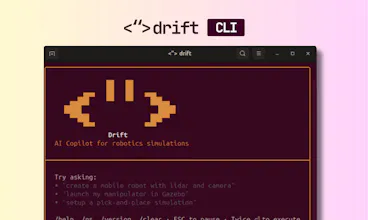
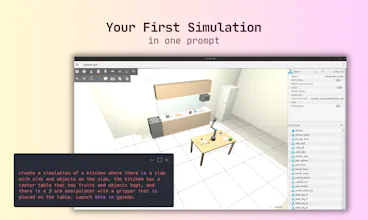
Drift with just a prompt on it's own can generate the robot description, the world files, setup the workspace, create launch files, add/connect control logic, build your workspace and launch the simulation. You can also ask it to write scripts to show you the outputs you want to see graphically.
Now with the integration of existing plugins for navigation, control or perception you can also test more complex robots inside simulations, and Drift will help you integrate them seamlessly.
Congrats!! Any plans to support cloud-based simulation runs?
Drift
Hey @zerotox
User's can currently install drift in the their remote VM's CLI and use drift to run simulators. Moving forward we plan to also offload computation for simulations to remote GPU clusters for users with decent or no GPUs. Talking to robotics engineers has made us understand that how important it is for them to have their workspace on their systems for not just privacy but also testing and iterating easily with hardware.