Launching today

FastRouter.ai
Route requests to the right LLM for cost, latency & quality
375 followers
Route requests to the right LLM for cost, latency & quality
375 followers
FastRouter is a unified AI gateway and control plane for developers and enterprise teams building with LLMs. It routes every request to the right model across 200+ LLMs through one OpenAI-compatible API, optimizing for cost, latency, quality, and reliability. With intelligent routing, failover, observability, and governance, teams can scale AI apps without vendor lock-in or code changes.




What is the exact mechanism behind the product that decides which model would be the best fit for specific request?
Great question, @himani_sah1! There are two different features:
Insights: We replay a sample of your requests, grouped by use case, against alternative models that perform well for those task types and complexity levels. You get a comparison of cost, latency, and quality scores from an LLM judge and a recommendation so you can evaluate the trade-offs before switching.
Auto-Router (per-request selection): While you can route to various models, you can also route to fastrouter/auto. In this case, the auto-router identifies the matching task/complexity cluster for the incoming request and selects a model based on its scores for this task/complexity level - balancing performance and cost.
In short: Insights helps you validate model choices on your actual traffic. It runs on the underlying Custom Evaluations product feature; whereas the auto-router uses task and complexity scoring to make the selection automatically.
Hey Product Hunt! I’m RP, part of the team behind FastRouter.ai.
We built FastRouter because running AI in production meant too much plumbing and too much guesswork: multiple SDKs, scattered dashboards, fragile failover, and no clear answer to “How do we make this cheaper without making it worse?” when all the logs are scattered all over the place.
⚡ One integration. Less provider juggling.
FastRouter gives you a unified API across major models and providers, with support for OpenAI, Anthropic Messages, and Gemini-compatible interfaces.
Claude models, for example, are available through Anthropic, Amazon Bedrock, and Google Vertex AI. FastRouter routes requests to healthy upstreams, so you don’t have to maintain separate SDK integrations and failover logic yourself.
Routing is the starting point. Routing Intelligence is what makes FastRouter different.
Most gateways show you traffic and spending. FastRouter helps you figure out what to change:
Proactive cost insights: Weekly recommendations based on real traffic. Find cheaper models, prompt caching opportunities, and workloads suited to flex pricing. Model-switching recommendations include evals so you can compare quality before switching.
Early warning signs: Spot latency drift, error spikes, and cost anomalies, with alerts delivered to Slack or PagerDuty.
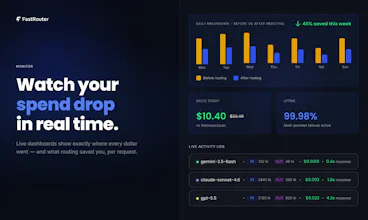
Request-level visibility: See which upstream served each request, allocate costs with tags, and inspect logs, including multimodal outputs.
Evals beyond text: Evaluate production traffic and datasets, including images and video. A successful API response doesn’t always mean a usable output.
Multimodal response caching: Reuse cached image and video responses for matching prompts or cache keys instead of calling the model again.
Better prompt management: Keep prompts in a shared, versioned library, with optimization and compression tools to improve them.
Our production customers are already saving $10K+ per month by acting on FastRouter’s recommendations.
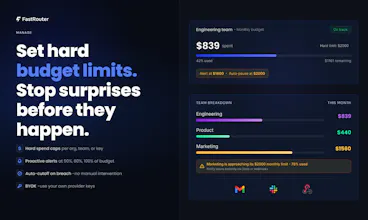
Available as SaaS or fully on-prem, with budget caps, alerts, and access controls built in.
We built this to spend less time maintaining integrations and investigating bills, and more time shipping things that work.
Claim 2 months free: https://fastrouter.ai/product-hunt
What’s your biggest AI production headache right now: reliability, cost, integrations, or quality? Let us know in your comments.
@ritprasad Many congratulations, Ritesh, Andrej and team! 😊
How I met the makers: Andrej reached out to showcase FastRouter, and I was immediately impressed by the product design, clarity of the mission, and the real developer pain point it addresses. It’s a well-timed solution for teams building AI applications at scale.
We worked together for polishing their launch assets, product positioning and messaging before the launch.
What FastRouter does: FastRouter is a unified AI gateway and control plane that routes requests across 200+ LLMs through one OpenAI-compatible API. It helps teams optimize for cost, latency, quality, and reliability, while providing failover, observability, governance and actionable insights without vendor lock-in.
Why I endorse it: Teams often struggle with managing multiple model providers, fragile fallback logic, unpredictable costs, and unclear quality trade-offs.
FastRouter turns that complexity into a single intelligent layer, with proactive recommendations, request-level visibility, and evaluation tools that make model choices easier to trust.
I’m confident FastRouter will see strong adoption among developers and enterprises looking to scale AI products more efficiently. ✨
@rohanrecommends Huge thanks, both for hunting FastRouter and for your feedback.
You’ve captured exactly why we’re building this: teams should spend more time building their AI products and less time managing providers, fallback logic, and cost surprises. What matters is driving meaningful outcomes be it in terms of cost, quality or performance for the AI products we build.
Grateful for your support and for hunting us today!
How quickly does it react when a model suddenly gets slower or starts giving weaker results?
Congrats @ritprasad & team!
Thanks for hunting another cool product @rohanrecommends :)
@rohanrecommends @hamza_afzal_butt
Every request is measured for latency and response time including all the intermediate attempts if any provider is down for example. This way, you are not measuring the wrong thing i.e. an individual attempt at a single provider rather than the overall time it took at the request level as that is what your end user is waiting. Moreover, FastRouter helps you set up custom alerts in real time that can get delivered on Slack, PagerDuty or your webhook so you can react immediately.
For quality, AI Evals or Insights continuously evaluates a sample of your production traffic by replaying requests against other capable models. It proactively delivers insights and recommendations when it identifies models that better fit your use case.
Curious. Which is harder for your team to catch today: latency spikes or spend spikes or drops in response quality?
we ended up building a crude version of this internally last month wish we found you guys earlier haha.
@adams_parker Haha, totally get it. The first version is one thing; maintaining it as providers and models change is another 😅 It’s worth keeping an eye on the ongoing DevOps work and the latency the router itself adds.
With FastRouter, you get a lightning fast gateway and also useful features such as AI evals, prompt optimization, and real-time alerts without having to build those separately. Would love to hear what you built and see whether we can save your team some work! Reach us at support@fastrouter.ai.
The first users usually seem to come from places where the problem is already being discusses. Curious if anyone has had better results from communities than from posting on their own profiles.
This solves a massive headache for us. we were literally spending hours last week figuring out how to balance claude and gpt costs.
@sansa_grey Yup, figuring out when to use Claude vs. OpenAI or even other models, tracking spend, and checking quality can quickly become a job of its own. That’s exactly why we built an easy to use AI evals product; as well as proactive cost recommendations with Insights -- to help you identify when to leverage different models. Thanks for checking us out!
Finally someone solved the headache of writing manual fallback code every time OpenAI drops.
@ashir_murtaza1 Thanks Ashir! That was one of the main pain points. Nobody should have to rewrite retry-and-switch logic - and waste time integrating new provider SDKs. We have moved a long way since then and added a lot more value added features around insights and optimizations. Thanks for checking us out!