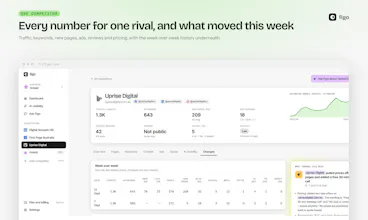
Figo watches your competitors so you do not have to. Every week it checks their rankings, new pages, blog posts, Google Ads, Meta ads, TikTok ads, Instagram, Facebook and Reddit, plus what ChatGPT, Claude, Gemini and Perplexity say when buyers ask for a recommendation. Monday morning you get a short briefing: what changed, what it means, and one thing to do about it. Add your website and it finds the competitors for you.
Hey Product Hunt,
I run a small white label SEO agency. Every month a client asked the same question: what are our competitors actually doing? Answering it took me half a day of tabs. Ahrefs for rankings, the Meta Ad Library, the Google Ads Transparency Center, their blog, their pricing page, Reddit. By the time I had an answer it was already old, and I still had to turn it into something the client could act on.
Figo does that half day automatically, every week.
You give it your website. It finds your competitors from search data, then checks nine things for each one: rankings and traffic, new pages, blog posts, Google Ads, Meta ads, TikTok ads, Instagram, Facebook and Reddit mentions. It also asks ChatGPT, Claude, Gemini and Perplexity the questions your buyers ask, and records who gets named.
Monday morning you get a briefing written in sentences, with your numbers next to theirs and one thing to do. A real one from this week: "Flatrate Moving runs 25 Meta ads, you run 0. Open the Meta Ad Library, write down the three offers they repeat, then decide if one fits your 5.0 rating and 530 reviews."
Every screenshot here is real data from real moving companies, not a demo.
Three things I would like your opinion on:
1. AI visibility. Nobody agrees yet on how to measure whether the assistants recommend you. I ask the same buyer questions every Monday and track the share of answers where each business is named, with citations counted separately. Is that how you would measure it?
2. The briefing. Is it specific enough to act on, or still too vague?
3. Agencies. One account covers five businesses and each client gets a live report link. Is that the right shape, or would you rather have something else?
I am here all day. Tell me what is missing.
The AI-answer tracking piece is the part I'd want to stress test - asking ChatGPT/Claude/Gemini/Perplexity "who gets named" is only as stable as those models' answers are from one query to the next. Do you run each question multiple times per week to smooth out the variance, or is it a single snapshot? A competitor briefing that flips based on model randomness rather than an actual ranking change would be worse than not tracking it at all.
@galdayan yes, if someone is mentioned or cited just once it won't be marked as present so we do multiple versions of the same prompt to get the actual state. There is room for further improvement too. Thanks Gal.
@ned_mehic Multiple prompts per week to catch the flip-flopping makes sense as a v1 approach - that's a reasonable tradeoff of cost vs signal. Curious if you've thought about surfacing the variance itself to the customer, like flagging "mentioned in 2 of 5 runs" instead of collapsing it to a binary present/absent in the weekly briefing. That would let the reader judge confidence themselves rather than trusting a single rounded number.




Figo
Build Check
Figo
@german_merlo1 Thank you Germán.
Dial
The AI-answer tracking piece is the part I'd want to stress test - asking ChatGPT/Claude/Gemini/Perplexity "who gets named" is only as stable as those models' answers are from one query to the next. Do you run each question multiple times per week to smooth out the variance, or is it a single snapshot? A competitor briefing that flips based on model randomness rather than an actual ranking change would be worse than not tracking it at all.
Figo
@galdayan yes, if someone is mentioned or cited just once it won't be marked as present so we do multiple versions of the same prompt to get the actual state. There is room for further improvement too. Thanks Gal.
Dial
@ned_mehic Multiple prompts per week to catch the flip-flopping makes sense as a v1 approach - that's a reasonable tradeoff of cost vs signal. Curious if you've thought about surfacing the variance itself to the customer, like flagging "mentioned in 2 of 5 runs" instead of collapsing it to a binary present/absent in the weekly briefing. That would let the reader judge confidence themselves rather than trusting a single rounded number.