
Forgettie
Control subscriptions. Plan bills. Save smarter.
2 followers
Control subscriptions. Plan bills. Save smarter.
2 followers
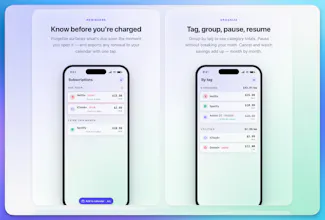
Most people underestimate recurring costs. A $9.99 subscription becomes $120 a year, and eight of them quietly become almost $1,000. Forgettie helps by making hidden costs visible: what renews next, what each bill really costs per year, which payments may be worth cancelling, and which yearly bills you should prepare for. It works offline, with no bank login and no account required.




Dumbnote
A few years back, I realized I didn’t really understand my own money as well as I thought I did.
It was not a dramatic problem. I was not trying to solve investing, retirement, or anything complicated. I just kept having the same feeling every month:
“Where did it all go?”
At first, I thought the problem was spending too much on random things. Food, coffee, small purchases, normal life stuff. But the more I looked, the more I noticed another pattern.
The problem was not that every subscription was expensive. The problem was that I was not looking at them as long-term commitments. I saw the monthly price, but I did not really see the yearly cost.
$9.99 did not feel like much.
$12 did not feel like much.
A few tools, services, memberships, and renewals did not feel like much.
But over a year, they became real money. And because they were automatic, I stopped making active decisions about them.
The yearly bills were the ones that made me feel the most stupid.
I knew car insurance would come back. I knew the domain would renew. I knew some annual software fee was coming. None of it was truly unexpected.
But because it only happened once a year, I never prepared monthly for it. So when the bill arrived, it felt like a surprise, even though the real problem was that I had ignored something I already knew.
That was the part I learned.
I was not managing my money by looking forward. I was mostly reacting after money had already gone out.
And for me, that is where financial literacy started to become practical.
Not with complicated finance theory.
Not with investing first.
Not with trying to track every small purchase perfectly.
It started with a simpler question:
“What have I already committed to paying?”
That question changed how I looked at my money.
If something costs $1,200 a year, it is not only a future bill. It is roughly a $100/month responsibility. If a renewal is coming in six months, it is not really six months away. It is something I can prepare for now.
Forgettie came out of that lesson.
I know this is not the kind of app I would open every day. And honestly, I do not think it should be.
I do not want another finance app that makes me feel like I need to check my money all the time.
For me, this is more useful at specific moments.
When I want to understand my monthly commitments.
When I am planning a bigger decision.
When I am thinking about moving, buying something expensive, starting a family, changing jobs, or simply trying to see if I can afford more responsibility.
That is when recurring costs matter.
Because before making a big decision, I need to know what money is already spoken for.
What renews next.
What it costs per year.
What it averages per month.
What I should prepare for.
What I may no longer need.
That is it.
No bank connection.
No automatic judgment.
No complicated personal finance system.
Just a small place to check the commitments I already made, especially when I need to make a new one.
Because I think this is one part of financial literacy that people often learn too late.
Money is not only about what you already spent.
It is also about what you have already agreed to spend again.
Would love your feedback. And genuinely curious — what yearly expense snuck up on you this year?