
Giselle
Build and run AI workflows. Open source.
977 followers
Build and run AI workflows. Open source.
977 followers
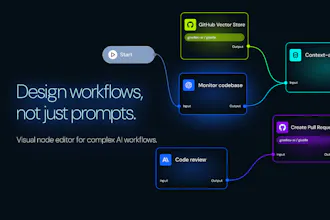
Built to design and run AI workflows that actually complete. Zero infra setup—just build and run. Handle complex, long-running tasks with a visual node editor and real-time tracking. Combine models from multiple providers in one canvas.



Product Hunt Wrapped 2025
Hits a nerve tbh. I’ve bounced off a bunch of workflow tools—too much setup, no clue when jobs hang. Open source + real-time view + mix providers sounds right. Gonna try it on a long-running scrape/summarize flow. Curious about retries/state.
Giselle
@alexcloudstar san! Thanks for the comment!
We've struggled with the same frustrations ourselves, so we're really happy to have built and launched a product that addresses them!
For long-running tasks, theoretically there's no time limit. That said, for scraping use cases specifically, we might be missing some features that could leave you wanting more—so if you have specific needs, we'd love to hear about them. You're also welcome to post an Idea here: https://github.com/giselles-ai/giselle/discussions/new/choose
On retries, we currently do a single retry, but we're thinking it'd be great to let users customize this themselves—definitely something we want to implement.
Giselle
@alexcloudstar san
Thanks so much for the comment - really appreciate it! Would love to hear how it goes with your scrape/summarize flow. Feel free to reach out if you have questions about retries/state management. And if you discover any interesting use cases, please share!✨
Giselle
@alexcloudstar Totally feel you — a lot of provider-specific “workflow” tools are convenient, but it’s frustrating when you can’t mix in other models/services. That was a big motivation for building Giselle as open-source + multi-provider from day one, with real-time visibility so you’re not guessing where/why a job is stuck.
And yes on retries/state: the execution side is basically ready — what we’re working through now is the UI/UX for it. We don’t want a “retry button somewhere” that’s technically there but awkward to use. We’re exploring how to surface retries at the most natural place/time in the flow (e.g., right on the node/step that failed, with enough context to decide whether to rerun/adjust).
Giselle
@alexcloudstar Thank you so much for the kind comment.
One of Giselle’s strengths is that it requires no infrastructure setup and is easy for anyone to get started with.
We’ve designed the UI to be as simple and intuitive as possible, so you can build workflows quickly without dealing with complex configuration.
We care a lot about making the experience approachable even for first-time users.
Giselle
@alexcloudstar This really resonates — we've bounced off plenty of tools for the same reasons. Hope Giselle works well for your scrape/summarize flow. Let us know how it goes!
Vercel
Congrats on the launch!
Giselle
@rauchg Thanks so much, Guillermo!
We build and deploy Giselle on Vercel, and make extensive use of Next.js and the Vercel AI SDK — really appreciate all the work behind them.
Looking forward to exploring Workflow DevKit and Vercel Queues as we continue building.
Giselle
Thank you so much, @rauchg san! This means a lot coming from you.
As I shared in our Build with Vercel review, Giselle truly wouldn't exist without Vercel's ecosystem—Next.js as our foundation, the AI SDK powering our multi-model orchestration, and AI Gateway ensuring reliable model access.
https://www.producthunt.com/products/vercel/reviews?review=418558
Your comment just made our launch day even more special. 🙌
Giselle
@rauchg Thank you so much! Vercel and the AI SDK are absolutely essential to what we do. I personally recommend Vercel to many people around me.
v0 is also getting great feedback from our customers here in Japan!
Congrats on the launch! "Zero infra setup" is exactly what I've been looking for—most AI workflow tools are way too heavy or complex to just get started. The visual node editor looks super intuitive. Since it's open source, are you planning to add community-contributed nodes/integrations soon?
Giselle
@sumit_deepenrich san, Thank you so much for your comment! It really means a lot to us.
As for adding community-contributed nodes and integrations, it's not on our immediate roadmap, but if we can design the architecture well, introducing a plugin system could really open up a lot of possibilities. Thanks for the great idea!!
@codenote Makes total sense! A plugin system would definitely be powerful down the road. I'll keep an eye out for updates-cheers and congrats again on the launch! 🚀
Giselle
@sumit_deepenrich san, thank you so much! We will do my best!! 🚀
Giselle
@codenote
Agreed — community-contributed nodes and integrations could unlock a lot of value once we have the right extensibility model in place.
Giselle
@washizuryo Thanks for the support! Looking forward to refining the product together in 2026.
Giselle
@sumit_deepenrich Thanks for the kind words! "Zero infra setup" was a big focus for us — glad it resonates.
Plugin system is definitely something we're excited about exploring. Feedback like yours helps us prioritize. Stay tuned!
This is mind-blowing! 🤯 The visual builder for chain-of-thought agents is exactly what the dev ecosystem needed.
I'm really curious about the 'GitHub-native' RAG part. How do you handle context limits when indexing massive repositories? Do you have intelligent chunking for code specifically?
Congrats on the launch, team!
Giselle
Thanks a lot — really appreciate it!
On the GitHub-native RAG side, we don’t try to cram an entire repo into an LLM context at indexing time. We keep the ingestion unit small (file/chunk) and embed those.
A few guardrails that make this hold up on massive repos:
- Skip huge files upfront (we enforce a max blob size — 1MB in Studio), so binaries / generated artifacts don’t blow up indexing.
- Handle GitHub Tree API limits explicitly: if the recursive tree is truncated, we fail loudly and recommend an initial import via tarball download (or git clone) instead.
- Text-only embeddings: if it can’t be decoded as UTF‑8, we skip it.
Re “smart” code chunking: today it’s intentionally robust rather than AST/parser-based — line-based splitting + overlap + a hard char cap (defaults: 150 lines, 30 overlap, 6000 chars). If a chunk still exceeds the cap, we shrink progressively and fall back to character splitting for pathological cases.
Happy to share more on the query-time side too (top‑k / thresholds / reranking) if you’re curious.
Giselle
@airtonvancin RAG itself is complex, but we've tried to keep the implementation relatively simple. There's still plenty of room for improvement, but even now we're able to pass enough context to the LLM to noticeably improve generation quality. Excited to keep pushing this further!
Giselle
@airtonvancin san! Thank you so much!
To be honest, we don't have code-specific intelligent chunking yet—we're currently splitting by regular chunk sizes. That said, it's been working well for our own use cases in production. We're definitely looking to improve the accuracy and make it smarter over time!
Giselle
@airtonvancin Thanks for the kind words! 🤯
For the deep dive into the 'GitHub-native' RAG architecture and how we manage context limits, I'd recommend reading the article. It explains all the specifics of our implementation.
https://giselles.ai/blog/github-vector-store-vercel-constraints
This is really well-executed. The visual node editor for multi-model workflows is exactly what the agent ecosystem needs right now.
Quick question: How do you handle state persistence across long-running tasks? We're launching Nex Sovereign tomorrow (cognitive OS with persistent memory + governance layer) and thinking about how workflow builders like this could interface with stateful agents.
Upvoted! 🚀
Giselle
@nexaios Thanks a lot — really glad it resonated.
On state persistence: each node’s runtime state is stored as an independent data object, so long-running workflows can rehydrate and resume by referencing the latest persisted state for the nodes they need (rather than relying on an in-memory “session”). That makes it easier to checkpoint, inspect, and replay parts of a run as it progresses.
“Cognitive OS + persistent memory + governance” is a super important direction — especially if you want these agents to be usable in real business contexts. Nex Sovereign sounds very relevant.
Giselle is intentionally designed to be pluggable so we can interface with stateful agents/memory layers and governance systems as they emerge. Would love to explore how Giselle workflows could hand off / sync state with Nex Sovereign once you launch. And congrats on the launch!
@toyamarinyonWe just went live: https://www.producthunt.com/products/nex-sovereign
Re: integration — the architecture is live in the demo now. Some concrete integration points I'm seeing:
Giselle workflows → Nex Memory Graph: Your workflows could query persistent context (user goals, preferences, past decisions) before executing steps
Nex Boardroom → Giselle orchestration: High-stakes workflow actions could require mandate approval from Nex's CEO/CTO sub-agents (built-in governance for automated workflows)
PDAR Thinking → Workflow transparency: Expose Nex's reasoning traces (Perceive → Decide → Act → Reflect) that Giselle workflows can consume or display
The 9-app architecture is visible in the demo. The Boardroom (App 9) and Memory Graph (App 4) are the most relevant for stateful workflow orchestration.
Would love to show you a deeper walkthrough when you have 15 mins. DM or email works: [manvendramodgil.ai@gmail.com]
Congrats again on Giselle ,really impressed by the execution. 🚀
Giselle
@nexaios Thanks for the upvote and the kind words! Would love to explore how Giselle and Nex Sovereign could work together. We'll check out your launch!
@gyu07 We're live!
The Boardroom governance layer (App 9) is exactly what I mentioned — internal CEO/CTO sub-agents make recommendations, users mandate approval. Could be interesting for workflow orchestration (e.g., Giselle workflows requesting governance approval before high-impact actions).
Would love your feedback on the architecture!
Giselle
@nexaios Thanks so much for the support, really appreciate it.
Giselle
@nexaios san, Thanks so much! Nex Sovereign sounds really impressive – can't wait to see your launch tomorrow! 🚀
@codenote We're live!
The 9-app architecture is in the demo (Mind, Memory Graph, PDAR Thinking, Boardroom, etc.). Really curious how Giselle's multi-model orchestration could interface with Nex's cognitive layer.
Would love your feedback! 🚀
Giselle
@nexaios Congrats on the launch! I'll check it out!!
Triforce Todos
I appreciate the open-source approach here. It makes it feel less like a black box and more like a tool I can actually trust and grow with.
Giselle
@abod_rehman san, Thanks so much!
That really means a lot to hear!! We're excited to keep growing the product while staying transparent and building that trust.
Giselle
@abod_rehman Thank you — I completely feel the same way.
When I see an impressive AI product, if it’s not open source, there’s always a small sense of unease. I often find myself thinking, “This feature is incredibly useful, but how is it actually implemented?” That curiosity is part of what draws me to OSS.
My own skills today are built on reading and contributing to the great open-source projects that came before me. Giselle is our attempt to give something back to that ecosystem — something people can trust, inspect, extend, and grow alongside. I’d be very happy if this project becomes a small part of that ongoing open-source tradition.
Giselle
@abod_rehman Thanks for this — it's exactly why we went open source. Trust is earned, not claimed. Glad it resonates!
Giselle
@abod_rehman Thanks, that means a lot to us.
We believe that being open and transparent is what builds real trust.
And we hope it also encourages people to help shape where this goes next.
Giselle
@abod_rehman Thank you, that means a lot.
We wanted Giselle to feel understandable and trustworthy, not like a black box — and open-source is a big part of that.
Appreciate you sharing this.
Oh, we’re actually working on a couple of AI startups in tourism and e-commerce. We’ll check out your product, thanks.
Giselle
@mykyta_semenov_ Thanks! Giselle's workflows can be used for content creation and analytics in tourism and e-commerce. We'd love to explore creating samples and templates for those use cases.
Giselle
@mykyta_semenov_ san, Thank you!
That's awesome! Please let me know when you launch — I'd love to check it out! And thanks for taking a look at Giselle :)
Giselle
@mykyta_semenov_ Thank you for sharing. Both tourism and e-commerce are ideal candidates for workflow-driven AI.
If you're interested, we can run it on a private cloud as well as a cloud version. Feel free to share more details or discuss your requirements.
@toyamarinyon My team and I will take a look at the beginning of January, and I’ll write to you on LinkedIn. I’ve already added you there.