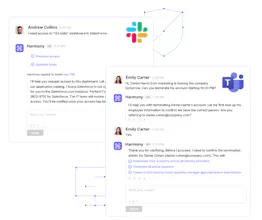
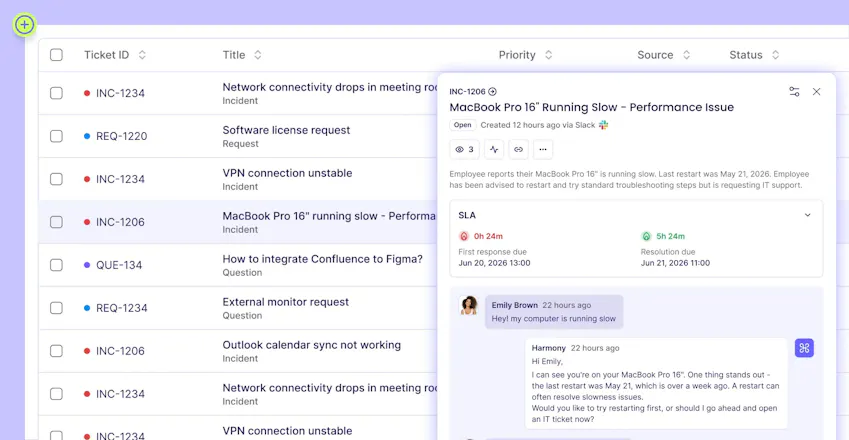
Harmony is an AI-native ITSM platform for IT teams. Instead of bolting a chatbot onto a ticketing tool, we built the helpdesk around AI agents: employees ask in Slack or Teams, and 100+ production-ready agents handle password resets, app access, onboarding, device issues and more end to end, escalating to a human only when needed. Ticketing, asset inventory, SaaS management and workflows live in one workspace, so agents have context to act. Teams hit 60%+ auto-resolution in days.
Hey Product Hunt! I'm Ran, co-founder and CTO of Harmony.
After our previous company (Epsagon, acquired by Cisco for $500m), Nitzan and I spent years talking to IT leaders at fast-growing companies and kept hearing the same story: the helpdesk eats the team's week. Password resets, app access, onboarding, "my laptop is slow" - hundreds of repetitive requests, and the tools built for them (Freshservice, Jira Service Management and friends) were designed to track the work, not do it.
So we built Harmony as an AI-native ITSM platform, with the agents at the core instead of bolted on:
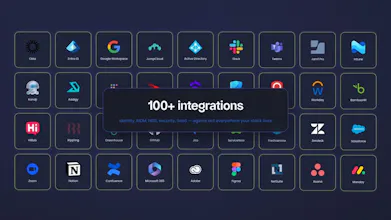
- Employees ask in Slack or Teams. Agents verify identity, take the action in your systems (Okta, Entra ID, Google Workspace and 100+ integrations) and close the loop. No portal, no form.
- 100+ production-ready agents out of the box, plus a builder for your own workflows.
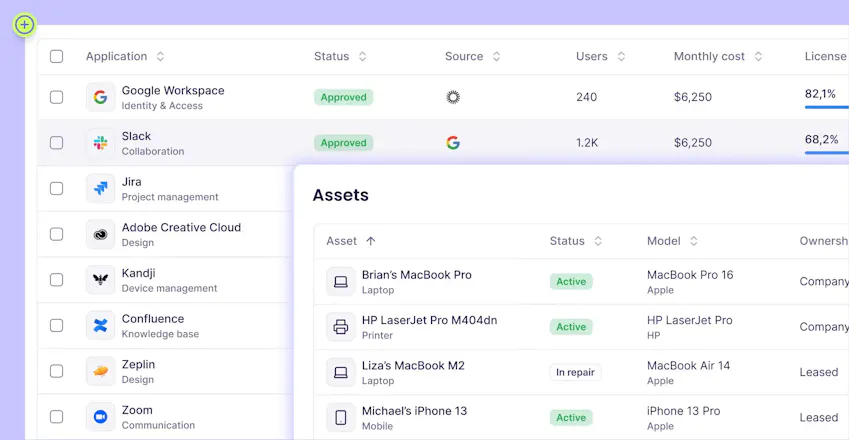
- Ticketing, asset inventory, SaaS management, onboarding/offboarding and AI governance in one workspace, so the agents actually have the context to act safely.
- Customers typically reach 60%+ auto-resolution within the first couple of weeks. Cyera is at 89% of employee requests auto-resolved; n8n runs IT for hundreds of employees with a single IT person.
We'd love your feedback, especially from IT folks who have lived with legacy ITSM tools. What's the first thing you'd hand off to an AI agent? I'll be here all day answering questions.
Report
@ranrib Congrats Ran and team! Love that you’ve taken this all the way from managing tickets to agents actually resolving requests and closing the loop. There’s so much further this model can go as more of IT operations becomes autonomous.
Curious, where do you draw the line today between what an agent can do autonomously and what still needs human approval?
Report
@ranrib Ran, this looks fantastic. Love seeing you and the team continuing to build and push the boundaries. Huge congrats on the launch - wishing you guys a lot of success with Harmony! 🚀
Report
I’m obviously biased because I work at Harmony 😊 but as the person leading Operations here, I also get to experience the product as a user every single day.
Ops is made up of small, repetitive requests: onboarding, offboarding, access, permissions, apps, and a million other things that come up during the day. Having Harmony take care of so many of these directly in Slack saves me a lot of time (and a lot of back and forth 😅).
Very proud to be part of this team and to actually use what we’re building every day. Congrats team! 🚀
Congrats on the launch keep shipping have some ideas in mind would love to connect
Report
As VP of R&D at Harmony, what stands out to me isn't only the 60%+ auto-resolution number, it's the architecture underneath it: the model never executes actions directly, it only matches requests to pre-approved workflows, and every object it references has to resolve against your real IdP/MDM data or the request just fails. That's the right answer to "what happens when the agent is wrong or fed a malicious prompt," which is the question every security team actually asks and most AI tools dodge. Scoped credentials, eligibility rules, human approval on sensitive actions, and a full audit trail mean prompt injection can steer the model's interpretation but has nowhere to steer it to. That's what building agentic AI the way a security team would've designed it themselves looks like! 🚀
Report
Harmony dev here, so pinch of salt. Everyone asks about the agents, but most of the hard part was identity. The person asking in Slack has to be provably the same human as the Okta user, the Jamf device owner and the HiBob record, and their name is spelled three different ways across those. Get that right and the agent part almost falls out. Get it wrong and you've built something that confidently resets the wrong person's password.


Harmony
@ranrib Congrats Ran and team! Love that you’ve taken this all the way from managing tickets to agents actually resolving requests and closing the loop. There’s so much further this model can go as more of IT operations becomes autonomous.
Curious, where do you draw the line today between what an agent can do autonomously and what still needs human approval?
@ranrib Ran, this looks fantastic. Love seeing you and the team continuing to build and push the boundaries. Huge congrats on the launch - wishing you guys a lot of success with Harmony! 🚀
I’m obviously biased because I work at Harmony 😊 but as the person leading Operations here, I also get to experience the product as a user every single day.
Ops is made up of small, repetitive requests: onboarding, offboarding, access, permissions, apps, and a million other things that come up during the day. Having Harmony take care of so many of these directly in Slack saves me a lot of time (and a lot of back and forth 😅).
Very proud to be part of this team and to actually use what we’re building every day. Congrats team! 🚀
Keep
Congrats!
EverTutor AI
Lfg! What a great idea team love it
Congrats on the launch keep shipping have some ideas in mind would love to connect
As VP of R&D at Harmony, what stands out to me isn't only the 60%+ auto-resolution number, it's the architecture underneath it: the model never executes actions directly, it only matches requests to pre-approved workflows, and every object it references has to resolve against your real IdP/MDM data or the request just fails. That's the right answer to "what happens when the agent is wrong or fed a malicious prompt," which is the question every security team actually asks and most AI tools dodge. Scoped credentials, eligibility rules, human approval on sensitive actions, and a full audit trail mean prompt injection can steer the model's interpretation but has nowhere to steer it to. That's what building agentic AI the way a security team would've designed it themselves looks like! 🚀
Harmony dev here, so pinch of salt. Everyone asks about the agents, but most of the hard part was identity. The person asking in Slack has to be provably the same human as the Okta user, the Jamf device owner and the HiBob record, and their name is spelled three different ways across those. Get that right and the agent part almost falls out. Get it wrong and you've built something that confidently resets the wrong person's password.