

How Much Rent Can I Afford?
Figure out what rent you can actually afford.
8 followers
Figure out what rent you can actually afford.
8 followers
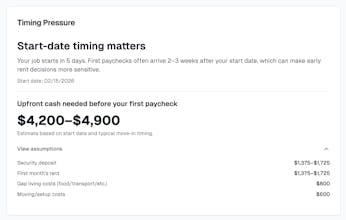
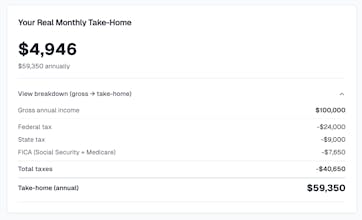
Most rent calculators only use a percentage of salary and ignore reality. This tool translates a job offer into a safe rent range by factoring in local rent levels, taxes, paycheck timing, and real monthly take-home, and shows how much cash you’ll actually need before moving in. It’s fast, opinionated, and built for recent grads and early-career professionals who want one clear answer before signing a lease.



I think you should explain "needs" and "wants" in parens so users understand what falls into the category. You discuss the rent tool but then go into monthly financial/budget planning. Also, I know the totals add up to 100%, but it is always best, to put a separator line under the line items, just so users can see the totals adding back up.
@yogesh_rane3 This is great feedback — thank you.
You’re right that “needs” and “wants” can feel abstract if we don’t define them clearly. Adding brief parenthetical examples (e.g., housing, transportation, groceries vs. discretionary spending) would make the categories more intuitive.
Good catch on the visual separator as well. Even when totals mathematically add to 100%, reinforcing that visually builds trust and reduces cognitive load.
And your point about staying focused on the rent decision before expanding into broader budgeting is fair. We’re trying to balance clarity with completeness — but keeping the surface tight and readable is important.
Really appreciate you calling out these UX details. That’s exactly the kind of feedback that makes the tool stronger.
I’ve always wanted an easy, realistic way to check whether I can truly afford a move to the city from living with family in the East Bay. Living closer to the city would let me network more, be part of an innovation focused community, and actually do things together with people in the same ecosystem but I’ve never had a clear way to see if it’s really financially viable for me.
As someone who doesn’t fully understand taxes, my actual in-hand pay has always felt confusing, which makes planning chaotic. I’m constantly unsure how much I need to save to live properly, and how that translates into a sustainable monthly budget.
That’s why seeing my real monthly take-home in this tool was incredibly helpful in calming that confusion. It grounded me in a concrete number I can plan around. Even more valuable was understanding what rent I can safely set aside from my salary so I can then think about other expenses like leasing a car, groceries, and day-to-day spending.
I really appreciated how the tool highlighted the gap in my cost of living as well, including transportation, and gave me a clear guideline for how to split my salary and how much I should ideally be saving. It was both relieving and a bit unsettling, in a good way to see how much I still need to optimize. A tool that not only shows this but actively guides me through those optimizations, based on my financials, would be incredibly powerful. I’m genuinely looking forward to seeing someone build that next layer on top of this. spoiler: There’s a clear next layer I’m craving like a light scenario planner: “What if I get +5k?” “What if I get a roommate?” and how that changes my safe rent and savings runway or maybe a simple “Day 1 / first 90 days” playbook for moving (deposits, furniture, commuting, social life hangout spots etc).
@prithvi_jpg This is such a thoughtful reflection — thank you for taking the time to write it.
You described the exact tension we’ve seen repeatedly: the desire to move closer to opportunity and community, but not having a clear, grounded number to anchor that decision.
The confusion around taxes and real take-home is one of the biggest hidden sources of stress. Salary feels concrete, but what actually lands in your account — and what’s left after rent — is what determines whether the move feels energizing or overwhelming.
I’m especially glad the upfront gap and cost-of-living breakdown helped. That “relieving but unsettling” reaction is usually the moment where clarity replaces guesswork.
Your point about scenario planning (“What if +5k?”, “What if roommate?”, first 90-day playbook) is spot on. That next layer — turning a number into a guided plan — is exactly the direction we’re thinking about. Not just showing the gap, but helping optimize around it.
Really appreciate you engaging at this level. Feedback like this shapes what we build next.
@prithvi_jpg This is such a thoughtful reflection — thank you for taking the time to write it.
You described the exact tension we’ve seen repeatedly: the desire to move closer to opportunity and community, but not having a clear, grounded number to anchor that decision.
The confusion around taxes and real take-home is one of the biggest hidden sources of stress. Salary feels concrete, but what actually lands in your account — and what’s left after rent — is what determines whether the move feels energizing or overwhelming.
I’m especially glad the upfront gap and cost-of-living breakdown helped. That “relieving but unsettling” reaction is usually the moment where clarity replaces guesswork.
Your point about scenario planning (“What if +5k?”, “What if roommate?”, first 90-day playbook) is spot on. That next layer — turning a number into a guided plan — is exactly the direction we’re thinking about. Not just showing the gap, but helping optimize around it.
Really appreciate you engaging at this level. Feedback like this shapes what we build next.
Upon using the tool for the first time, I noticed how quick, easy, and efficient it was to generate these results. A tool such as this one is very practical and useful for many young people like me, who are constantly on the road and looking for apartments to live in.
I really appreciate having the taxes accounted for, and the remaining annual balance. These are very useful.
There is a lot of utility to this tool. Here are some thoughts as to what might make it better:
More clarity on the "start date/time pressure" boxes - It is not very clear to me whether it is asking for the start date of my paycheck or the start date of the day I wish to move into a new apartment
The "Safe Rent Range" calculation - What is considered a "safe rent range"? This is a very useful measurement, though it might be of more benefit to me if it took into account other factors, such as the lifestyle I want to have. Perhaps a more frugal person would like to see other cost ranges that accommodate their preferences. Similarly, someone who wants to live a more extravagant life would have that reflected in their final rent report.
It might also be helpful to include a breakdown of how these numbers are calculated, though it may make the UI too convoluted.
One thing that could be taken into consideration is the cost of utilities and transportation (if someone commutes to work/school) each month if it hasn't been included in the cost range already.
In my opinion, the greatest appeal to this tool is how easy it is to use and to view the information presented to us. I'm very optimistic as to how this tool can evolve once it has access to a user profile that can make suggestions or reports that are tailored to the individual, offering the best utility.
Edit: I just noticed that there was also a retirement account calculator, and I think it is a great addition to this tool. Adding different savings/retirement accounts is very helpful in planning for the long term. I see the vision of WeLeap handling much more than just rent and retirement. Whether it be insurance, taxes, investments, saving, lifestyle, debt, and loans, WeLeap is something that can keep me financially safe and allow me to live the life I would want to live.