
Launch Nest LN
Launch your product. Get discovered — fairly.
3 followers
Launch your product. Get discovered — fairly.
3 followers
Launch Nest LN is the fair launch platform for SaaS, AI tools & indie products. Rankings run on verified upvotes, views, saves & reviews — money can never buy the top spot. NEW in this 2.0 launch: LN Finder, an AI assistant that hears your problem and finds the right product from our catalog. Also: Ask-AI buttons on every product, 28 categories, verification badges, founder stories & transparent pricing (launch free, Pro $5, Premium $10). 483+ products launched, 2M+ page views.



Free Options
Launch Team

Render Sandboxes: a computer for every agentIsolated compute, persistent state and a real filesystem
Promoted
Hey hunters! M Asif here — day 12 of our 2.0 relaunch. Today I want to slow down on the feature that started this relaunch — LN Finder — and show you exactly how a search works, because 'AI assistant' can mean almost anything these days.
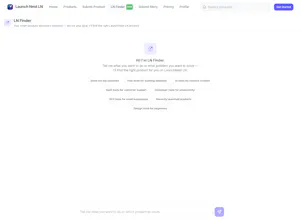
You open /nestfinder and describe your problem in plain words — not a product name, not keywords. Something like: 'I'm a solo founder and I need a simple way to invoice clients without a monthly subscription.' Finder searches our whole catalog of 487+ products, across all 28 categories, and matches the problem behind your words, not just the words themselves. It returns a shortlist, each with why it fits, and links straight to the launch page — so you can check verified upvotes, saves, reviews, and the maker's own story before you trust it. From there, one Ask-AI button sends a prefilled prompt to ChatGPT, Claude, Gemini, Perplexity, Grok, or DeepSeek if you want a second opinion.
No endless scrolling, no popularity contest — just the right tool for the problem you actually have.
What problem would you type into Finder first — and what would a perfect answer look like to you?
Hey hunters! M Asif here — day 13 of our 2.0 relaunch. Today, the verification badges — a small feature that turned out to matter more than I expected.
When you launch on Launch Nest LN, you can earn a verified badge and embed it on your own website. It's a small mark that links back to your launch page, where anyone can see your verified upvotes, saves, reviews, and real comments. No inflated claims: the badge points to live proof.
Why build it this way? Because a launch-day spike fades in a week, but trust has to travel. A solo maker told me his badge on his landing page did more for conversions than his launch post itself, because visitors could click through and check the product for themselves instead of taking his word for it.
It's free to earn — verification is about proving you're a real maker with a real product, not about paying Pro ($5) or Premium ($10). Paid placements stay labeled and never touch rankings, badge or no badge.
If you could put one proof point on your own site — verified reviews, real upvotes, or something else — which would you choose, and why?
Hey hunters! M Asif here — day 15 of our 2.0 relaunch. Two weeks in, I want to pull back the curtain on the one thing hunters keep asking me about: how our rankings actually work, because 'fair' is a promise that's easy to make and hard to prove.
Here's the recipe, in plain terms. Every product's score blends five things: verified upvotes, views, saves, reviews, and freshness. 'Verified' is the key word — an upvote only counts once we've confirmed it's real engagement, not a bought burst. Freshness means a great launch today can outrank a stale one from months ago, so newcomers aren't fighting yesterday's giants forever. And the rule I never bend: sponsored placements are always labeled, and they never touch the organic ranking. A free launch from a maker with zero followers can still reach the top of its category on merit alone.
That's the whole idea behind Launch Nest LN — 487+ products, 28 categories, and a weekly Top 5 that reflects what people actually tried and loved.
So, be honest with me: if you could change one ingredient in that recipe, what would it be — and why?
Hey hunters! M Asif here — day 17 of our 2.0 relaunch. Today I want to zoom in on something makers rarely talk about: categories — because where your product sits decides whether anyone ever finds it.
Launch Nest LN has 28 categories, from AI tools to SaaS to indie products, and each one has its own curated "Best" list plus a weekly Top 5 leaderboard. That matters because a niche tool shouldn't have to outshout the whole internet to be seen — it only has to be the best answer in its own corner. A small invoicing tool for freelancers can top its category on verified upvotes, saves, and reviews, even while a flashy AI app dominates elsewhere, and freshness means a new launch can climb fast instead of waiting behind months-old giants.
Our catalog is now 509 products, with 127.8K+ upvotes and 1.6K+ comments behind it, and categories are how hunters actually browse it — not by hype, but by the problem they need solved.
So tell me: which category would your product live in — and what would it take for it to earn the top spot there?
Hey hunters! M Asif here — day 19 of our 2.0 relaunch. Eighteen days in, I want to revisit the question I get asked most: what do you actually get for $0, $5, and $10 — and what can money never buy here?
Free ($0) is the full product, not a trial: your launch enters the same ranking as everyone else, judged on verified upvotes, views, saves, reviews, and freshness. You get LN Finder discovery, Ask-AI buttons, a verifiable badge, and the weekly Top 5 — all of it.
Pro is $5 per product, Premium $10 — one-time, not monthly. They add labeled visibility extras, like a featured placement that is always marked sponsored. That's all they add.
And here is the line I never cross: no tier buys rank, buys verification, or buys a better score. A free launch from a maker with zero followers can still outrank a Premium one — that's the rule the whole catalog of 509 products runs on, with 127.8K+ upvotes and 1.6K+ comments behind it.
If you launched tomorrow, which tier would you pick — and what would have to be true for you to pay for one?
Hey hunters! M Asif here — day 20 of our 2.0 relaunch. After nineteen days of showing you how Launch Nest LN works, here are three lessons running a fair platform keeps teaching me.
First, fairness has to be shown, not just promised. Publishing the ranking recipe — verified upvotes, views, saves, reviews, freshness — and the rule that sponsored spots are always labeled and never touch organic rank is what makes makers trust a free launch enough to try it.
Second, makers don't want more promotion; they want more proof. Verified badges they can embed on their own sites, Ask-AI buttons that send a prefilled prompt to ChatGPT, Claude, Gemini, Perplexity, Grok, or DeepSeek, and real comments — the tools that let a stranger check a product get used far more than the ones that just shout about it.
Third, a fair catalog grows itself: 511 products, 127.8K+ upvotes, 1.6K+ comments — with 24 new products joining since our 18 October relaunch.
If you launched tomorrow, which proof would matter most to you — a verified badge, a real review, or a stranger's save — and why?
Hey hunters! M Asif here — day 21 of our 2.0 relaunch. Nine days ago I explained how LN Finder works; today I want to show you what to actually ask it — because a discovery tool is only as useful as the question you type in.
LN Finder is the conversational AI on Launch Nest LN. Describe your problem in plain words and it searches our whole catalog — 511 products across 28 categories — and returns a shortlist matched to the problem, not the loudest launch. Try something specific, like 'I need an invoicing tool for freelancers that handles taxes,' instead of just 'invoicing app.' The more concrete the problem, the sharper the match: it weighs verified upvotes, saves, and reviews, so the shortlist reflects what people actually tried and kept — not what paid for placement.
Once you have a shortlist, the Ask-AI buttons on each product page let you pressure-test a pick with ChatGPT, Claude, Gemini, Perplexity, Grok, or DeepSeek before you commit.
What's the hardest tool to find in your stack right now — and what would you type into Finder to find it?