Headline:
A Reputation System Proposal to Incentive High-Quality Content and Prevent Spam
Review / Suggestion Body:
I love using professional networks, but platforms like LinkedIn heavily filter engagement or allow spammy, AI-generated generic comments to flood the feed. To fix this, I would like to propose a user-reputation system designed to incentivize high-quality content and protect the community.
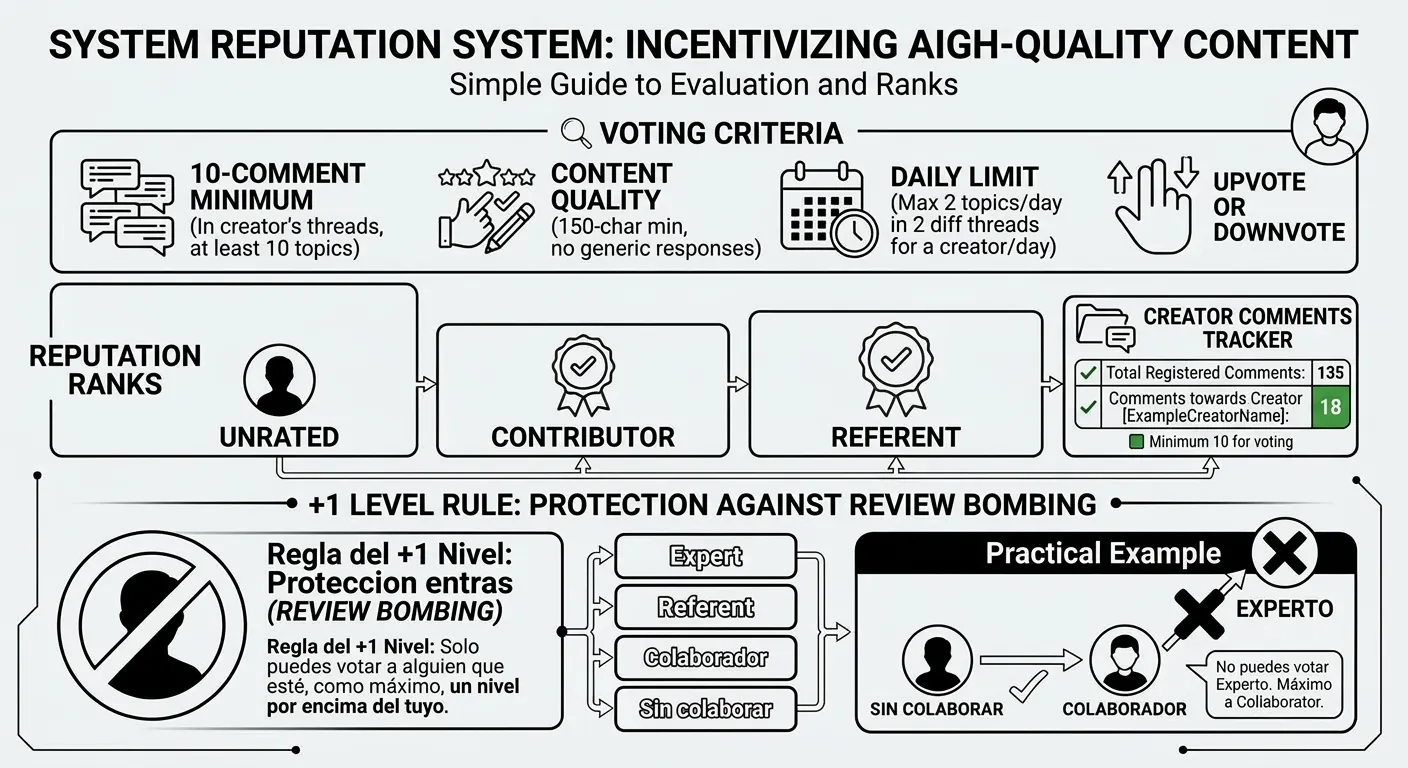
Here is how the core framework works (you can see the full visual workflow attached in my screenshot):
1. Reputation Tiers
Users move up through four clear levels based on their active and genuine contributions:
2. High-Quality Voting Criteria
To ensure votes are authentic, users can cast a single upvote or downvote (like an editable "verdict") on an author only if they meet strict criteria:
Minimum engagement: The user must leave at least 10 comments across 10 different threads from that creator (tracked by the platform).
Minimum Length & Substance: Comments must be at least 150 characters long. Generic answers are automatically filtered out.
Daily Caps: The system only counts a maximum of 2 comments on 2 different threads per creator per day to prevent artificial farming.
Style Fingerprint: If a user repeatedly uses the exact same sentence structures, the system gradually reduces their voting weight instead of blocking them, allowing for natural but repetitive writing styles.
3. Anti-Review Bombing Protection (The "+1 Level Rule")
To stop mass harassment or coordinated downvoting, users can only vote on content creators who are, at most, one tier above them.
Example: A "Non-Contributor" cannot vote on an "Expert." They must first upgrade their account to "Contributor" by engaging properly before they can vote on someone in the higher tier.
Search Utility: Users can filter their main feed to specifically find threads from one tier above them, helping them find relevant content to engage with and climb the ranks.
Fairness: Users can drop tiers if they receive negative community feedback, but they can never drop below the baseline "Non-Contributor" level.
I believe integrating a gamified system like this would drastically improve the quality of discussions and give real importance to community threads. I would love to hear your thoughts on this approach!
---### UPDATE: NEW FEATURE PROPOSAL
Headline:
Feature Proposal: Dynamic "[Name Autocomplete]" Attribute for Segmented Posts and Recruitment
Review / Suggestion Body:
What if your professional feed could speak directly to you? I want to propose a dynamic personalization tool for the feed that solves "scroll blindness" and drastically improves engagement between recruiters and qualified candidates.
The idea is simple: allow content creators to insert a special dynamic tag (like [Username]) into their posts. If a user views the post and matches the creator’s search criteria or target audience, the tag automatically replaces itself with the viewer's actual name on their screen.
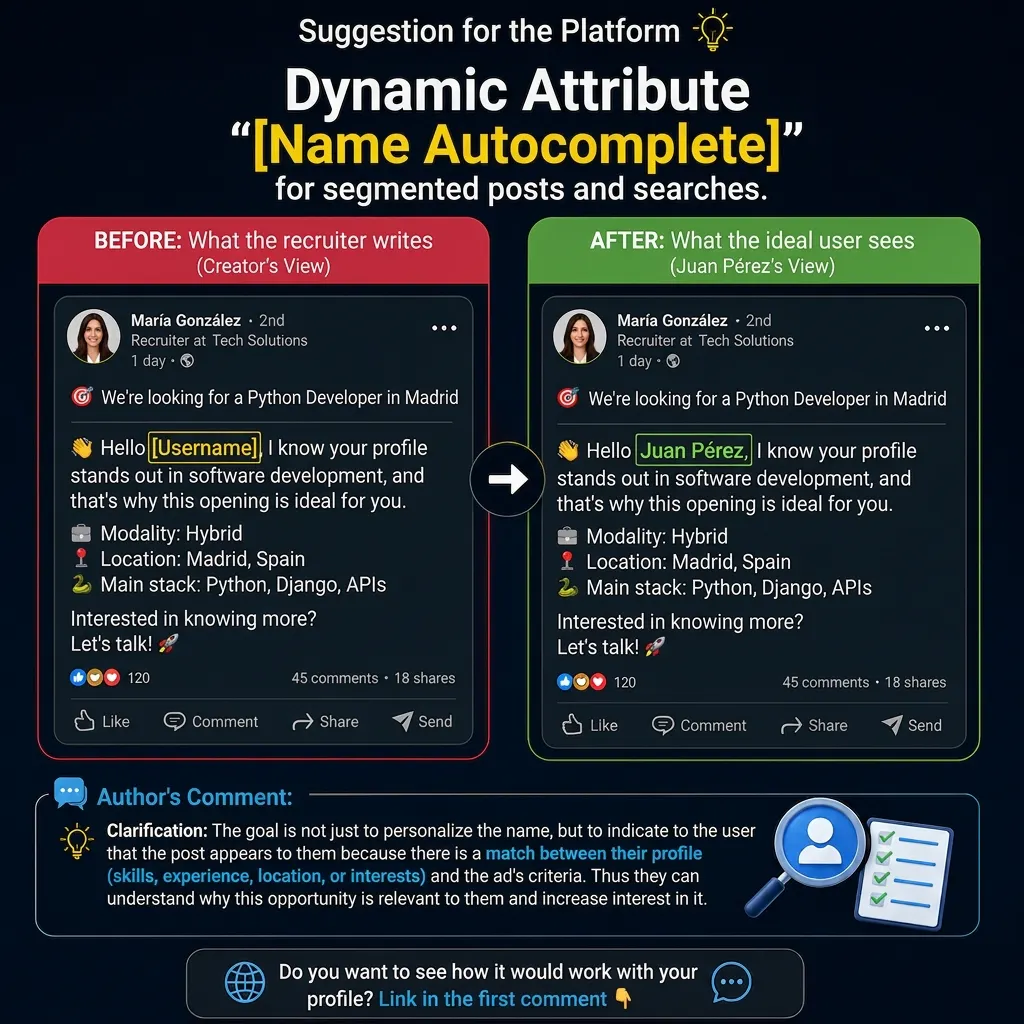
Here is how the core framework works (you can see the full visual "Before & After" concept attached in my screenshot):
1. Practical Example
A recruiter is searching for a Python Developer in Madrid. They write a post containing:
"Hello [Username], I know your profile stands out in software development, and that's why this opening is ideal for you."
If a user named Juan Pérez (who matches the exact criteria) scrolls past the post, he will dynamically see:
"Hello Juan Pérez, I know your profile stands out..."
2. Creator Configuration Modes
To ensure quality, creators can choose between two deployment modes:
Strict Mode (Rigorous): The name is only triggered if the user matches 100% of the target filters (skills, location, experience). This prevents false expectations.
Broad Mode (Flexible): Triggered by partial matches or shared industry interests, allowing for a wider organic reach.
3. Absolute Privacy by Design 🔒
Security and privacy are crucial. The rendering happens 100% locally on the user's client side. Neither the author of the post nor anyone else can see the user's name until the user explicitly decides to engage, apply, or reply to the post.
4. Key Benefits
Massive CTR & Engagement: Seeing your own name immediately breaks the scroll fatigue by leveraging the psychological Cocktail Party Effect natively.
Efficient Recruitment: It automates mass personalization at scale without losing the human touch.
Ultra-Relevant Feed: The feed instantly transitions from generic noise to direct, high-value opportunities.
Check out the attached design concept link: https://lnkd.in/e3t8T5hN
Discussion Prompt: Do you think a micro-personalization feature like this would humanize the professional feed, or would users find it too invasive? I would love to read your feedback!
---### UPDATE: NEW FEATURE PROPOSAL
Feature Pitch: Memory-Based Search (Equation Search)
Ever tried to find someone on Product Hunt, only to realize you can’t remember their name, handle, or company?
When our memory gets fuzzy, standard search bars fail us. We don't search by keywords; we search by fragment—a concept, a vibe, a visual memory.
To bridge this gap, we’re pitching an AI-driven Contextual Memory Engine that connects the dots using advanced multi-modal metrics.
How Memory Search Works
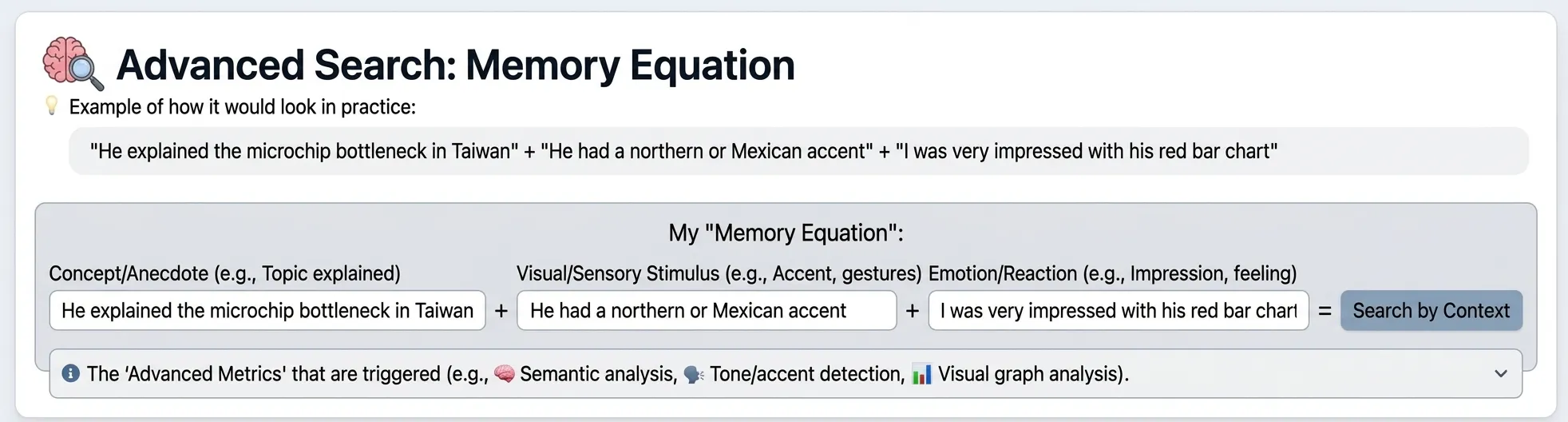
Human recall usually breaks down into three core signals:
Concept / Anecdote: What did they actually explain or build?
Visual / Sensorial Cue: How did they present it, or what stood out visually?
Emotion / Impression: How did the interaction or presentation make you feel?
🔗 The Operator: Concatenating Context
Instead of forcing users into strict search fields, the AI processes contextual blocks linked by a simple string operator: +.
By breaking down and weighting each section, the LLM maps natural language fragments against platform dataprofiles, comments, launches, and media to find your missing connection.


 Facebook