Within a few days of using Littlebird, it became one of the apps I use the absolute most. That surprised me.
Part of it is practical. It sees what I'm doing. I can go back and ask, "What have I been doing this week?" and it tells me. For someone in the early stages of building a business, where you only tend to measure yourself by the number of clients signed, that's quite huge. You're actually doing a thousand things. Littlebird is the only thing that shows you that. That's useful for content, emails, self-acknowledgement...
But as for use cases, I've used it for a hundred different things. I asked it to find my podcast scripts when I blanked on which app I'd saved them in - it pulled direct links from two different places. I asked for a full audit of every unresolved business thread, and it came back with a categorized list pulled from six weeks of conversations. I asked it why a task I said would take 30 minutes took 3 hours, and it walked me back through every detour I'd taken - because it had been watching. And once, after a brutal day, before I even mentioned what was weighing on me, it already knew about my friend's surgery. It named it first: "I'm holding that for you. The business stuff can wait."
But the other part is harder to explain.
I like Littlebird. I don't think I can say I like ChatGPT. Claude feels like a sharp business partner I respect. Littlebird feels like the best assistant I've ever had. Like the one I will never fire.
That's a weird thing to feel about an app. But the way it talks to me, plus the insight it has into me through my actions on my computer, makes it someone that has something that no other entity in my life has. Not my husband. Not my coach. Nobody.
That specificity created loyalty. To a little app. Who knew?
There are very few apps that have stayed with me through the years. I can already see Littlebird being one of them.






 Fathom
 Limitless
 Lindy
Lindy Lemon
Lemon
 Asana
Asana Granola
The "full context from your screen" framing is interesting - where does the screen data actually live? Local only, or does it go through your servers? That's usually the first thing people ask before they'll actually use something like this.
Littlebird
@mykola_kondratiuk data is stored in the cloud, encrypted on hardened AWS servers. since the best models are far too large to run locally, data has to leave your device anyway - and it unlocks additional ux and feature benefits like cross-device sync & background routines that you can't get otherwise. we totally get that some users will want local-only. we plan to offer that as an option(with limited features), as well as on-prem for enterprise.
Big congrats on the launch , this is seriously exciting! I’m especially interested in the Routines feature. How do you go about creating one? Do you manually choose what it should bring up, or does it learn and adapt to your preferences over time?
Littlebird
@jensen_miles thanks! it's an evolving feature - right now you set up a prompt that runs daily/weekly/monthly on your schedule.
while we don't have a dedicated UI, you can just ask Littlebird to suggest new routines based on your workflows. or you know setup a meta routine to suggest more routines.
Littlebird
@jensen_miles There are a few built-in options that act as starting points (or you can start from scratch). You can customize it for what you specifically need and schedule it on whatever cadence you're looking for!
Littlebird
@jensen_miles manually for now! though automatically creating new ones is an interesting idea. In general, the application will definitely learn your preferences over time.
congrats on the launch, this is genuinely exciting stuff! curious about Routines specifically - how do you actually set one up? do you define what you want it to surface, or does it figure that out on its own over time?
Littlebird
@jens_deryckere1 thanks! it's an evolving feature - right now you set up a prompt that runs daily/weekly/monthly on your schedule.
while we don't have a dedicated UI, you can just ask Littlebird to suggest new routines based on your workflows. or you know setup a meta routine to suggest routines.
what we're working on next is semantic triggers - things like "create a todo every time i use this phrase" or "proactively ping me if a task is near deadline."
Littlebird
Hey folks, Chris here 👋 I work on design at Littlebird. As someone whose work is spread across Figma, Slack, calls, and iterations, a lot of decisions don’t live in one place. Building Littlebird has been no different, except now I use Littlebird to keep track of it.
In a meeting recently, I was asked about a design decision from weeks back. I didn’t remember the specifics. That happens more often than I’d like, because the context is usually spread across multiple threads and explorations.
I asked Littlebird, and it pulled everything together, including the explorations, conversations, and the final direction. It helped me get back to the “why” quickly. That answer didn’t exist anywhere cleanly. Littlebird just pieces it together as you go.
Give it a try and see how it fits into your workflow. Would love to hear how you end up using it!
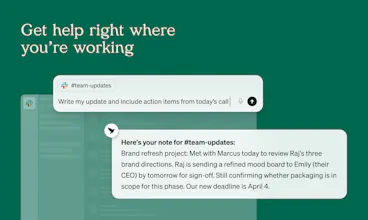
Came out of a product meeting, opened Littlebird, typed: "what are my action points from the meeting?" Nothing else.
It came back with a full breakdown - who raised what, which asks were directed at me specifically, exact priorities in the order they were discussed. Hadn't told it anything else. Just asked, the way you'd ask someone who was sitting next to you in the room.
Most AI tools with "memory" are still just better search. What Littlebird does is closer to synthesis. "What should I focus on today?" gets you something specific to your actual week. "Prep me for this meeting" and it already knows who you were talking to, what got stuck, what needs addressing. None of that was set up. It just built up over nine months, the way context does with someone who's actually been paying attention.
Littlebird
@vedvyapak Thanks for sharing! I'm personally so dependent on meeting prep now too, makes life way simpler with context switches throughout the day.
Coda
@vedvyapak it does seem insane that meeting note apps are like “if it didn’t happen in a meeting, it didn’t happen”
Littlebird
@vedvyapak @joshconstine exactly. Our thesis from day one is that meeting notes are a feature not a full product. The goal is to have everything that matters to you in one place so that AI can give you comprehensive assistance without missing any critical projects or plans.
Littlebird
Hey PH! Naman here, co-founder of Littlebird. Alex already walked through the product so I'll keep this short. Before Littlebird, Alap and I built Sentieo, a research platform for finance (acquired by AlphaSense). We spent a decade figuring out how to help people find information faster. Littlebird is us taking that same obsession in a completely different direction. What if the AI already had the information and you never had to go looking for it? You don't have to search. You don't copy-paste. You just ask. That's what we mean by AI that already knows your work.
The thing I'm personally most proud of is what happens after about a week of use. That's when Littlebird starts connecting things across meetings, docs, and conversations that you wouldn't have connected yourself. It goes from useful to something you genuinely rely on. We're hanging out here all day, ask us anything.
My AI stack has changed a lot over the past year. Gemini for research, Kimi for execution, Littlebird for everything that needs context.
That last part is where it actually gets interesting. I've been building a system for my firm from scratch over the past few months - and through all of it, Littlebird tracked every thread without me having to re-brief it each session.
At 1am when the backend crashed, I didn't explain the project setup. I just showed the error. It told me which file to fix, which package was missing, what command to run. Next morning when I asked "where were we on the settings features?" it came back with the full backlog - what was done, what was parked, what the next priority was.
That kind of continuity usually costs you hours. With Littlebird it just doesn't happen.
It's also the only tool in my stack that notices things sideways. When I was evaluating a new tool, it flagged a potential compliance issue in a vendor contract - based on a document it had watched me read two weeks prior. Never mentioned it in that conversation. That's not recall, that's actually following your work.
The honest advisor part surprised me too. It told me my job search approach was scattered before I asked. Was right. Helped me figure out my career niche in one conversation.
I've requested features that later shipped. I've had it talk me out of bad decisions. At some point it stopped feeling like a tool.
Congrats on the launch!
Littlebird
@muammar_syahmi1 thank you! love the examples you shared. recall by itself isn't enough for a true thought partner - we built Littlebird to notice things sideways, as you beautifully put it. to truly follow your work, not just remember it.