

Logic, Inc.
Build and operate fleets of agents.
856 followers
Build and operate fleets of agents.
856 followers
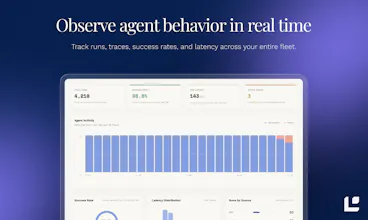
Shipping a real AI agent can mean weeks of wiring up frameworks, prompts, retries, and eval harnesses before you see production. Logic replaces that stack. You write a structured spec that describes what the agent should do, and Logic gives you a fully managed agent, with evals, observability, and versioning built in. Used in production by teams at Routable, Paid.ai, Neuranimus, Garmentory, and DroneSense.
This is the 2nd launch from Logic, Inc.. View more

Logic
Launched this week
Shipping a real AI agent can mean weeks of wiring up prompts, retries, eval harnesses, and logging before you see production. Logic solves that.
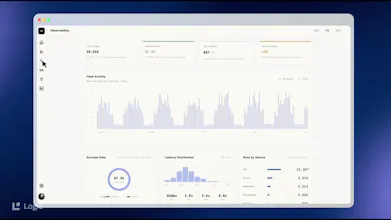
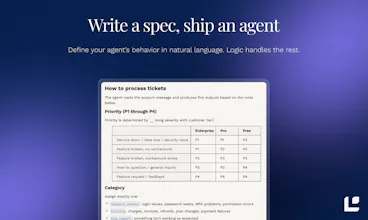
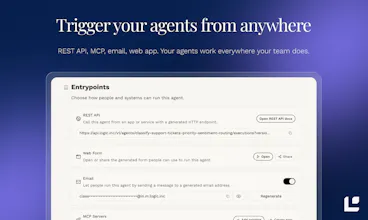
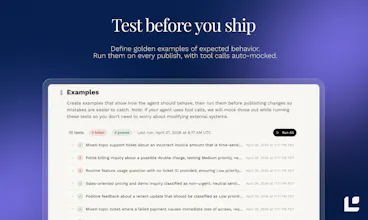
You write a structured spec that describes what the agent should do, and Logic gives you a fully managed agent, with evals, observability, model routing and more built in, ready to be called from anywhere.



Free Options
Launch Team

UXPin Merge
Really like this direction. Turning plain English specs into production-ready agents is a big unlock. How are teams typically structuring their specs to keep outputs consistent?
Logic, Inc.
@uxpinjack The teams getting the most consistent outputs usually keep their specs very explicit: clear inputs, a strict output shape, direct decision rules, and the edge cases they care about. We’ve also found it helps to keep shared reference material in the knowledge library instead of stuffing it into every spec, then use tests to catch drift before publish. And thank you, that’s exactly the unlock we’re going after.
the 6 point gain on IFBench over the base model is pretty impressive. what's actually happening in the harness that improves instruction following that much?
Logic, Inc.
@ahmadhajj Thanks, Ahmad! We wrote up a detailed description of exactly that in a recent blog post: https://logic.inc/resources/logic-scores-83-3-on-ifbench-beating-every-model-on-the-public-leaderboard
WUPHF by Nex.ai
The structured spec approach is a smart bet. Most agent frameworks right now ask you to wire everything imperatively, which makes it really hard to reason about what the agent is supposed to do versus what it actually does. Curious how the spec handles cases where an agent needs to adapt its behavior based on context it did not have at definition time. Is there a way to express conditional logic in the spec, or does that get pushed into tool implementations?
Logic, Inc.
@najmuzzaman Appreciate that. Our view is: put adaptive judgment in the spec, put deterministic actions in tools. The spec can describe how the agent should behave under different conditions, and at execution time Logic can pull in context from the knowledge library, similar past runs, or external systems before responding. So conditional logic does not have to get pushed down into tool code by default. We usually only push it into tools when you need exact side effects, strict business rules, or system-specific operations. That keeps the agent flexible without turning it into a branching workflow graph.
multi-provider routing with fallback is usually the thing that gets rebuilt from scratch on every project. either you're locked into one provider or you've added a custom routing layer on top of whatever sdk you started with. having it in the agent harness directly is the right place for it.
Logic, Inc.
@webappski Thanks, Alex! I couldn't agree more. Every LLM-based project needs fallback, as well as the ability to switch models for specific features.
The SOC2 HIPAA angle is important if this is truly targeting enterprise adoption.
Logic, Inc.
@elliot_grant1, we completely agree! If you're asking teams to trust agents in real workflows, security and compliance can't be an afterthought.
Lancepilot
Logic, Inc.
@odeth_negapatan1 Thanks, Odeth. That was exactly our goal. Appreciate the shout-out!
Looks awesome. Getting an agent to actually work in production is a whole different challenge vs vibe coding automations, and this feels like it removes a lot of that headache. Excited to try this as a PM.
Logic, Inc.
@robmcarpenter, we appreciate that. We built Logic for exactly that jump from a cool demo to something a team can actually ship and sleep well at night knowing it'll just keep working.