
Design Agent by Lokuma
The designer for your AI agents (Openclaw, CC, Codex)
713 followers
The designer for your AI agents (Openclaw, CC, Codex)
713 followers
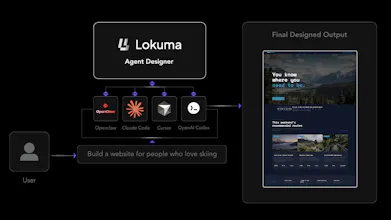
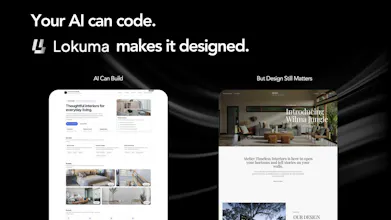
Lokuma Design Agent, is an AI designer your agents can call, a design intelligence layer for agents like OpenClaw, Claude Code, or Codex. AI can generate almost anything. But generation isn’t design. Turning raw outputs into something clear, structured, and visually refined still requires design thinking. Built by design tool makers, Lokuma helps AI reason about layout, typography, and visual balance — transforming outputs into landing pages, websites, and campaign pages that feel designed.





Well done @mu_li !! It moves fast without sacrificing craft.
Most AI outputs feel like rough drafts. Lokuma feels closer to something you’d actually ship. The structure, spacing, and visual decisions make a real difference.
Feels like giving AI a sense of taste.
Design Agent by Lokuma
@trashcannot Thanks Ruolan!! We’ve always talked about this gap, right? AI can get something out fast, but getting it to a place you’d actually ship is a different game.
Glad the “taste” part comes through - still a long way to go, but this is exactly what we’ve been trying to push on.
Next time we should jam on this properly :)
Best,
Mu
This looks like a design tool. But it's actually solving a coordination problem.
Right now, the bottleneck in AI agent development isn't intelligence — it's presentation. Agents can think, but they can't express themselves visually without a human designer in the loop.
What you're really building is the translation layer between what an agent can do and what a user is willing to trust.
Because here's the part nobody talks about: users don't trust capability. They trust experience. And experience is design. The agents that feel trustworthy will outperform the ones that are technically superior. Design isn't the skin. It's the bridge between intelligence and adoption.
Design Agent by Lokuma
@julian_francis Thanks Julien! This is really well put - specially the “users don’t trust capability, they trust experience” part.
We kept seeing agents that technically worked, but just didn’t feel shippable.
That gap between “it works” and “you’d actually trust it” is exactly what we’re trying to close.
Curious if you’ve run into that in your own builds too?
InsForge
This fits the moment.
Design Agent by Lokuma
@jiaqichen Appreciate that, Jiaqi. It feels like the timing finally caught up with the idea. Curious how you’re thinking about this shift on InsForge too.
Best,
Mu
Creatify
Design Agent by Lokuma
@nyn531 Thanks Steven, really appreciate it. Been following Creatify for a while and love how you’ve made creation feel so effortless. Means a lot coming from you!
Cheers,
Mu
SLog Fitness
Finally, a designer for my agents! I use OpenClaw and Codex daily, and having a way for them to actually reason about hierarchy and balance instead of just spitting out generic components is a game changer. Huge congrats to the team for identifying this missing piece!
Design Agent by Lokuma
@lidongze91 Love this! Thanks Ben, you captured it perfectly. Speed is mostly solved, but hierarchy and balance are a different layer. That’s exactly what we’re trying to bring in.
Would be great to see how it plays with your OpenClaw/Codex workflow!
Cheers,
Mu
Congratulations on the launch! Another great tool in the OpenClaw ecosystem.
Design Agent by Lokuma
@mykyta_semenov_ Glad to be part of the ecosystem. Would love for you to give it a try.
If it ends up being useful, feel free to share it with others as well. Thanks!
Generation isn't design is a sharp line. It names something builders are starting to feel but haven't quite articulated yet.
The real bottleneck you're solving isn't speed or capability, it's the gap between output that works and output that people actually trust. Most AI generated interfaces feel assembled. You're going after the layer that makes something feel intentional, and that's a harder, more valuable problem.
The timing also feels right. People deep in Codex or Claude Code are already running into this. They're not looking for a designer, they're looking for something that makes their agent's output not look like it came from an agent.
One thing worth testing, a concrete before and after might do more work than the "design intelligence layer" framing for cold visitors. Same prompt, same agent, with and without Lokuma. That contrast could make the value land in seconds instead of paragraphs.
Curious whether Lokuma gets more opinionated over time, almost like enforcing a house style, or stays flexible enough for each product to develop something distinct.
I notice these things partly because I spend time helping SaaS teams make new categories easier to grasp on first contact. This one has a strong core. The main challenge is probably just communicating a problem people feel but can't name yet.
Design Agent by Lokuma
@copywizard This is a really sharp read. Appreciate it.
“Output that works vs. output people trust” is exactly the gap we’re going after.
+1 on the before/after — we’re starting to test that, it makes the value click much faster than explaining “design intelligence.”
On direction: likely a balance, opinionated on structure and taste, flexible on identity.
Thanks for taking the time to break it down like this.
@mu_li Output people trust is the stronger framing, and it lands immediately.
The interesting tension here is that you're selling to humans but proving value through agents. That gap usually means the fastest path to traction is making the human feel the difference in seconds, not asking them to understand it first. Comprehension comes after the gut reaction, not before.
One angle worth exploring: leaning harder into trust as a conversion lever, not just design quality. A question like would you confidently ship this as is? carries a lot of weight on a page, because it makes the stakes real without having to explain them.
Curious what the strongest "aha moment" looks like from early users. Whether it's the visual polish, the consistency, or just the time saved tells you a lot about where the real hook lives and where the messaging should be anchored.
I've worked with a few SaaS teams on this kind of before and after positioning at launch, so I find the framing questions here particularly interesting. Would love to see how you push this further.