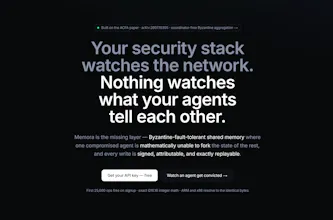
The AI giants run agent swarms on last-write-wins databases like Redis. Result? Silent state forks and swarm-wide memory poisoning (OWASP ASI06). You can't patch this with middleware. Memora replaces fragile DBs with a 3-layer mathematical engine: L1 CRDTs guarantee fork-free convergence. L3 ACFA uses Q16.16 fixed-point math to auto-ban equivocators without a central coordinator. L2 Epistemic logic detects when agents agree on a lie and forces human escalation.
No reviews yetBe the first to leave a review for Memora-Swarm
Maker
📌
The AI industry is racing to build smarter agents. I'm building the infrastructure that stops them from silently corrupting each other.
Today's swarms run on last-write-wins databases. One compromised agent poisons the fleet, and standard CRDTs just silently converge on the bad data.
I built Memora-Swarm to fix the physics. Based on my ACFA research, it uses Q16.16 fixed-point math to guarantee un-forkable state and auto-ban Byzantine actors—without a central coordinator.
But the core vision is a philosophical shift: Consensus does not equal authority. If 100 agents mathematically agree on a stale fact, it's still a lie. Memora is the first state layer that refuses to act on agreed-upon untruths, escalating to humans when the swarm loses its grounding.
It's not another database. It's the immune system autonomous AI needs to actually deploy. The infrastructure agent swarms occupy.
Report
the L3 equivocator banning thing actually worked when I spun up two agents sending conflicting claims, and it just resolved it without me touching anything. Honestly the epistemic layer is what sold me, finally something that flags when my swarm has collectively agreed on nonsense instead of silently shipping it.
Report
honestly the epistemic lie detection layer sounds promising but i'd love to see a built in replay debugger so we can step through exactly when an agent went rogue before the auto ban kicked in. kind of hard to trust the swarms reasoning if you cant audit the chain after the fact. would also help when explaining it to security teams during reviews
Report
The ACFA auto-ban layer is genuinely clever, finally something that addresses equivocation without leaning on a coordinator bottleneck. Setup was heavier than I expected but once the three layers clicked the convergence behavior felt rock solid.
Report
Finally tried Memora-Swarm on a small agent test and the L2 epistemic layer catching a coordinated hallucination mid-run genuinely surprised me. Solid pick if you're done babysitting Redis state.
Report
Finally something that actually tackles the OWASP ASI06 problem instead of pretending middleware can fix it. The fixed-point auto-ban layer is clever, feels like it would have saved us weeks of debugging on our last multi-agent build.



the L3 equivocator banning thing actually worked when I spun up two agents sending conflicting claims, and it just resolved it without me touching anything. Honestly the epistemic layer is what sold me, finally something that flags when my swarm has collectively agreed on nonsense instead of silently shipping it.
honestly the epistemic lie detection layer sounds promising but i'd love to see a built in replay debugger so we can step through exactly when an agent went rogue before the auto ban kicked in. kind of hard to trust the swarms reasoning if you cant audit the chain after the fact. would also help when explaining it to security teams during reviews
The ACFA auto-ban layer is genuinely clever, finally something that addresses equivocation without leaning on a coordinator bottleneck. Setup was heavier than I expected but once the three layers clicked the convergence behavior felt rock solid.
Finally tried Memora-Swarm on a small agent test and the L2 epistemic layer catching a coordinated hallucination mid-run genuinely surprised me. Solid pick if you're done babysitting Redis state.
Finally something that actually tackles the OWASP ASI06 problem instead of pretending middleware can fix it. The fixed-point auto-ban layer is clever, feels like it would have saved us weeks of debugging on our last multi-agent build.