As someone who has designed and launched many e-commerce stores, one recurring problem I see is that store owners rarely have a clear view of where profit is leaking. Inventory decisions, refund spikes, and sudden conversion drops often remain invisible until it’s too late.
What I find interesting about this product is that it seems to turn those hidden signals into something actionable. The idea of dedicated AI agents monitoring cash flow, stockouts, revenue concentration, and refund spikes feels very aligned with the real operational challenges e-commerce teams face.
I haven’t used the product directly yet, but from the concept and the examples shown, the approach makes a lot of sense. Many Shopify merchants spend hours inside spreadsheets trying to answer exactly these questions.
If the insights are as clear and actionable as they appear, this could become a very valuable operational layer for store owners who want faster decision-making without digging through data manually.




@mojtaba_kh_amiri Great concept. Turning raw Shopify data into clear profit risk insights is powerful. Love the focus on real signals, not noisy dashboards. Good luck!
@nimaaksoy Thanks so much! You hit the nail on the head. The 'noise' in e-commerce analytics is exactly what we wanted to kill. Most founders have 'dashboard fatigue' because they get alerted for every little fluctuation.
We built the Materiality Filter specifically so Metrixon only speaks up when a leak actually threatens your bottom line (usually >5% of store health).
This tool looks really helpful for founders!
I’d love to know, how do you adjust the suggestions based on the type or size of a business? For example, do you treat small businesses differently than medium-sized ones, or do you consider if a business is inventory-based?
I think that would make the tool even better!
@iman_roomana That is such an insightful point! Right now, you’re exactly right. We use one core set of 'Governed Logic' rules because we wanted to perfect the baseline accuracy first.
However, the long-term vision for Metrixon is definitely segment-specific intelligence. For example, a high-volume apparel store has completely different 'Cash Flow' risks (like seasonal clearance) than a small boutique with high margins.
We’re actually using the feedback from this PH launch to decide which 'Industry Profile' to build next.
@mojtaba_kh_amiri Congrats for the launch. Curious to know why have you used Gemini?
@aakpro Great eye! We actually chose Gemini 2.5 Flash specifically because it’s a 'hybrid reasoning' model. In the Shopify world, speed is everything, but so is accuracy when you're dealing with profit margins.
Controllable Thinking: We use Gemini 2.5’s 'thinking budget' to scale up reasoning during complex risk audits (like cross-referencing shipping delays with refund patterns) but keep it lightning-fast for simple stock alerts.
Native Multimodality: Since 2.5 was built from the ground up for more than just text, it’s incredibly efficient at parsing the structured JSON data coming out of Shopify’s APIs without losing the 'thread' of the business logic.
The 1M Context Window: Even the Flash version now handles a 1-million-token context. This allows Metrixon to 'remember' a store’s seasonal trends from last year and apply that context to a sudden dip in sales today.
It’s essentially the best price-to-intelligence ratio on the market right now.
Who is this app best for? small boutiques or high-volume stores?
@shadi_rafati Great question! The short answer: Both, but for different reasons.
For High-Volume Stores: Metrixon is a 'Dashboard Killer.' When you have thousands of orders, you don't have time to hunt through charts. Our Materiality Filter is the MVP here that suppresses the noise and only pings you if a leak (like a bestseller stockout or a refund spike) hits a threshold that actually moves the needle on your bottom line.
For Small Boutiques: It acts as your 'Fractional CFO.' Small teams usually don't have a dedicated data analyst. Metrixon fills that gap by watching your cash flow and inventory 24/7, ensuring you aren't leaving money on the table while you're busy with the creative side of the brand.
The sweet spot? Merchants doing $100k - $5M ARR who have enough data to be dangerous, but not enough time to be data scientists.
Hi Mojtaba!
can you please explain these 2 agents you developed?
@hamed_sattarian Great question! Think of these two agents as a Defensive Coach and an Offensive Coach for your store:
1. The Cash Flow Agent (The Protector) This one watches your wallet. It tells you exactly how much money is trapped in stock that isn't moving and alerts you the second a bestseller is about to sell out so you don't miss a single order.
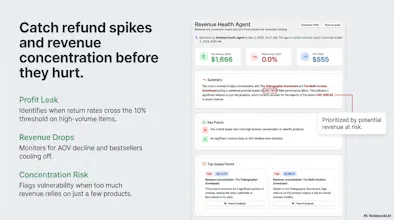
2. The Revenue Health Agent (The Hunter) This one watches your growth. It pings you if refunds suddenly spike or if your average order value (AOV) starts dropping. It also warns you if your store is relying too much on just one product, so you aren't in trouble if that item stops being popular.
The Best Part: > Our AI (Gemini 2.5 Flash) acts as a filter. It stays quiet most of the time and only alerts you when a problem is big enough to actually hit your bank account.
Hi Hunters! 👋
I'm Saeed, the other half co-founder behind Metrixon AI.
Mojtaba covered the why. I want to share the how, and the honest story behind building this.
This app started from a simple frustration: we watched Shopify merchants open their dashboards every morning, stare at 10 different charts, and still walk away not knowing the one number that matters: how many dollars are leaking out of my store right now?
So we didn't build another dashboard. We built a decision system.
What's actually under the hood:
Two specialized autonomous agents run continuously on your store data:
- Cash Flow Agent: watches for stockouts on your bestsellers and dead inventory tying up your cash
- Revenue Health Agent: detects refund spikes, AOV drops, and dangerous product concentration before they compound
The part I'm most proud of is what we didn't build. We deliberately left out the noise. The Materiality Filter is an engineering constraint, not just a UX feature; our system is architecturally prevented from alerting you unless a risk crosses a threshold that actually moves the needle on your bottom line (>5% of store health).
No black boxes either. Every insight traces back to a transparent business formula you can verify yourself.
Why now?
Most Shopify merchants are sitting on months of rich order data and getting almost zero proactive value from it. That gap is exactly what we built this to close.
We're free to install today, and the first 10 users get a lifetime subscription 🚀
Ask me anything about the architecture, the agent design, or where we're taking this next. I'm here all day!
Formaloo
Kudos on the launch!
@farokh_shahabi Thanks Farokh jan! I'm super excited.